BATCH PROCESSING · BROKER SYSTEMS · PERFORMANCE ENGINEERING
This batch processing platform was enhanced for parallel execution and scalability, improving runtime, throughput, and maintainability of enterprise broker engine operations.
Quick Answer
What Is a Batch Processing Platform Enhancement?
A batch processing platform enhancement re-engineers a batch execution engine for parallel processing, scalability, and transactional consistency, resolving runtime growth and throughput limits. ICANIO enhanced this batch processing platform’s CM Engine for multi-process execution, tripling processing throughput capacity and cutting data processing cycles by 50% for enterprise broker operations.
Executive Summary
Turning a Slowing Batch Engine Into a Scalable, Parallel System
Batch processes for the CM Engine suffered increasing runtime due to customizations, suboptimal configurations, and scalability limits, impacting performance, throughput, and maintainability for enterprise broker operations. ICANIO’s partner was facing exactly that gap: batch runtime increasing year over year and reducing efficiency, extensive customizations that slowed execution and complicated maintenance, suboptimal configurations and scalability issues that limited throughput and prevented parallel processing, and data handling inefficiencies that affected premium accumulation tracking accuracy.
ICANIO addressed this by enhancing the DCM CM Engine to support multi-process execution, parallel processing, and transactional consistency, rather than tuning the existing single-process engine incrementally. The objective was to enhance the engine for multi-process batch execution, optimize configurations for parallel processing and throughput, implement transactional consistency for accurate data handling, and improve scalability to support high-volume batch workloads, all while ensuring reliable compensation and premium accumulation calculations.
The result was a 3x improvement in processing throughput capacity and a 50% reduction in data processing cycle time, with a 40% improvement in application performance efficiency, a scalable batch processing platform architecture, a reliable compensation calculation engine, and enhanced system maintainability and stability.
“A batch job whose runtime grows every year is not a maintenance detail, it is a scalability ceiling the business will eventually hit at the worst possible moment.”
The Challenge
Five Constraints on the Legacy Batch Processing Engine
Batch processes for the CM Engine suffered increasing runtime due to customizations, suboptimal configurations, and scalability limits, impacting performance, throughput, and maintainability for enterprise broker operations.
Batch Runtime Increased Year Over Year
Batch runtime increased year over year, reducing efficiency and eating further into the operational window available for downstream processes.
Customizations Slowed Execution and Maintenance
Extensive customizations slowed execution and complicated maintenance, making every engine change riskier and slower than it needed to be.
Configuration and Scalability Limited Throughput
Suboptimal configurations limited system throughput and reliability, and scalability issues compounded the problem by preventing parallel processing entirely.
Data Handling Hurt Premium Accumulation Accuracy
Data handling inefficiencies affected premium accumulation tracking accuracy, putting financial calculations at risk of drifting from reality.
Delayed Processing Impacted Compensation Workflows
Delayed processing impacted compensation and operational workflows, slowing down payouts and decisions that depended on timely batch results.
Batch Processing Platform Solutions Provided
A Six-Part Batch Processing Platform Enhancement
Icanio enhanced the DCM CM Engine to support multi-process execution, parallel processing, and transactional consistency, improving batch performance, scalability, and reliability while maintaining accurate compensation and premium calculations. The solutions included:
Batch Processing Platform Gained Multi-Process Execution
Enhanced the CM Engine for multi-process batch execution, replacing single-threaded runs with parallel processing capacity.
Batch Processing Platform Configurations Optimized for Throughput
Optimized configurations for parallel processing and throughput, removing the settings that had previously capped performance.
Transactional Data Consistency
Implemented transactional consistency for accurate data handling, so parallel execution never came at the cost of correctness.
Improved Scalability for High-Volume Workloads
Improved scalability to support high-volume batch workloads, so growth in transaction volume no longer meant proportionally longer runtimes.
Enhanced Maintenance and Monitoring
Enhanced maintenance and monitoring for batch processing efficiency, giving the team visibility into performance as workloads grew.
Batch Processing Platform Keeps Compensation Calculations Reliable
Ensured reliable compensation and premium accumulation calculations, keeping financial accuracy intact through every architecture change.
Business Outcomes
Measurable Results Across Speed, Scale, and Accuracy
This batch processing platform enhancement delivered outcomes across every dimension of the original runtime and scalability problem, converting a slowing, single-process engine into a fast, parallel, and financially accurate system.
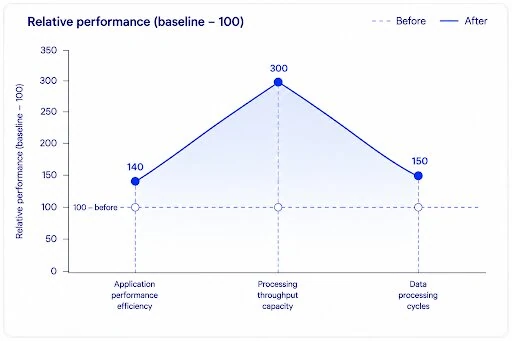
Batch processing platform outcomes: 50% faster data processing cycles, three times higher throughput capacity and 40% better application performance.
40%Improved
Application performance efficiency
Scalable Batch
Processing platform architecture
Reliable Compensation
Calculation engine accuracy
3xHigher
Processing throughput capacity
Enhanced System
Maintainability and stability
50%Faster
Data processing cycles
Key learnings
What This Engagement Proves for High-Volume Batch Engines
This Batch Processing Platform Proves Parallelism Needs Consistency
Enabling multi-process execution alone would have risked data integrity without transactional consistency built in at the same time. Pairing parallel processing with consistent transaction handling is what let throughput triple without sacrificing accuracy.
Configuration Tuning Has to Precede Scalability Work
Improving scalability on top of suboptimal configurations would have just scaled the same inefficiency further. Optimizing configurations for throughput first is what made the subsequent scalability improvements actually effective.
Financial Accuracy Cannot Be a Casualty of Speed
A 3x throughput improvement means little if premium accumulation and compensation calculations become unreliable in the process. Ensuring reliable calculations throughout the re-architecture is what made the performance gains usable in production.
Conclusion
From a Slowing Batch Engine to a Scalable, Parallel System
A single-process batch engine might have been workable when transaction volume was smaller, but for a broker operation facing batch runtime that grew year over year, it had become a real constraint on throughput and reliability. This engagement demonstrates that a single batch processing platform enhancement can resolve runtime, scalability, and accuracy gaps within one structured programme rather than three separate initiatives.
By enabling parallel batch execution, implementing transactional data consistency, and automating broker engine operations around premium accumulation tracking, ICANIO helped this partner reach 3x higher processing throughput and 50% faster data processing cycles. The scalable architecture and reliable compensation engine delivered through this engagement are the foundation every future batch workload this platform processes will run on.
Related Resources
This engagement sits within ICANIO's application development practice. Our team re-engineers high-volume batch engines through application development services and data engineering and AI. Related work covers cloud cost, DevOps automation and other software development case studies. To discuss a similar batch workload, contact ICANIO.
- Application Development Services
- Fintech and Banking Industry Solutions
- Insurance Application Modernization: 50% Less Debt
- Best JVM Performance Optimization in 2026
- SQL Server ACID, Isolation Levels, Developer Guide
References
- Batch processing: Wikipedia overview of batch job execution.
- Parallel computing: how work is split across concurrent processes.
- ACID: the properties that keep database transactions consistent.
- Database transaction: how transactions keep data correct under concurrency.
Frequently asked questions
Common Questions About This Batch Processing Platform
Why did this batch processing platform need an enhancement?
A batch processing platform enhancement re-engineers a batch engine for parallel execution and scalability, needed here because batch runtime was increasing year over year and suboptimal configurations were limiting throughput.
How does parallel batch execution reduce processing time?
Parallel batch execution runs multiple processes concurrently instead of sequentially, which is what let processing throughput capacity triple compared to the original single-process CM Engine.
Why does transactional consistency matter when adding parallelism?
Transactional data consistency ensures parallel processing never produces conflicting or inaccurate results, keeping premium accumulation tracking and compensation calculations reliable even as execution speed increases.
How does premium tracking stay accurate at higher throughput?
Premium accumulation tracking stays accurate because transactional consistency and improved data handling were built into the engine alongside parallel processing, not added afterward as a separate fix.
What role does broker engine automation play in this platform?
Broker engine automation through the enhanced CM Engine reduces manual intervention in compensation and premium workflows, keeping operational processes reliable as batch volume grows.
How much faster is data processing after this enhancement?
This batch processing platform enhancement delivers 3x higher processing throughput capacity and 50% faster data processing cycles compared to the original single-process engine.