HEALTHCARE BACKEND · SCALABLE APIS · CLINICAL SYSTEMS
This healthcare backend engineering platform gives providers a dedicated engineering team, scalable architecture, and secure integrations for clinical and patient-facing applications.
Quick Answer
What Is a Healthcare Backend Engineering Platform?
A healthcare backend engineering platform provides dedicated engineering, scalable architecture, and secure integrations for clinical and patient-facing applications, replacing strained internal teams and fragile integrations with reliable, high-performance infrastructure. ICANIO built this healthcare backend engineering platform to cut operational risk by 30% and deliver healthcare services twice as fast.
Executive Summary
Turning Strained Internal IT Into Scalable Backend Engineering
Healthcare providers faced growing backend complexity, integration challenges, and performance bottlenecks, increasing risks of delays, defects, and operational inefficiencies while managing multiple clinical and patient-facing healthcare applications simultaneously. ICANIO’s partner was facing exactly that gap: managing multiple healthcare projects that caused backend complexity and delays, growing client demands that strained internal IT and engineering teams, integrations across systems that created potential performance and data issues, and a lack of scalable backend that limited delivery of new features.
ICANIO addressed this by building a healthcare backend engineering platform rather than adding more internal headcount. The objective was to provide a dedicated backend team for healthcare platform development, build robust APIs connecting securely to third-party healthcare systems, deliver scalable backend architecture for reliability and compliance, offer continuous support for performance tuning, and streamline data flows across clinical and patient systems through an integration layer.
The result was 2x faster healthcare service delivery and a 30% reduction in operational risk exposure, with higher application uptime reliability, scalable service capacity, improved client experience, and enhanced performance monitoring insights.
“A healthcare application that can’t scale its backend doesn’t fail gracefully, it fails during the exact traffic spike when patients need it most.”
The Challenge
Five Backend Risks Across Growing Healthcare Applications
Healthcare providers faced growing backend complexity, integration challenges, and performance bottlenecks, increasing risks of delays, defects, and operational inefficiencies while managing multiple clinical and patient-facing healthcare applications simultaneously.
The Healthcare Backend Engineering Platform Gap
Managing multiple healthcare projects caused backend complexity and delays, and growing client demands strained internal IT and engineering teams even further.
Fragile Cross-System Integrations
Integrations across systems created potential performance and data issues, leaving clinical data flows vulnerable to breakage.
No Scalable Backend for New Features
A lack of scalable backend limited delivery of new features, slowing every product roadmap down to the pace of the weakest infrastructure layer.
Operational Bottlenecks Risked Defects and Downtime
Operational bottlenecks increased risks of defects and downtime, putting both patient-facing reliability and clinical workflows at risk.
Why This Healthcare Backend Engineering Platform Was Needed
Maintaining compliance and security for sensitive data was challenging, adding regulatory risk on top of the technical debt already accumulating.
Healthcare Backend Engineering Platform Solutions Provided
A Six-Part Healthcare Backend Engineering Platform
Icanio delivered a dedicated backend engineering platform providing scalable architecture, secure integrations, continuous support, and API development to ensure reliable, high-performance healthcare applications and accelerated delivery timelines. The solutions included:
The Healthcare Backend Engineering Platform Core
A dedicated backend team managed development for healthcare platforms efficiently, replacing strained internal capacity with focused engineering ownership.
Secure Healthcare APIs
Robust APIs connected applications with third-party healthcare systems securely, keeping integrations reliable instead of fragile.
Scalable Backend Architecture
Scalable backend architecture ensured reliability, security, and compliance standards, giving every application room to grow.
Continuous Performance Support
Continuous support enabled performance tuning and feature enhancements quickly, instead of waiting on the next release cycle.
Streamlined Clinical Integration Layer
An integration layer streamlined data flows across clinical and patient systems, closing the gaps that previously created data issues.
This Healthcare Backend Engineering Platform Reduces Dependency
The backend platform reduced internal team dependency and delivery bottlenecks, freeing internal IT to focus on strategic priorities.
Business Outcomes
Measurable Results Across Speed, Reliability, and Risk
This healthcare backend engineering platform delivered outcomes across every dimension of the original scaling and reliability problem, converting strained internal delivery into fast, reliable, low-risk backend operations.
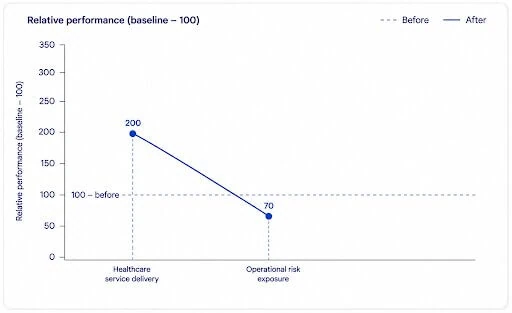
Healthcare backend engineering platform results: twice as fast service delivery, 30% lower operational risk exposure and higher application uptime reliability.
2xFaster
Healthcare service delivery.
Higher
Application uptime reliability.
Scalable
Service capacity expansion.
30%Reduced
Operational risk exposure.
Improved
Client experience satisfaction.
Enhanced
Performance monitoring insights.
Key learnings
What This Engagement Proves for Healthcare Platform Engineering
This Healthcare Backend Engineering Platform Beats Thin Teams
Growing client demands were straining internal IT and engineering teams, not because the work was impossible, but because it was spread too thin across multiple healthcare projects. A dedicated backend team is what let delivery speed double without adding internal headcount.
Secure Healthcare APIs Must Be Built for Integration, Not Bolted On
Integrations across systems were creating performance and data issues because connectivity was an afterthought. Building robust, secure healthcare APIs as core infrastructure is what turned fragile integrations into reliable data flows.
Healthcare Backend Engineering Platform Ships Compliance Together
A scalable backend architecture that ignored compliance and security standards would have just traded one risk for another. Building both into the same architecture is what let this engagement reduce operational risk exposure by 30% while still improving delivery speed.
Conclusion
From Strained Internal IT to Scalable Backend Engineering
Managing multiple healthcare projects on strained internal capacity might have been workable at a smaller scale, but for a provider facing growing client demands across clinical and patient-facing systems, it had become a real constraint on delivery speed and reliability. This engagement demonstrates that a single healthcare backend engineering platform can resolve capacity, integration, and compliance gaps within one structured programme rather than three separate initiatives.
By providing a dedicated backend team, secure healthcare APIs, scalable healthcare solutions architecture, and clinical workflow management through a streamlined integration layer, ICANIO helped this partner reach 2x faster healthcare service delivery and a 30% reduction in operational risk exposure. The healthcare integration services, performance-optimized backend, and reduced internal dependency delivered through this engagement are the foundation every future healthcare application this partner builds will run on.
Related Resources
This healthcare backend engineering platform reflects ICANIO's software development and data engineering work in healthcare. Our team delivers backend and API engineering through application development services. Healthcare providers can explore our healthcare and life sciences solutions. For cloud and devops support, see our DevOps and cloud engineering services. Related work includes healthcare record digitization and our guide to electronic health records software. To plan a similar platform, contact ICANIO.
- Application Development Services
- Healthcare and Life Sciences Solutions
- Healthcare Record Digitization: 4x Faster
- Digital Healthcare Platform Cuts Admin 40%
- Secure Electronic Health Records Software 2026
References
- API: Wikipedia overview of application programming interfaces.
- System integration: Wikipedia overview of connecting separate systems into one whole.
- Scalability: Wikipedia overview of how systems handle growing workloads.
- Application performance management: Wikipedia overview of monitoring application performance.
Frequently asked questions
Common Questions About This Healthcare Backend Engineering Platform
Why do providers need a healthcare backend engineering platform?
A healthcare backend engineering platform provides dedicated engineering, scalable architecture, and secure integrations for clinical and patient-facing applications, which providers need when managing multiple healthcare projects strains internal IT capacity.
How do secure healthcare APIs improve third-party integrations?
Secure healthcare APIs connect applications with third-party healthcare systems reliably, replacing the fragile, ad hoc integrations that previously created performance and data issues.
What makes a backend architecture scalable for healthcare solutions?
Scalable healthcare solutions architecture ensures reliability, security, and compliance standards hold as usage grows, instead of requiring a rebuild every time a new feature or client demand arrives.
How does an integration layer help clinical workflow management?
Clinical workflow management improves when an integration layer streamlines data flows across clinical and patient systems, removing the manual reconciliation that previously introduced delays and errors.
What do healthcare integration services reduce for internal teams?
Healthcare integration services reduce internal team dependency and delivery bottlenecks by giving a dedicated backend team ownership of complex system connections, instead of spreading that work across internal IT.
How much faster is healthcare service delivery with this platform?
This healthcare backend engineering platform delivers healthcare service delivery twice as fast while reducing operational risk exposure by 30% compared to strained internal backend management.