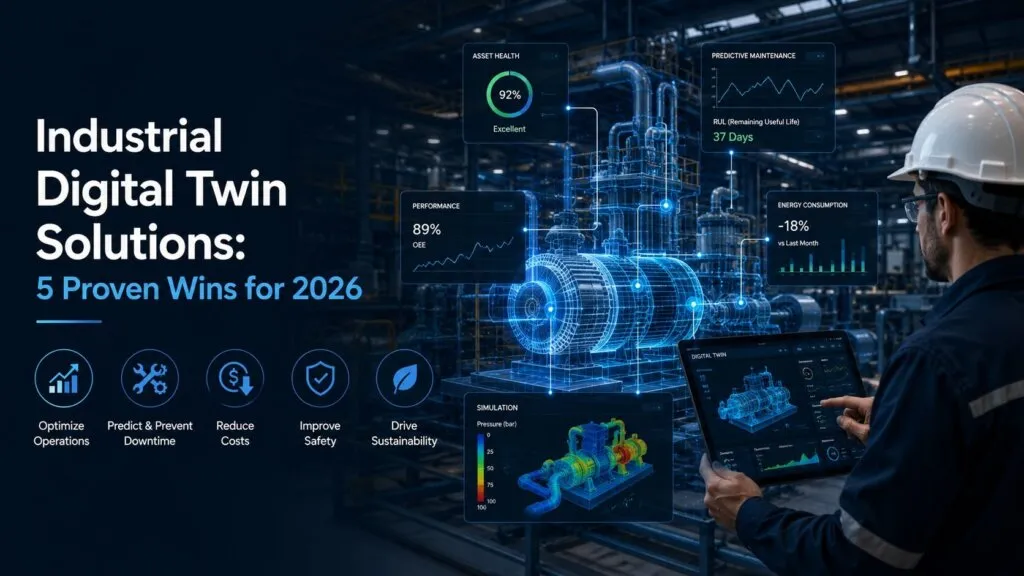
Industrial digital twin solutions give plant managers, heavy industry operators and asset owners a way to test, predict and optimize physical operations before they commit real capital or take real risk. An industrial digital twin is a continuously updated virtual replica of a physical asset or process. It is fed by sensor data, historical performance records and predictive models. Engineers use it to simulate changes, anticipate failures and tune throughput without touching the live system until a change has been validated virtually.
Office software can tolerate trial and error. A refinery, a steel plant or a power station cannot. That is why the industrial digital twin has become such an important tool in heavy manufacturing. Where unplanned downtime is expensive and safety stakes are high, a validated virtual model changes how operations teams make decisions. This guide covers the five use cases that matter most and the mistakes that stall projects.
Key Takeaways
- An industrial digital twin is a live virtual replica of an asset or process, fed by sensors and predictive models.
- Legacy equipment, noisy data and safety stakes make industrial projects harder than typical software twins.
- An industrial IoT digital twin foundation must come first; everything else depends on clean data.
- Automation should be phased: monitoring, then advisory, then increasingly autonomous control.
- A smart factory digital twin and industrial asset performance management deliver compounding value at facility scale.
- Baseline existing metrics before a pilot so the business case rests on your own data.
What Is an Industrial Digital Twin?
A digital twin is a virtual representation of a physical object or system that stays synchronized with it. An industrial digital twin applies that idea to pumps, compressors, production lines, substations and whole plants. It combines three ingredients: live sensor data, historical records and models that predict behavior.
The core idea is simple. The engineering underneath is not. The twin must reflect real equipment closely enough that engineers trust its predictions. That requires sound data engineering, physics or machine learning models, and a clear plan for how decisions flow back to the plant. Our Digital Twin Solutions practice is built around those three layers.
Why an Industrial Digital Twin Needs a Different Approach
Industrial environments differ from enterprise software contexts in ways that shape how a twin gets built. Three realities stand out:
- Harsh data: heavy equipment produces noisier sensor data than office or retail environments.
- Legacy control systems: many plants run PLCs and SCADA systems that were never designed for modern connectivity.
- Safety stakes: small modeling errors can cost far more than lost revenue.
Industrial digital twin solutions must account for all three from the first day. They cannot be bolted on after a pilot proved the concept in a cleaner environment. This is also why an industrial digital twin tends to need more upfront data engineering than twins built for digital-native settings.
Legacy PLCs, SCADA systems and decades-old sensor networks often need an integration layer before usable data reaches the modeling stage. That layer must be built with an understanding of industrial protocols such as OPC UA, not generic IT assumptions.
The 5 Industrial Digital Twin Use Cases at a Glance
The table below summarizes the five use cases covered in this guide. Each builds on the one before it.
| Use case | Scope | Main goal |
|---|---|---|
| 1. Industrial IoT foundation | Single asset | Clean, reliable data |
| 2. Industrial automation | Control loop | Closed-loop optimization |
| 3. Smart factory | Whole facility | Coordinated production |
| 4. Energy optimization | Facility utilities | Lower energy per unit |
| 5. Asset performance | Asset fleet | Longer asset life |
Use Case 1: The Industrial IoT Digital Twin Foundation
An industrial IoT digital twin starts with the sensor and connectivity layer. Everything downstream depends on getting clean data from equipment that was rarely designed to be monitored this closely. The industrial internet of things provides the sensors, gateways and protocols that make this possible.
Our team begins by auditing what data already exists. Vibration sensors, temperature probes, flow meters and existing SCADA logs often hold more than expected. Only then do we decide what new instrumentation is needed. Over-instrumenting an asset is as costly a mistake as under-instrumenting it.
Bridging Legacy Equipment and Modern Connectivity
Many facilities run equipment that has been in service for fifteen or twenty years. It predates IoT connectivity as a design concern. An industrial IoT digital twin on this kind of equipment usually needs retrofit sensors and edge gateways. Those gateways translate legacy protocols into formats a modern cloud platform can ingest.
ICANIO's DevOps and Cloud Engineering service line handles this integration layer. Getting it wrong means the whole twin rests on unreliable data. Once the foundation is solid, it becomes the backbone for predictive maintenance, process optimization and automation.
Use Case 2: Industrial Digital Twin for Automation
An industrial digital twin for automation goes beyond monitoring into closed-loop optimization. The virtual model does not just observe the physical system. It informs automated control decisions in near real time. This is where industrial digital twin solutions meet data engineering and MLOps, because the models must be retrained against live data rather than static snapshots.
Closing the Loop Between Simulation and Control
Mature deployments do not stop at dashboards and alerts. They feed predictions back into the control systems that manage the process. They adjust setpoints, schedule maintenance windows or reroute production based on what the model projects.
Reaching that level requires trust that only comes from extended validation. Our team recommends phasing the work in three steps:
- Monitoring: the twin observes and reports, while people decide.
- Advisory: the twin recommends actions, and operators approve them.
- Autonomous control: the twin acts within agreed limits, with human override.
Attempting full closed-loop automation on day one is one of the fastest ways to lose operator trust. Phasing lets the plant build confidence one decision type at a time.
Use Case 3: The Smart Factory Digital Twin
A smart factory digital twin extends the concept across a whole production environment. It models how machines, workers, materials and schedules interact across a facility. This broader scope is where an industrial digital twin starts to deliver compounding value. Tuning one machine in isolation rarely matches the gains from coordinating the whole floor.
Production Line Simulation
A smart factory digital twin lets plant engineers simulate layout changes, line rebalancing or new equipment in software first. They can test ideas before a physical changeover takes a line offline for days. Our Application Development teams typically build the visualization and simulation interfaces that make the twin usable. The modeling work draws on data science to keep the simulation accurate against real plant behavior.
For the data side of simulation, our guide to digital twin simulation explains how sensor data becomes a 3D scene.
Use Case 4: Energy and Resource Optimization
Beyond throughput, an industrial digital twin can model energy consumption across a facility. It shows where equipment runs inefficiently. It also shows where scheduling changes could shift energy-intensive processes to lower-cost periods.
This use case has grown as energy costs and sustainability reporting expectations have risen across manufacturing. The data is often already available from utility meters and building systems. Connecting it to production schedules is what turns readings into decisions.
Typical questions the twin can answer include:
- Which machines draw power while idle between shifts?
- Which batch jobs could move to off-peak hours without hurting delivery dates?
- How would a new compressor change energy use per unit of output?
Use Case 5: Industrial Asset Performance Management
Industrial asset performance management is the discipline that industrial digital twin solutions ultimately serve. The point of building a twin is to extend asset life, reduce unplanned downtime and get more reliable output from existing capital. It replaces periodic inspections and run-to-failure habits with a continuously updated view of asset health.
From Reactive to Predictive Asset Management
Traditional maintenance relied on fixed intervals and manual inspection logs. Both have weaknesses. Fixed schedules waste budget on unnecessary servicing. Inspections can miss failures that develop between windows.
A twin-driven approach to industrial asset performance management uses condition-based triggers instead. It flags assets that show early signs of degradation and leaves healthy equipment running. This is predictive maintenance in practice.
MLOps is central to keeping this reliable. Predictive models drift as equipment ages, operating conditions shift and new failure patterns emerge. Without continuous retraining, asset health scores slowly lose touch with reality. Our article on AI project failure after launch explains why.
How ICANIO Approaches Industrial Digital Twin Projects
ICANIO structures industrial digital twin solutions around a cross-disciplinary team. Data and artificial intelligence, application development, DevOps and cloud engineering, support engineering and MLOps work as one unit. None is treated as a standalone deliverable.
For industrial clients, the usual path looks like this:
- Start with an industrial IoT digital twin on one high-value asset.
- Validate the data pipeline and model accuracy there.
- Expand to automation or a smart factory digital twin once the foundation is reliable.
- Add industrial asset performance management across the wider fleet.
Clients evaluating a digital twin partner in heavy industry tend to weigh process discipline and data security heavily. The operational and safety stakes justify that scrutiny. Our team documents data flows, access controls and validation results at each phase for that reason. You can see related work in our manufacturing digital transformation case study.
Common Industrial Digital Twin Mistakes to Avoid
Several recurring mistakes separate projects that deliver lasting value from those that stall after a pilot.
| Mistake | Why it hurts | Better approach |
|---|---|---|
| Facility-wide scope first | Multiplies cost and risk | Prove one asset first |
| Rushing to full automation | Erodes operator trust | Phase through advisory |
| Ignoring legacy integration | Delays and overruns | Budget for gateways early |
| No metric baseline | Weak business case | Measure before the pilot |
The first mistake is building a smart factory digital twin before validating the industrial IoT digital twin foundation on a smaller scale. Cost and risk multiply before the modeling approach is proven.
The second is moving to fully automated control without the validation period needed to build trust. The third is underinvesting in legacy integration. Treating sensor connectivity as solved is a frequent source of delay in projects with older equipment.
Industrial Digital Twin Adoption by Sector
Industrial digital twin solutions look different from one sector to the next. Procurement and validation timelines also vary.
- Automotive and aerospace: engineering rigor and documentation standards run high, so traceable validation matters.
- Energy and utilities: aging infrastructure and regulatory reporting push operators toward data-driven asset management.
- Discrete manufacturing: Industry 4.0 programs make the industrial digital twin a natural next step.
- Mining and resources: remote sites make connectivity and edge processing harder engineering problems.
In each sector, the right first project is the one where downtime or quality issues already hurt. That focus keeps the twin tied to a real operational problem. Our manufacturing industry solutions page describes how we support these programs.
Measuring Return on an Industrial Digital Twin
Industrial clients want a clear sense of return before committing budget. The most reliable way to build that case is to anchor it to metrics the organization already tracks. Familiar metrics are easier to defend than new ones.
Useful anchors include:
- Unplanned downtime hours.
- Mean time between failures.
- Maintenance labor costs.
- Energy consumption per unit of output.
Our team works with clients to baseline these metrics before a pilot begins. We then track the same figures through the engagement. Plant managers and finance teams get a concrete before-and-after comparison instead of theoretical projections.
This also makes it easier to justify expansion into a broader smart factory digital twin or fleet-wide industrial asset performance management. The evidence comes from the client's own operations, not generic benchmarks that may not reflect their equipment.
Conclusion
An industrial digital twin earns its place when it rests on clean data, validated models and a phased path to automation. Start with an industrial IoT digital twin on one important asset. Prove the pipeline. Then expand into automation, a smart factory digital twin, energy optimization and industrial asset performance management.
Avoid the common traps: facility-wide scope too early, rushed automation and underestimated legacy integration. Baseline your metrics so the return is visible in your own numbers. If you are weighing industrial digital twin solutions for your plant, contact ICANIO and our engineers will help you choose a sensible first asset.
References
- Digital twin, Wikipedia
- Industrial internet of things, Wikipedia
- SCADA, Wikipedia
- OPC Unified Architecture, Wikipedia
- Predictive maintenance, Wikipedia
- Industry 4.0, Wikipedia
Frequently asked questions
How are industrial digital twin solutions different?
Industrial digital twin solutions must handle harsher sensor environments, legacy equipment integration and higher safety stakes than twins built for office, retail or purely digital settings. These factors change both the engineering approach and the validation timeline. Projects usually need more upfront data engineering, protocol translation and careful phasing before any automated control decision reaches the plant floor.
How does an industrial IoT digital twin handle older equipment?
Older equipment usually needs retrofit sensors and edge gateways. These translate legacy protocols into formats a modern cloud platform can ingest. Most industrial IoT digital twin projects involve machines that predate current connectivity standards by a decade or more. A data audit first shows which signals already exist, so new instrumentation is added only where it adds real value.
Can an industrial digital twin for automation replace oversight?
Not at first. Mature deployments move through phases. They start with monitoring and advisory recommendations, then progress toward increasingly autonomous control within agreed limits. Manual oversight is not removed on day one. Trust in the underlying model must be earned through extended validation, and operators should keep the ability to override automated decisions at every stage.
How is a smart factory digital twin different from an asset twin?
A smart factory digital twin models an entire production environment. It captures how machines, workers, materials and schedules interact across a facility. A single-asset twin focuses on one piece of equipment. The facility-wide view supports line balancing, layout testing and energy scheduling, which often deliver larger gains than optimizing one machine in isolation.
Why is MLOps important for industrial asset performance management?
Predictive models used in industrial asset performance management need continuous retraining as equipment ages and operating conditions change. Without an active MLOps practice, asset health predictions drift away from real equipment behavior. That reduces their reliability and erodes trust. MLOps adds monitoring, retraining pipelines and version control so the predictions stay accurate over the asset's lifetime.
Where should a company start with an industrial digital twin?
Start with one high-value asset where downtime or quality problems already cost money. Audit the available data, fill gaps with targeted sensors and build a reliable pipeline. Baseline existing metrics such as downtime hours and maintenance costs. Once the twin proves accurate on that asset, expand to related equipment, automation or a broader smart factory scope.