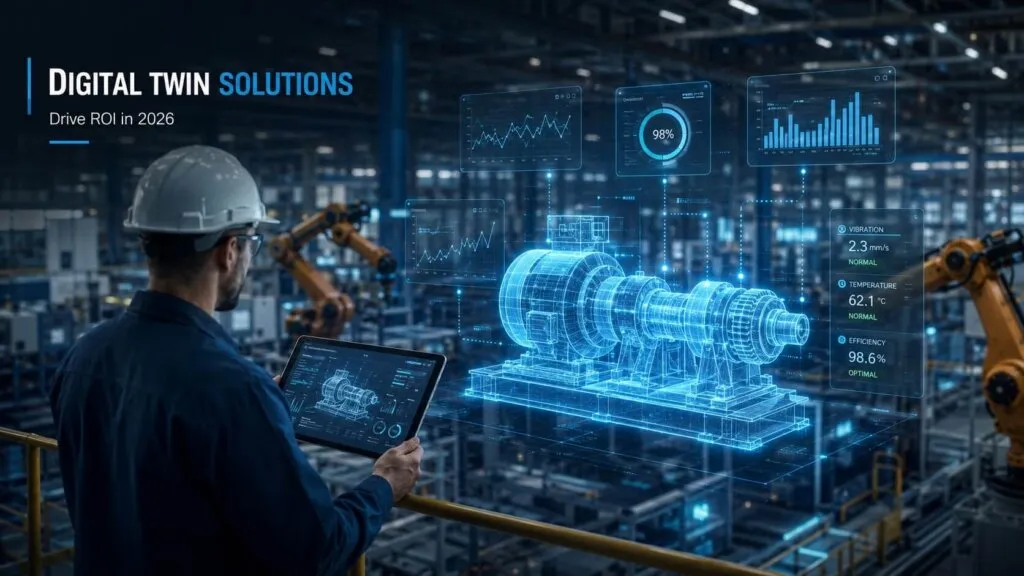
Digital twin solutions are changing how enterprises in manufacturing, healthcare, retail and transportation plan, monitor and optimise physical operations. A digital twin is a living, continuously updated virtual replica of a physical asset, process or system. It is fed by real-time sensor data, historical records and predictive models. The result gives decision makers a way to see problems before they happen, rather than after the damage is done. ICANIO Technologies builds this capability for organisations that can no longer manage complex assets on instinct alone.
What used to be a research topic confined to aerospace and heavy industry is now a practical, deployable technology stack. Mid-sized and enterprise organisations alike can adopt it within months. The shift happened because the supporting pieces matured: cloud infrastructure, industrial IoT sensors, artificial intelligence inference and DevOps automation. ICANIO works at the intersection of all four. This guide explains what digital twin solutions are, where they deliver value across six industries, and how to choose a partner for the build.
Key Takeaways
- Digital twin solutions combine live sensor data, cloud infrastructure and AI models into one continuously updated virtual model.
- Predictive maintenance is usually the easiest entry point because downtime has a cost finance teams already track.
- Six industries benefit today: manufacturing, healthcare, fintech, education, retail and transportation.
- Successful digital twin software development needs data engineering, cloud, DevOps and MLOps depth working together.
- Start narrow with one asset or process, prove accuracy, then scale outward in phases.
What Is a Digital Twin, and Why Does It Matter Now?
A digital twin is more than a 3D model or a dashboard. It is a virtual counterpart that stays synchronised with its physical twin through a steady flow of data. The Wikipedia overview of digital twins traces the idea back to product lifecycle management and NASA mission planning. Today the same concept applies to machines, buildings, supply chains and even business processes.
Three forces are pushing digital twin adoption from niche to mainstream. First, the cost of IoT sensors and edge hardware has dropped. Assets that were never worth monitoring closely can now be instrumented economically. Second, cloud platforms offer managed services built for twin modelling, such as Azure Digital Twins and AWS IoT TwinMaker. These remove much of the infrastructure burden that once made projects slow and expensive. Third, machine learning models can now turn raw sensor streams into genuinely predictive insight.
Together, these shifts mean that digital twin solutions no longer require a multi-year research budget. A team with the right mix of data engineering, cloud architecture and domain expertise can stand up a working pilot in weeks.
How a Digital Twin Differs From a Simulation
A simulation models a system using assumed or historical inputs. It answers "what would happen if" for a fixed scenario. A digital twin, by contrast, is continuously updated with real data from the asset it represents. It reflects current conditions, not a snapshot. Many digital twin solutions run simulations on top of the live twin, which is where the real power appears.
The Core Building Blocks of Digital Twin Solutions
Every working twin rests on the same layered architecture. The names of the tools change from project to project, but the layers stay consistent. The table below summarises them.
| Layer | What it does | Typical technology |
|---|---|---|
| Data capture | Collects signals from assets | Industrial IoT sensors, SCADA, PLCs |
| Ingestion | Moves data reliably | MQTT, Kafka, edge gateways |
| Storage | Keeps history and context | Time-series and data lakes |
| Modelling | Represents the asset | Graph models, physics, ML |
| Insight | Turns data into action | Dashboards, alerts, APIs |
| Operations | Keeps it accurate | DevOps, MLOps, monitoring |
The data capture layer often reuses what a plant already has. Many factories run SCADA systems and historians that hold years of useful signal. Good digital twin solutions connect to these sources first, before adding new sensors. That approach lowers cost and shortens the path to a first result.
The modelling layer is where most of the intellectual work happens. Some twins use physics-based models. Others rely on machine learning trained on historical behaviour. Many combine both, using physics for known dynamics and ML for patterns that are hard to describe with equations. Our team recommends choosing the simplest model that meets the accuracy target, then adding complexity only when the data justifies it.
Digital Twin Solutions for Manufacturing
Manufacturing remains the heaviest adopter of digital twin solutions, and for good reason. A production line generates a continuous stream of measurable signals: vibration, temperature, throughput and defect rate. These map cleanly onto a digital model. When the model is built correctly, engineers can simulate a process change before touching the physical line. Bottlenecks and quality issues are caught in software instead of on the factory floor.
The NIST programme on digital twins for advanced manufacturing highlights standards and interoperability as key challenges. That matches what our team sees in practice. Plants often run equipment from many vendors, each with its own data format. A twin is only as good as the integration work behind it.
ICANIO's manufacturing work typically starts with a narrow, high-value use case rather than an attempt to twin an entire facility. A single high-cost machine, one production cell or one quality checkpoint gives a contained environment. The model's accuracy is proven there first. The twin then expands outward to adjacent equipment and eventually full lines, once the data pipeline has shown it is reliable.
Predictive Maintenance as the Entry Point
Predictive maintenance is usually the easiest business case to make. Unplanned downtime has a direct cost that finance teams already track. The predictive maintenance approach feeds vibration, temperature and usage data into a model trained on historical failure patterns. The twin can then flag a bearing or motor drifting toward failure before it breaks. Maintenance teams get a scheduled window instead of an emergency stoppage.
This is also where an MLOps practice becomes essential. A predictive maintenance model is not a one-time deployment. Equipment behaviour drifts, seasons change and new failure modes appear. The model needs continuous retraining and monitoring to stay accurate. Without that discipline, predictions degrade quietly until nobody trusts them.
AI-Powered Digital Twin Solutions Across Industries
While manufacturing gets the most attention, AI-powered digital twin solutions are spreading into sectors that do not usually come to mind first. ICANIO works across Digital Twin Solutions, Data and AI, Application Development, DevOps and Cloud Engineering, Technical Support Engineering and AgenticOps. Twin projects tend to draw on most of these at once, because a working twin is a system of systems rather than one piece of software.
Healthcare
In healthcare, digital twin solutions model hospital workflow bottlenecks, equipment usage and care pathways. Clinical and operations teams can test interventions virtually before applying them to real schedules. Bed allocation, staffing patterns and equipment availability can all be twinned. This surfaces inefficiencies that are not visible in a spreadsheet. AI layered on top can then suggest adjustments that reduce waiting without overstaffing.
Fintech and Banking
Financial institutions use digital twin concepts to model transaction flows, fraud patterns and operational risk scenarios. They simulate how a system responds under stress before that stress shows up in production. This is not a physical twin in the traditional sense. Still, the principle is the same: a continuously updated virtual model fed by real data.
Education and E-Learning
Education technology platforms can use digital twin solutions to model learner behaviour and resource allocation at scale. A twin of the platform can simulate how a curriculum change or a feature release will affect engagement. Providers test changes in a contained environment instead of learning from a live rollout gone wrong.
Retail and E-Commerce
Retailers apply digital twin solutions to supply chain and inventory modelling. Virtual replicas of warehouse operations and demand patterns let planners stress-test seasonal spikes or supplier delays. Paired with AI demand forecasting, these twins can help teams hold less safety stock while still avoiding stockouts.
Transportation and Logistics
Transportation networks are perhaps the most natural fit for digital twin solutions outside manufacturing. Fleets, routes and warehouses all generate continuous operational data. A logistics twin can simulate route disruptions, fuel cost shifts or warehouse congestion. Operators test contingency plans before a disruption actually hits.
How to Choose a Digital Twin Software Development Partner
Selecting the right partner for digital twin software development matters more than most organisations expect. Early choices about data architecture, cloud platform and modelling approach are hard to reverse later. A handful of considerations separate successful digital twin solutions from ones that stall after the pilot.
- Cross-disciplinary engineering depth. A twin spans industrial IoT ingestion, cloud infrastructure, AI modelling and ongoing support. The partner needs real depth in all of them.
- Strong DevOps and cloud practice. Automated deployment, infrastructure monitoring and fast incident response decide whether a twin stays available.
- A long-term MLOps commitment. Model monitoring, retraining pipelines and drift detection must be built in from day one.
- Domain understanding. The team should speak the language of your operators, not just your data scientists.
- A phased delivery plan. Look for a partner that proposes a narrow pilot with clear success criteria.
Why Cross-Disciplinary Depth Matters
A digital twin is not a single application. It is a layered system, and a weakness in any layer shows up as an unreliable twin. ICANIO structures its engagements around a coordinated team. Data and AI specialists, DevOps and cloud engineers, and support engineers work as one unit rather than as separate vendors stitched together.
Why MLOps Cannot Be an Afterthought
Many digital twin solutions fail not at launch but months later. The underlying model drifts away from reality and nobody notices until predictions stop making sense. The MLOps discipline exists to prevent exactly this. It treats models like production software, with versioning, monitoring and automated retraining.
What a Digital Twin Engagement With ICANIO Looks Like
ICANIO's approach starts with a scoping phase. The goal is to find the highest-value, lowest-risk use case within a client's wider operation. Trying to twin everything at once almost always fails. From there, our team builds a data ingestion pipeline. It pulls from existing sensors, enterprise systems or operational logs, depending on what is already in place. AI models are layered on top to deliver the prediction or simulation the client needs.
Application development resources build the dashboards and interfaces that make the twin usable. DevOps and cloud engineering ensure the infrastructure scales as data volume grows. Support engineering stays involved after launch. A twin that breaks silently is worse than no twin at all, so ongoing reliability is part of the value, not an optional extra.
A typical engagement moves through these stages:
- Discovery and use-case selection with operations and finance stakeholders.
- Data audit covering existing sensors, SCADA, historians and business systems.
- Pilot build on one asset or process, with agreed accuracy targets.
- Production hardening, including security, monitoring and MLOps pipelines.
- Phased expansion to adjacent assets once the pilot proves its value.
You can read more about how ICANIO approaches this work on our digital twin solutions service page. For a deeper look at the data side, see our guide to digital twin simulation and sensor data pipelines.
Common Pitfalls in Digital Twin Projects
Several patterns show up repeatedly in projects that struggle to deliver value. Knowing them in advance is one of the best ways to protect your investment in digital twin solutions.
- Starting too big. Twinning a whole facility before proving the model on one asset multiplies risk and delays any return.
- Underinvesting in MLOps. Treating the twin as a one-time build, rather than a living system, leads to silent model decay.
- Ignoring data quality. Missing timestamps, unit mismatches and sensor gaps undermine every model built on top.
- Choosing on AI skill alone. The infrastructure layer decides whether the twin stays reliable in production.
- Leaving operators out. If the people on the floor do not trust the twin, they will not act on it.
Digital twin solutions succeed when all of these disciplines are treated as equally important from the start. That is the structural reason ICANIO runs twin engagements as cross-functional efforts rather than single-specialty projects.
Security and Governance Considerations
Connecting operational technology to the cloud expands the attack surface. A twin that can send commands back to equipment needs especially careful design. Our team recommends network segmentation, least-privilege access and clear audit trails. For AI components, the NIST AI Risk Management Framework offers a useful structure for thinking about model risk and accountability.
Measuring the Value of Digital Twin Solutions
Why do some twins win continued funding while others are quietly shelved? Usually it comes down to measurement. Before a pilot of digital twin solutions starts, agree on the metrics that matter. Examples include unplanned downtime hours, maintenance cost per asset, first-pass yield, or order fulfilment time. Capture a baseline, then compare against it honestly.
The benefits of digital twin solutions are often indirect as well as direct. Teams make faster decisions because they trust the data. Engineers spend less time gathering information and more time solving problems. These gains are harder to quantify, but they matter.
The Road Ahead for Digital Twin Solutions
As industrial IoT costs keep falling and AI models handle messy real-world data better, digital twin solutions will keep expanding. The core pattern applies just as well to a hospital ward as to a production line. Organisations can test and predict before committing real resources.
Generative and agentic AI are also starting to shape the field. Natural language interfaces let operators ask a twin questions in plain words. Agents can propose and test scenarios automatically, with humans approving the final action. Our guide to industrial digital twin solutions explores several of these patterns in more depth.
Conclusion
Digital twin solutions have moved from experiment to everyday engineering. The supporting technology stack is mature, and the business cases are clear in manufacturing, healthcare, fintech, education, retail and logistics. The question is no longer whether twins work. It is how to build one that stays accurate and trusted over time.
The answer is a phased plan, a strong data foundation, and a partner with real depth in cloud, DevOps and MLOps. Start with one asset, prove the value, then grow. If you are exploring digital twin solutions for your operation, contact ICANIO to talk through your first use case with our team.
References
- Digital twin overview (Wikipedia)
- NIST: Digital Twins for Advanced Manufacturing
- Microsoft Learn: What is Azure Digital Twins?
- AWS IoT TwinMaker
- Predictive maintenance (Wikipedia)
- MLOps (Wikipedia)
- NIST AI Risk Management Framework
Frequently asked questions
What industries benefit most from digital twin solutions?
Manufacturing remains the largest adopter. Healthcare, fintech and banking, education, retail and transportation are also building meaningful use cases. Common themes include predictive maintenance, operational simulation and resource planning. The best fit is any environment that produces continuous operational data and where better foresight has a clear financial value. Starting with one high-value process keeps the risk low.
How long does it take to build a digital twin?
A focused pilot covering one asset or process can often be built within a few months. Timing depends on the quality and availability of existing sensor or operational data. Expanding the twin to a full facility takes considerably longer. It usually happens in phases, with each phase proving its value before the next begins. Clean, well-documented data shortens every stage.
What is the difference between a digital twin and a simulation?
A simulation models a system using assumed or historical inputs for a fixed scenario. A digital twin is continuously updated with real-time data from the physical asset it represents. That lets it reflect current conditions rather than a snapshot. Many digital twin solutions run simulations on top of the live model, combining both strengths for planning and forecasting.
Do digital twin solutions require IoT sensors?
Most physical-asset twins rely on industrial IoT sensors for real-time data. Many plants already have useful signals in SCADA systems and historians, so new hardware is not always needed. Some digital twin concepts, such as fintech transaction or risk models, draw entirely on existing digital data streams. The data audit at the start of a project shows what is already available.
Why does MLOps matter for digital twin projects?
A twin's predictive accuracy depends on its AI models staying current with real-world conditions. Equipment ages, operating patterns shift and new failure modes appear. Without ongoing monitoring and retraining through a proper MLOps practice, models drift over time. The twin's predictions then become unreliable, and operators stop trusting it. MLOps keeps the model honest after launch.
How should we start a digital twin project?
Begin with a single, high-value use case that has measurable outcomes, such as reducing unplanned downtime on one critical machine. Audit the data you already have, agree on success metrics and build a focused pilot. Once the pilot proves its accuracy and value, expand in phases. This approach keeps digital twin software development affordable and lowers delivery risk.