Scaling AI from prototype to production is where most enterprise programs stall. The pattern is familiar. A team builds an impressive prototype. It answers queries accurately in a controlled environment. Stakeholders are excited and ready to invest. Then the conversation turns to serving tens of thousands of real users, and the room goes quiet.
The prototype never becomes a production system. It stays a demonstration of what could be. This gap is rarely a model problem. It is a systems engineering problem. Scaling AI needs a different set of engineering capabilities from the ones used to build the model behind the demo.
ICANIO's Data and AI practice helps enterprises make this transition. We build platform infrastructure, LLM deployment architecture, semantic caching layers, and governance programs that let artificial intelligence run reliably at scale. This guide covers why scaling AI programs fail, what production requires, a worked LLM deployment example, and the KPIs that reflect real production success.
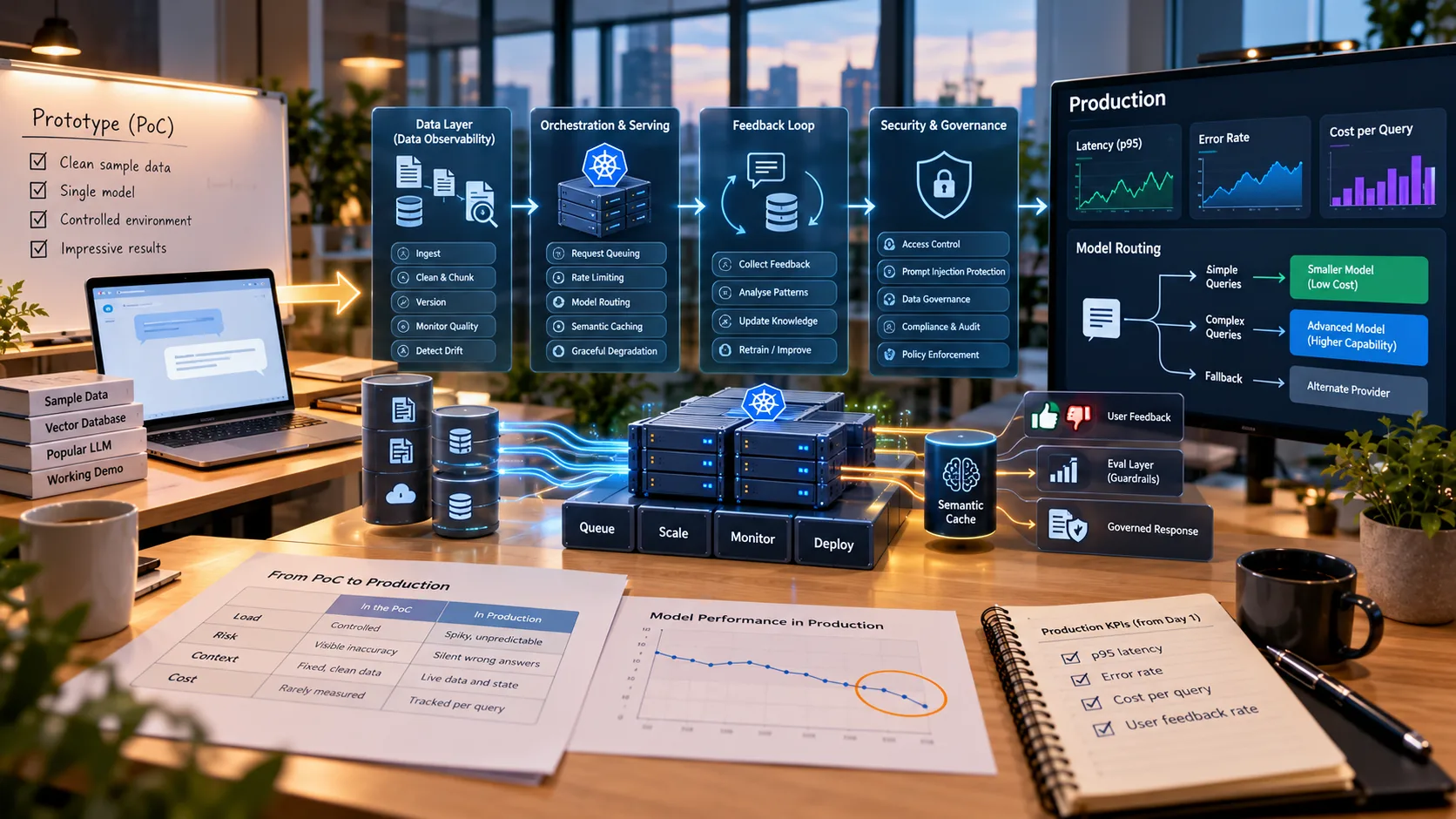
Key Takeaways
- Scaling AI is a platform engineering challenge, not a model selection exercise.
- An AI proof of concept hides problems with load, silent failures, and changing data that production exposes.
- Four pillars support production: data observability, feedback loops, security and governance, and semantic caching with cost control.
- Model routing in LLM deployment matches task complexity to model cost.
- Production KPIs such as p95 latency, error rate, and cost per query should be set from the first sprint.
Why Scaling AI Programs Fail: The Prototype Trap
Most AI initiatives start in a controlled environment, which is exactly why scaling AI later feels so hard. A team picks a vector database, uses a popular language model, assembles clean sample data, and demonstrates a working system. In that vacuum, results look impressive.
Scaling AI exposes the assumptions built into that environment. Production data is not clean, static, or curated. Real users are not a sample population sending predictable queries. Infrastructure is not a single machine with unlimited time per request. The AI proof of concept that worked well in the lab starts to show structural gaps.
The Measurement Gap
In an AI proof of concept, accuracy on a curated evaluation set is the main KPI. In production, 80% accuracy means a 20% error rate applied to real users and real decisions. An enterprise AI strategy must use production-grade success metrics, not prototype benchmarks.
The Model Versus System Gap
Leaders who focus only on choosing the best model, while underinvesting in the surrounding system, tend to struggle with scaling AI. The model is one component. The data pipeline, serving infrastructure, integration layer, monitoring stack, and governance framework together decide whether it delivers value. Our article on AI project failure after launch looks at what happens when these pieces are missing.
What Changes When AI Goes Live
Scaling AI from an AI proof of concept to production shifts the challenge along three dimensions.
| Dimension | In the PoC | In production |
|---|---|---|
| Load | Controlled, predictable | Spiky, unpredictable |
| Risk | Visible inaccuracy | Silent wrong answers |
| Context | Fixed, clean data | Live data and state |
| Cost | Rarely measured | Tracked per query |
Load becomes unpredictable. Users send queries the system was not designed for. They exceed expected volumes and find edge cases nobody anticipated.
Risk shifts from inaccuracy to silent failure. Traditional software either works or throws a visible error. An AI system can return a confident, wrong answer with no error signal. This is the hallucination problem, and every enterprise AI strategy must address it explicitly.
Context becomes dynamic. Production context includes real-time enterprise data, user history, session state, and the changing state of connected systems.
Infrastructure That Production Requires
These shifts have direct infrastructure consequences for scaling AI. Production needs:
- An orchestration layer with request queuing and rate limiting to prevent cascade failures.
- Semantic caching to avoid repeated inference calls for similar queries.
- Graceful degradation when an LLM provider is down or rate limited.
- An evaluator layer that checks outputs before they reach users.
Container platforms such as Kubernetes are a common foundation for this serving layer, because they handle scaling, health checks, and rollouts. Our DevOps and cloud engineering services team often builds this layer alongside the AI work.
Four Essential Pillars for Scaling AI
Enterprises that succeed at scaling AI treat it as a platform engineering challenge. The question changes from "which model is most accurate?" to "which architecture lets any model be deployed reliably, monitored continuously, updated safely, and governed properly?" This is the core idea behind MLOps. Our team recommends four architectural pillars for every production program.
Pillar 1: Data Observability
Scaling AI needs data pipelines that clean, version, chunk, and monitor data quality continuously. An AI proof of concept uses a fixed dataset. Production data changes. Documents are updated, knowledge bases evolve, and real user inputs differ from the curated sample.
Data observability tools watch for these changes and alert the team before drift degrades results silently. Good data engineering practice, including lineage and schema checks, is the base layer. In regulated industries, where data quality affects compliance, observability is a governance requirement as well as an engineering one.
Pillar 2: Feedback Loops
When scaling AI, production systems improve only when user feedback is captured and fed back into retrieval or fine-tuning. Without a feedback loop, a system performs at its launch level indefinitely.
An effective enterprise AI strategy includes three parts:
- Feedback collection at the output layer, such as ratings and corrections.
- Analysis to find patterns in negative or low-confidence responses.
- A defined cycle for updating the retrieval knowledge base or running fine-tuning.
ICANIO treats feedback loop infrastructure as a standard delivery component, not a post-launch extra.
Pillar 3: Security and Governance
Production governance needs prompt injection protection, PII masking on inputs and outputs, role-based access control, and audit logging of all AI interactions. The OWASP Top 10 for LLM Applications is a practical checklist for these threats.
For industries with reporting duties, audit logs must capture enough to reconstruct what the system said, to whom, based on which retrieval context, and under which system prompt. These needs are absent in the prototype stage. They must be designed in before any user-facing launch. Retrofitting governance into a deployed system is typically harder and more expensive than building it in. The NIST AI Risk Management Framework provides a useful structure.
Pillar 4: Semantic Caching and Cost Governance
Semantic caching stores responses and serves them for semantically equivalent follow-up questions. That avoids redundant inference calls. Inference costs grow with query volume, and many production queries resemble recent ones, so semantic caching is one of the most effective cost tools available.
Model routing adds a second lever. Simple tasks go to cheaper models, and only complex reasoning reaches high-capability models. Together, semantic caching and routing can reduce inference spend substantially compared with a naive single-model setup. We build cost governance into the platform from the first sprint, rather than reacting once bills have grown.

LLM Deployment Example: Resume Intelligence Platform
A global recruitment platform had an AI proof of concept that summarised PDF resumes using a high-capability language model. It worked well on ten resumes at a time. The production requirement was very different: process 50,000 resumes per day, match each against 5,000 active job descriptions, and keep cost below five cents per match. Running a larger model, or the same model at higher volume, could not meet that target.
ICANIO designed a multi-stage LLM deployment pipeline that assigned the right model to each task:
- Stage one: a lightweight, cost-efficient model parsed and structured raw resume data at high throughput.
- Stage two: a specialised embedding model running locally handled matching, removing API calls from the most compute-heavy step.
- Stage three: only top-ranked candidates went to a high-capability model for final summaries, so under five percent of resumes reached the expensive layer.
The design was built to meet throughput, cost, and accuracy requirements that the prototype architecture could not support. This model routing pattern, matching task complexity to model capability, is now a standard part of our approach to high-volume LLM deployment. For related evaluation practices, see our guide to LLM evaluation before deployment.
AI Production KPIs: Measuring What Matters
| KPI | PoC baseline | Production target |
|---|---|---|
| p95 latency | None | Under 2 seconds |
| Error rate | Tolerated in demos | Under 2% |
| Cost per query | Not measured | Tracked per tier |
| Uptime | Not applicable | 99.5% or higher |
| Cache hit rate | Not applicable | Above 40% |
These targets are illustrative starting points; each organisation should set its own. The gap between AI proof of concept metrics and production KPIs explains why many programs fail to scale. They measure prototype performance rather than production reliability.
Scaling AI to production grade means aligning the whole program around production KPIs from day one. Our team recommends setting a baseline and a target for each metric at the start of every engagement. That gives leaders visibility into progress against measurable outcomes, and it gives engineers a clear definition of done.
Adoption as a KPI
User adoption deserves its own line. A technically sound system that nobody uses delivers nothing. Define the intended audience, track weekly active users, and treat low adoption as a product problem to investigate, not a training issue to ignore.

Common Mistakes When Scaling AI
Several mistakes appear again and again when teams start scaling AI. Avoiding them saves months of rework.
- Scaling the demo code. Prototype notebooks are not production services. Rebuild with tests, versioning, and CI/CD.
- Ignoring cost until the invoice arrives. Track cost per query from the pilot onwards.
- Skipping evaluation datasets. Without a regression set built from real traffic, every model change is a gamble.
- Treating security as a later phase. Prompt injection and data leakage risks exist from the first public user.
- No named owner. Scaling AI needs a product owner who is accountable for outcomes, not only a data science team.
Each mistake is avoidable with planning. The common thread is treating scaling AI as an engineering and operating model change rather than a bigger version of the prototype. DevOps habits, such as automated releases, rollback plans, and infrastructure as code, apply to AI services just as they do to any other cloud workload.
The Role of the Platform in Scaling AI
The most common failure mode in scaling AI is treating the model as the product rather than the platform. Teams that frame their goal as "deploy model X" tend to hit the same obstacles. Models change every few months as providers release new versions. The infrastructure, monitoring, and governance needs of production stay constant whichever model runs.
The platform view reframes every decision:
- Instead of "which model should we use?", ask "how do we build a model-agnostic serving layer so we can swap models without rewriting integrations?"
- Instead of "how do we make answers more accurate?", ask "how do we build a feedback loop that keeps improving the retrieval context?"
Google Cloud's guide to MLOps continuous delivery and automation pipelines describes the same progression, from manual machine learning workflows to fully automated pipelines.
Platform Assessment Before Model Selection
ICANIO starts every scaling AI program with a platform assessment before any model selection or LLM deployment work. The assessment reviews data pipelines, integration architecture, security and governance needs, observability tooling, and cost management. The output is a roadmap of what must exist before a production system can run reliably at the organisation's scale. Platform first, model second is a consistent difference between programs that scale and programs that stay at the prototype stage.
How to Prepare for Scaling AI: What Leaders Should Do Next
Scaling AI from prototype to production is a specific engineering journey that many organisations underestimate when budgeting. The gap is operational, not scientific. It is the distance between a convincing demo and a system that serves real users, handles real data, meets compliance constraints, and keeps improving.
Four questions reveal readiness for scaling AI:
- Will monitoring detect performance degradation before users report it?
- Does the data pipeline keep retrieval context fresh as source data changes?
- Is there a cost governance model that stops spend growing unchecked?
- Does audit logging satisfy the compliance needs of your industry?
Teams that can answer yes are ready to scale. Teams that cannot should close these gaps before investing further in model improvements. Our enterprise AI deployment guide covers the rollout stage in more detail.
Conclusion
Scaling AI is less about finding a better model and more about building the platform around it. Data observability, feedback loops, security and governance, and semantic caching with cost control turn an AI proof of concept into a dependable service.
Set production KPIs early, design governance in from the start, and use model routing to keep LLM deployment affordable as volume grows. Treat the platform as the product, and models become replaceable parts.
If you are planning the move from prototype to production, our Data and AI services team can help. Contact ICANIO to discuss your current architecture.
References
- MLOps (Wikipedia)
- Google Cloud: MLOps continuous delivery and automation pipelines
- OWASP Top 10 for LLM Applications
- NIST AI Risk Management Framework
- Kubernetes overview
Frequently asked questions
Why do AI proof of concept programs fail to reach production?
They are built around model performance in controlled conditions rather than production engineering needs. Scaling AI requires load management, silent failure detection, reliable data pipelines, security governance, and cost control, none of which a typical AI proof of concept addresses. Teams that succeed treat the move as a platform engineering challenge, not a model selection exercise.
What is semantic caching and why does it matter for LLM deployment?
Semantic caching stores responses to earlier queries and serves them for semantically equivalent follow-up questions, avoiding redundant inference calls. In enterprise LLM deployment, many queries resemble recent ones, so caching cuts both latency and cost. Combined with model routing, semantic caching can reduce spend substantially compared with sending every request to one expensive model.
What is an enterprise AI strategy for scaling AI?
It is a platform-level approach built on four foundations: data observability, feedback loops, security and governance, and semantic caching with cost governance. It reframes AI engineering from model selection to platform building, so the organisation can deploy, monitor, update, and govern AI systems over time without depending on one specific model or vendor.
How should enterprises measure AI production success?
Use operational KPIs: p95 response latency, error and hallucination rates, infrastructure cost per query, uptime, user adoption, and cache hit rate. These show whether the system delivers value reliably. Accuracy scores from the prototype phase are internal engineering benchmarks, because an accurate model that is slow, expensive, or unused delivers no operational value.
What skills does a team need for scaling AI?
Scaling AI needs more than data scientists. Teams typically combine machine learning engineers, data engineers for pipelines and quality, platform or DevOps engineers for serving and automation, security specialists for governance, and a product owner who defines success. Smaller organisations often partner for platform and operations skills while building internal capability over time.
How long does scaling AI from PoC to production take?
It depends on the state of existing data pipelines, integration complexity, and compliance requirements, so there is no single answer. A useful approach is to run a platform assessment first, then deliver in phases: a limited pilot with production monitoring, followed by staged expansion. Each phase should meet agreed KPIs before the next begins.