Coordination Pattern Design
We map your workflow and pick the pattern that fits: supervisor, pipeline, hierarchy or peer review. Multi-agent systems fail most often because the pattern was chosen by habit.
Pattern fit →AgenticOps · Multi-Agent Systems
One agent with fifty tools gets confused. A team of focused agents, each with a clear job and a supervisor, gets work done. We design that team, wire it together and keep it stable in production.
⟳ Orchestrating agents…
every step traced · guardrails on · reversible
Multi-agent systems split a large task across several AI agents, each with a narrow role, its own tools and a shared goal. A supervisor plans the work, specialists do it, and a reviewer checks it. When the pieces are designed well, the whole team is more accurate than any single agent.
Our team builds multi-agent systems for enterprises that have outgrown one-prompt chatbots. We choose the coordination pattern, define how agents share state, and add the stop rules that prevent loops, runaway costs and silent failures.
This page goes deep on the multi-agent specialism inside AgenticOps. It covers the patterns we use, the frameworks and protocols behind them, where teams go wrong, and how we take a design from whiteboard to a system people trust.
In computer science, multi-agent systems are groups of autonomous agents that interact to solve problems no single agent could solve alone. The idea is decades old. Large language models gave it new life, because each agent can now read, reason and use tools in plain language.
In an enterprise setting, the agents are usually LLM-driven workers with scoped permissions. A planner decides what needs doing. Specialists handle research, calculation, drafting or system updates. A critic or verifier checks results before anything leaves the system.
The value comes from separation of concerns. A small prompt with five tools is easier to test than a giant prompt with fifty. Each agent can use a different model, so cheap models handle simple steps and stronger models handle judgement calls.
The risk comes from interaction. Agents can pass bad data to each other, argue in circles or duplicate work. Good multi-agent systems treat communication as a contract. Messages have a schema, handoffs are logged, and every loop has a budget.
Working definition
“Multi-agent systems are software architectures in which several autonomous AI agents, each with a defined role, tools and permissions, coordinate through structured messages and shared state to complete a goal under human oversight.”
Foundations
Each agent owns a narrow task with a short prompt and a small toolset. Narrow roles are easier to test and replace.
Agents pass typed messages, not free text dumps. A schema makes every handoff checkable and every failure visible.
A common state object holds the plan and results. Each agent reads only what it needs and writes only its own fields.
Step limits, token budgets and approval gates stop loops early. People sign off on anything costly or irreversible.
Core capabilities
Each capability below is a piece of work we scope, build and hand over with tests and runbooks.
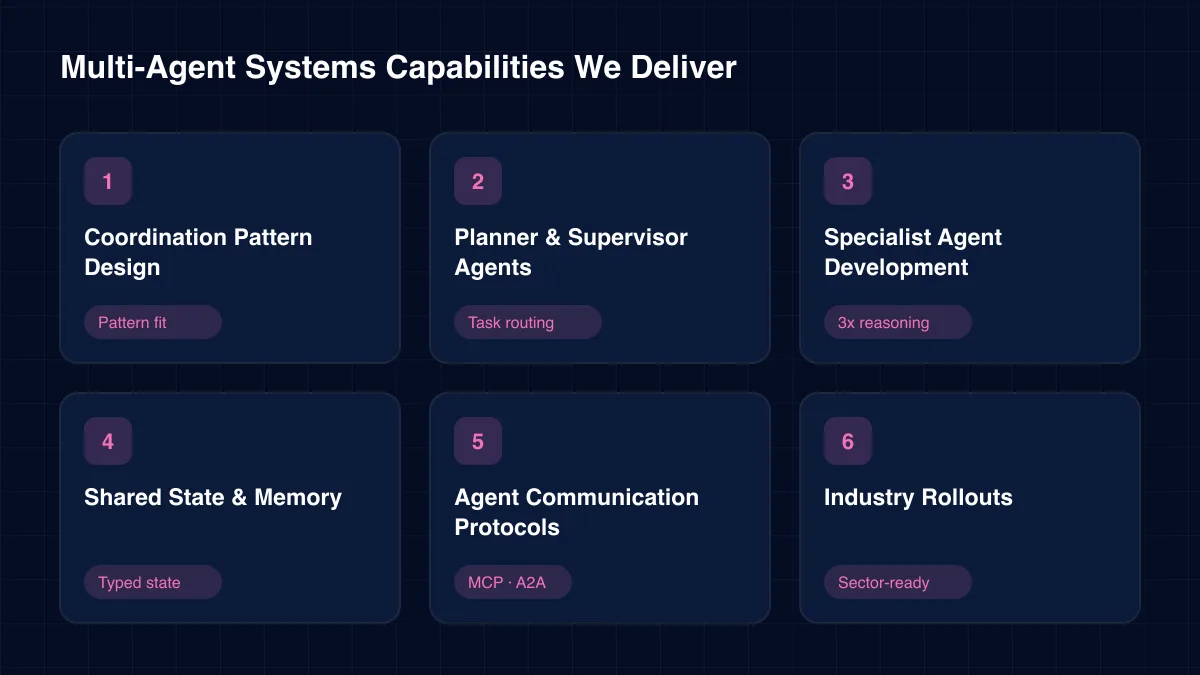
We map your workflow and pick the pattern that fits: supervisor, pipeline, hierarchy or peer review. Multi-agent systems fail most often because the pattern was chosen by habit.
Pattern fit →Supervisors break goals into tasks, route each one to the right specialist and merge the results. They also decide when to stop and when to ask a person.
Task routing
Research, extraction, pricing, drafting and verification agents, each with its own prompt, tools and tests. In our framework work, collaborative and reflective agents lifted reasoning quality 3x.
3x reasoning →Graph state, session memory and vector retrieval designed so agents see the right context. We keep memory small, typed and auditable, which cuts token use as well.
Typed state
Tools exposed through Model Context Protocol and cross-vendor agents linked through the Agent2Agent protocol. Multi-agent systems stay open as your vendor mix changes.
MCP · A2A →Agent teams tuned to sector rules in banking, healthcare, logistics and more. Each rollout inherits the guardrails and approval gates of our wider AgenticOps practice.
Sector-ready →Architecture
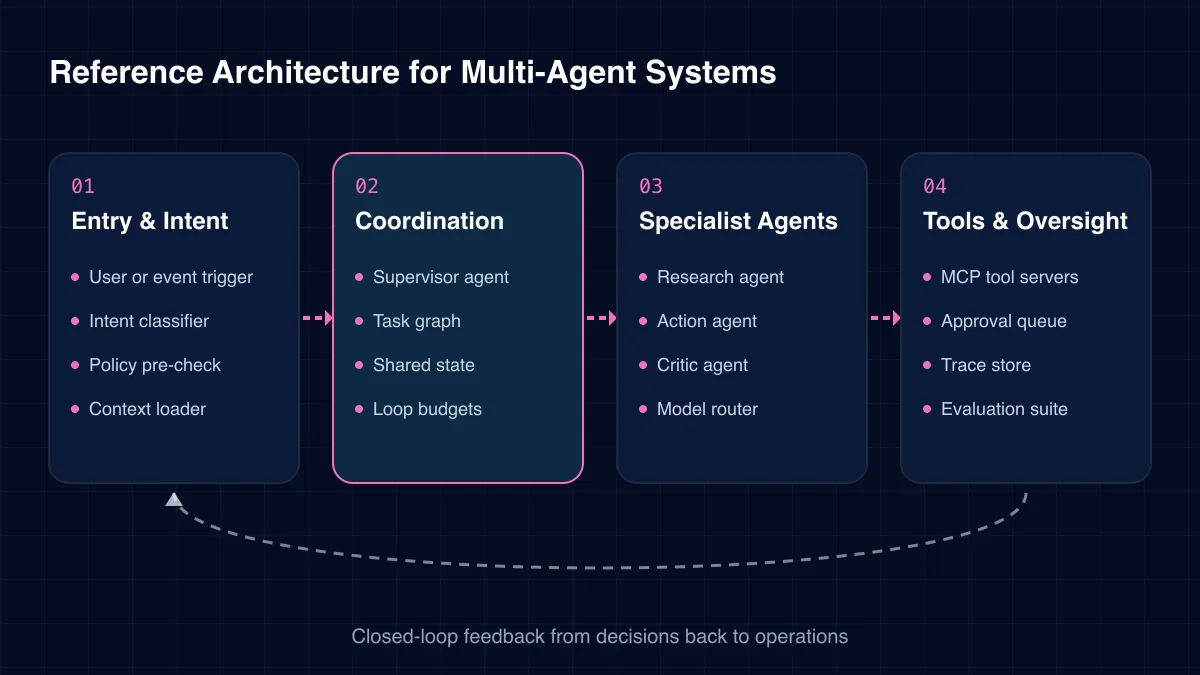
Our builds use four layers. The coordination layer is the heart: it holds the plan, the shared state and the rules for who talks to whom.
01
02
03
04
Challenges we solve
We are often called in after a first attempt stalls. These are the failure modes we see most.
One agent holds every tool and every instruction. It picks the wrong tool, forgets steps and becomes impossible to test.
Two agents keep correcting each other with no referee. Costs climb while the answer never settles.
Agent B never receives what agent A learned. Work is repeated or, worse, done with half the facts.
A small extraction mistake early on flows through every later agent. By the end it looks like a confident answer.
Nobody knows which agent made a decision. Audits stall and debugging turns into guesswork.
The design is welded to one library. Switching models or vendors later means a rewrite.
Most enterprise builds use one of these four patterns, or a blend. We choose based on how predictable the work is and how much judgement it needs.
Not every task needs a team of agents. This table shows where each approach fits.
| Criterion | Scripted bot | Single agent | Multi-agent |
|---|---|---|---|
| Handles varied requests | No | Partial | ✓ Yes |
| Easy to test each step | ✓ Yes | No | ✓ Yes |
| Mixes cheap and strong models | No | No | ✓ Yes |
| Built-in peer checking | No | No | ✓ Yes |
| Best for | Fixed screens | Short tasks | Long, mixed tasks |
The gains below appear when roles, handoffs and budgets are designed up front.
Delivery
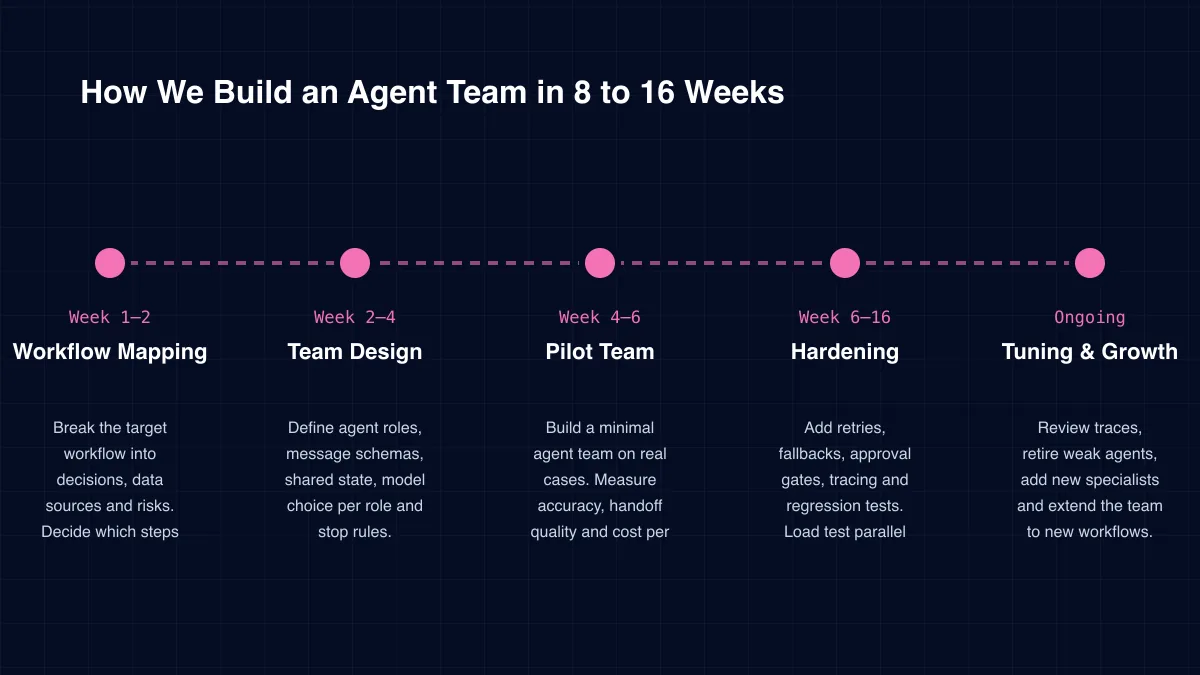
Week 1–2
Break the target workflow into decisions, data sources and risks. Decide which steps need an agent at all.
Week 2–4
Define agent roles, message schemas, shared state, model choice per role and stop rules.
Week 4–6
Build a minimal agent team on real cases. Measure accuracy, handoff quality and cost per run.
Week 6–16
Add retries, fallbacks, approval gates, tracing and regression tests. Load test parallel runs.
Ongoing
Review traces, retire weak agents, add new specialists and extend the team to new workflows.
Case study
An enterprise AI platform ran multi-agent systems whose pre-built components behaved inconsistently and failed under production load. ICANIO audited every agent workflow, then designed new collaborative and reflective reasoning agents. The result was 40% better stability, 3x stronger reasoning and compatibility across local and cloud LLMs.
“A framework that works in isolation but fails in production is an architecture and workflow engineering problem.”Read the full case study →
Stability debugging
Traced instability through reasoning chains to its root cause, agent by agent.
Reflective reasoning
New agents that work together and review their own output before passing it on.
Local & cloud models
The same agent team runs across several model environments.
Specialist services within our agenticops practice.
Anyone can wire three agents together in a notebook. We recommend testing a partner on these five points.
In our experience, failure design separates a pilot from a product. We start there, then build up.
More agents means more doors. Each agent gets its own credentials, scoped to the tools its role needs. A research agent can read; only an action agent can write, and only after approval.
Messages between agents are treated as untrusted input. We filter them for prompt injection, the top risk in the OWASP Top 10 for LLM applications, and we never let one agent grant another new permissions.
ICANIO works under ISO 9001 and ISO 27001 certified processes. Controls map to the NIST AI Risk Management Framework, and every agent message is kept in a tamper-evident trace for audit.
Start with one workflow and record today's numbers: cases per month, minutes per case, rework rate and cycle time. These form the baseline that multi-agent systems must beat.
After launch, add agent-level measures. Track accuracy per specialist, handoff failures, human override rate and cost per completed run. These show where to tune next.
Model choice per role is the biggest cost lever. Routing extraction and formatting to small models, while saving large models for planning and review, keeps cost per run steady as volume grows.
Do not ignore the soft gains. Staff stop copying data between tools. Reviews arrive complete. Audit requests are answered from traces in minutes, not weeks.
Technology stack
We stay framework-neutral and pick tools per use case. These are the ones we use most for agent teams.
Orchestration
Microsoft AutoGenCustom orchestrators
Protocols
Agent2Agent (A2A)
Models
OpenAI GPT modelsOpen-source LLMsSmall local models
State & Memory
Graph checkpointsVector databasesRAG pipelines
Durable Execution
Queues and retriesHuman task inbox
Observability
Agent tracingDeepEvalCost dashboards
Multi-agent systems are architectures where several AI agents, each with a specific role and toolset, work together on one goal. A supervisor usually plans and routes the work, specialists carry it out, and a reviewer checks the result.
Use multi-agent systems when a task has distinct stages, needs different tools or data per stage, or benefits from a second check. For short, single-purpose tasks, one well-tested agent is simpler and cheaper.
We work with LangGraph, Microsoft AutoGen, CrewAI and custom orchestrators. We choose per project based on state handling, human-in-the-loop support and your existing stack. Designs stay portable so a framework change is not a rewrite.
Every run has step limits, token budgets and timeouts. A referee or supervisor decides when an answer is good enough. If a budget is hit, the run stops safely and passes its state to a person.
Yes. Tools are exposed through Model Context Protocol, and agents can talk across vendors through the Agent2Agent protocol. This keeps multi-agent systems open as your platform choices change.
A pilot team on one workflow usually takes four to six weeks. A hardened production system with tracing, approval gates and regression tests takes eight to sixteen weeks in total.
How we deliver multi-agent systems and the wider agenticops practice in each sector.
Multi-agent systems let enterprises hand long, varied work to AI without trusting one fragile prompt. The design choices, roles, handoffs and stop rules decide whether the team helps or hurts.
ICANIO designs, builds and stabilises multi-agent systems on real workflows, with tracing and human oversight from day one. Contact us to review your use case and get a clear view of the right agent team for it.
By ICANIO AgenticOps Engineering Team · Published · Updated
Share the workflow you want to hand to AI. We will tell you whether it needs one agent or several, and what a safe first release looks like.
Contact Our Agent Team Engineers