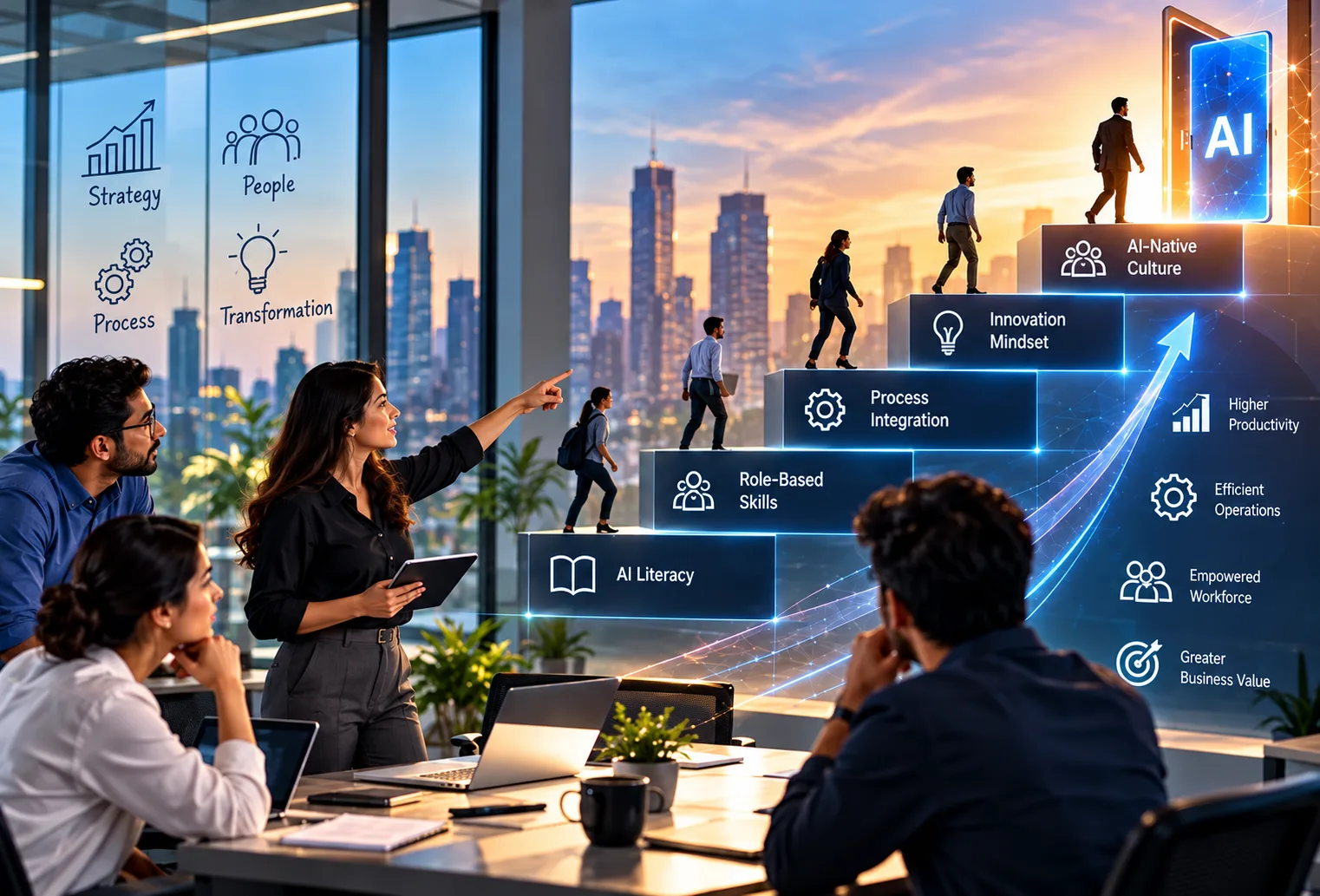
Agentic AI architecture is the discipline of designing software in which AI agents pursue goals rather than follow fixed request paths. For three decades, software architecture perfected deterministic systems. A request enters, an API processes it, a service applies business rules, a database persists the result, and a response returns. This model scaled from monoliths to microservices and from on-premises to cloud-native platforms.
Each transition kept the same principle: design the path a request follows, and the system follows it reliably. Agentic AI architecture breaks that principle at the foundation. An AI agent does not follow a predefined path. It understands a goal, reasons about the problem, builds a plan, invokes tools, observes outcomes and re-plans when results diverge. The architect's task shifts from designing request paths to designing decision boundaries. That shift changes every layer of the enterprise technology stack.
ICANIO's AgenticOps and Data and AI practices work on agentic AI architecture, multi-agent systems, agent orchestration, AI observability and human-in-the-loop design. This guide sets out the seven layers our team treats as core design concerns, and why each one matters before the first agent reaches production.
Key Takeaways
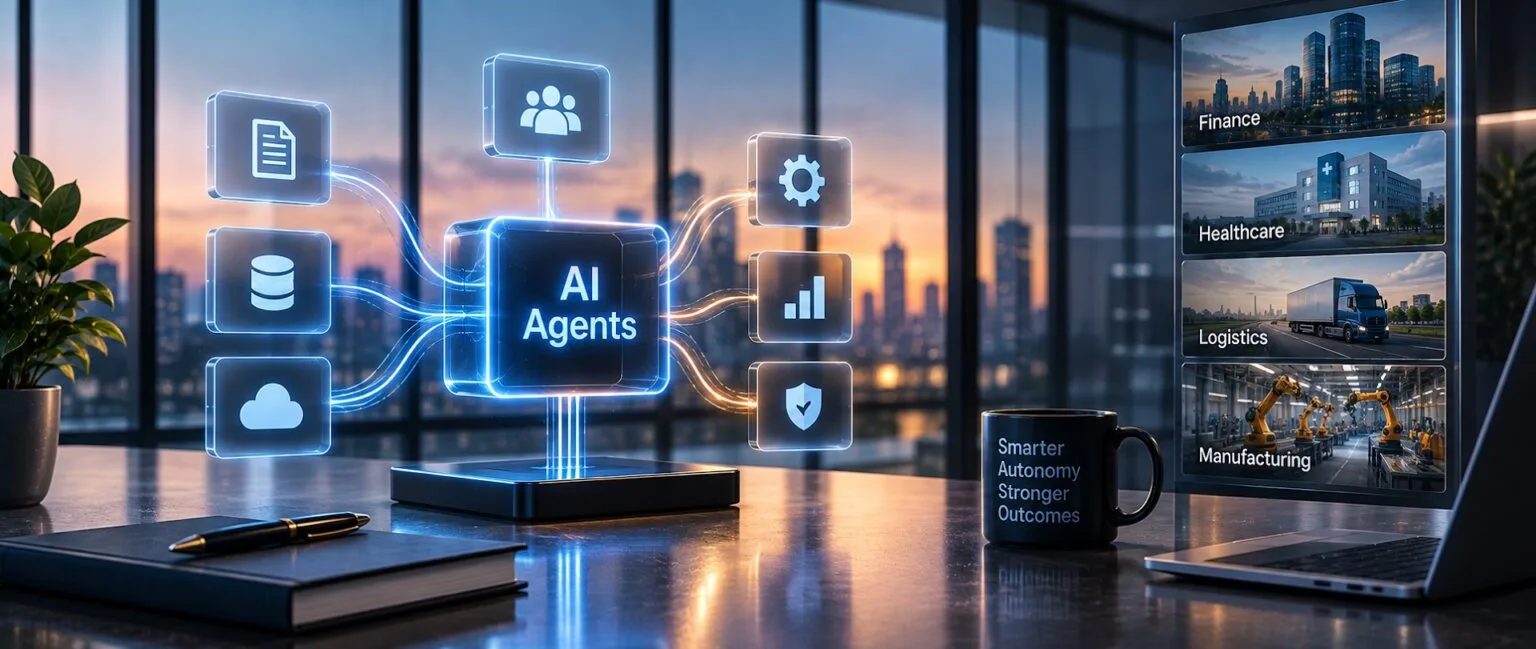
- Agentic AI architecture replaces fixed request paths with goals, decision boundaries and governed tools.
- APIs become agent tools, so tool-level authorisation and approval gates are architectural requirements.
- Agent orchestration coordinates multi-agent systems, handling communication, conflicts and failure containment.
- Memory, human-in-the-loop design and AI observability must be specified up front, not added later.
- Security moves from user-to-API checks to agent identity and policy enforcement.
What Is Agentic AI Architecture?
An intelligent agent perceives its environment, decides and acts towards a goal. Agentic AI architecture applies that idea to enterprise software built on large language models and other artificial intelligence components. The system receives an objective instead of a procedure. The agent then decides which steps to take and which tools to call.
This does not mean the system is unconstrained. A well-designed agentic AI architecture defines exactly what the agent may decide, what it may touch and when it must stop and ask. The difference from classic design is where the specification lives. It lives in boundaries, policies and evaluation criteria rather than in a fixed sequence of calls.
The table below summarises the seven layers covered in this guide.
| Layer | Core question | Key control |
|---|---|---|
| Goals | What may it decide? | Decision boundaries |
| Tools | What may it do? | Tool authorisation |
| Orchestration | Who does what? | Orchestrator |
| Memory | What may it recall? | Retention policy |
| Oversight | When must it ask? | Approval gates |
| Observability | Why did it act? | Decision traces |
| Security | Who is it? | Agent identity |
Agentic AI Architecture: From Request-Driven to Goal-Driven
The shift from request-driven to goal-driven systems is the defining trait of agentic AI architecture. In a request-driven system, the architecture specifies each step. It states which service receives a request, which rules apply, which data changes and what response returns. The system has no latitude to deviate. Correctness comes from the completeness of the specification.
In a goal-driven agentic AI architecture, the system receives an objective. The agent reasons about how to reach it, selects tools and evaluates whether each action moved it closer. When an action does not help, it re-plans. The specification no longer describes every step.
Instead, it describes the boundaries within which the agent may reason and act. It lists the tools the agent may use and the conditions for escalation to human review. It also defines the criteria by which success is measured. For engineering teams, this is the most significant conceptual change. The skill of constraint design, defining what a system may decide rather than exactly what it will do, becomes as important as service design.
Why the shift matters for enterprise teams
Deterministic systems fail in predictable ways. Agents can fail in novel ways, because their path is chosen at run time. That is why agentic AI architecture puts so much weight on boundaries, testing and evidence. Teams that skip this step often discover gaps only after an agent has taken an unexpected action in production.
APIs Become Tools: Governance in Agentic AI Architecture
In traditional enterprise architecture, APIs let services and applications communicate. In agentic AI architecture, APIs become tools available to agents. This reclassification brings governance needs that standard API design never addressed.
Consider an insurance agent with tools to retrieve customer data, validate policies, check eligibility, calculate premiums, create claims, generate documents and send notifications. It is not simply calling APIs. It decides which actions to take, in what order and on what information, without a human reviewing each decision.
That raises a question the architecture must answer explicitly: what should an agent be allowed to do? The answer cannot be "whatever the API permits". API permissions were designed for authenticated humans or deterministic integrations, not for autonomous agents acting at scale. Open standards such as the Model Context Protocol help describe tools consistently, but they do not decide policy for you.
Tool governance controls to specify
Our team recommends specifying these controls before any agent tool integration is built:
- Tool-level authorisation that separates what an agent may read from what it may execute.
- Least-privilege scopes limited to what the specific task requires.
- Input validation that resists prompt injection attempts to hijack agent actions.
- Rate limits that bound the volume of agent-initiated operations.
- Human approval gates for high-risk actions such as payments or data deletion.
- Compensation steps that can roll back a multi-step workflow that fails partway.
In regulated industries, these are not optional safeguards. They are architectural requirements in any agentic AI architecture.
Agent Orchestration: Coordinating Multi-Agent Systems
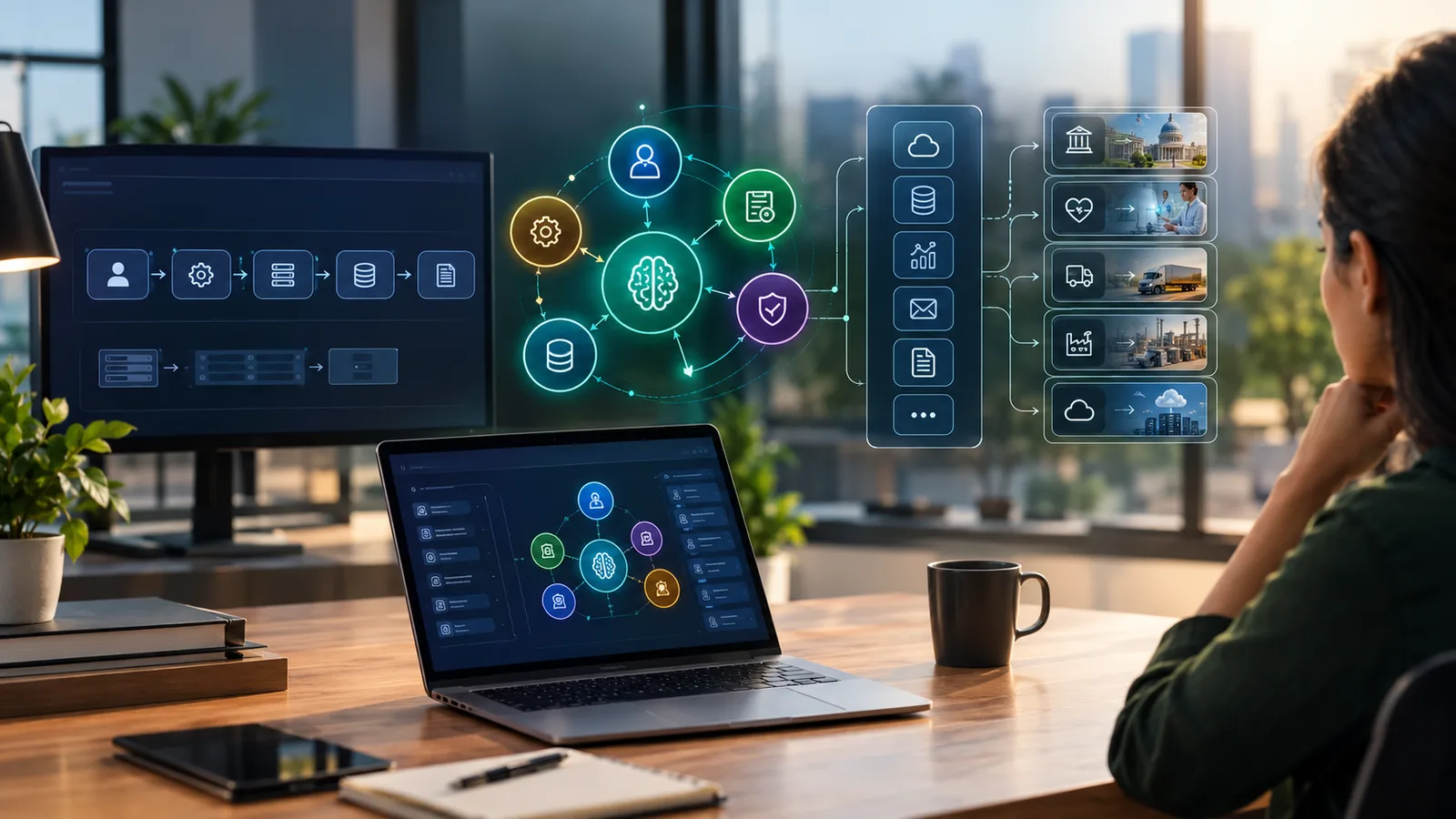
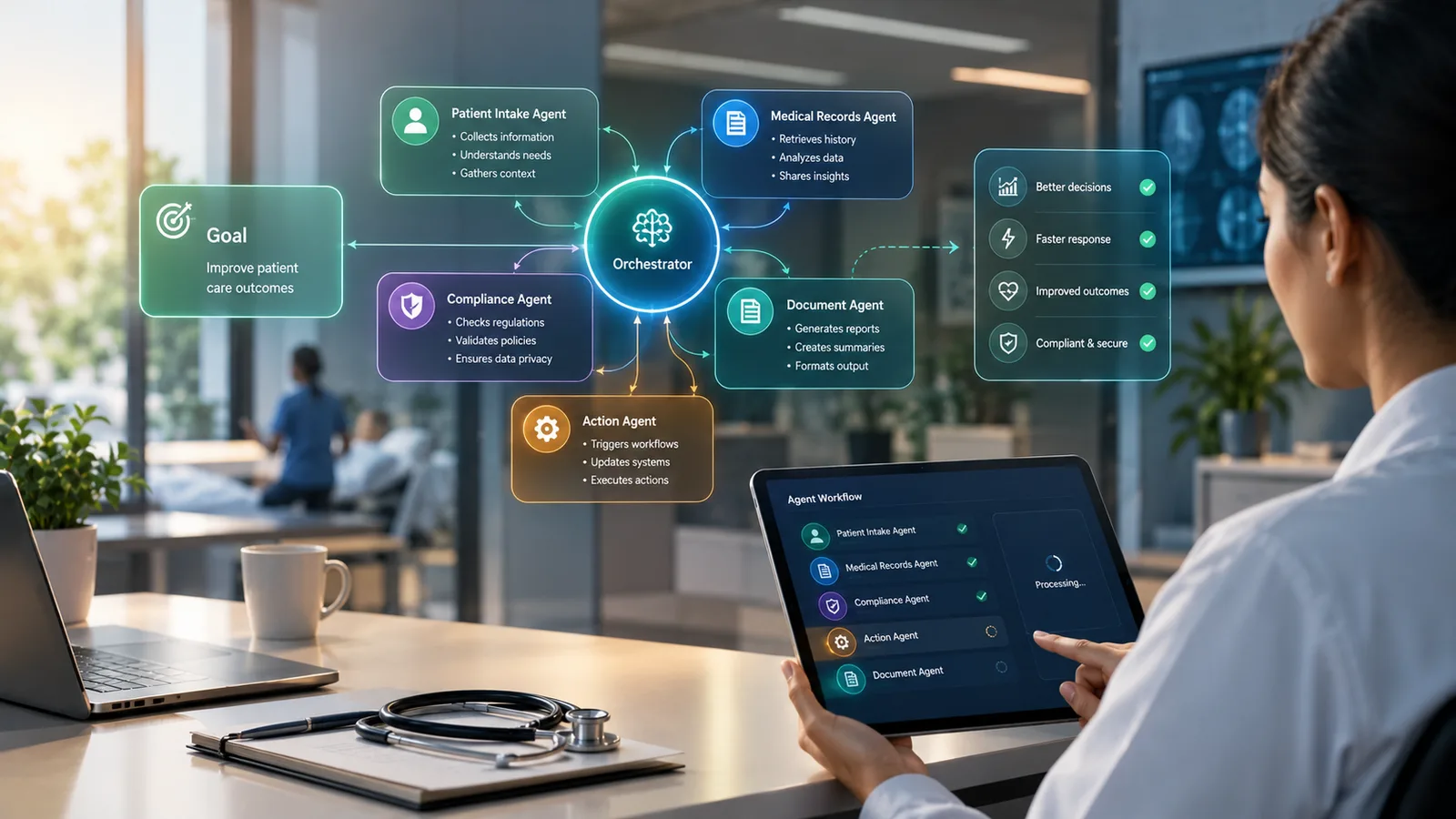
Agent orchestration is the layer that coordinates how several agents collaborate on goals that exceed any single agent. As programmes mature, a single-agent deployment often reveals that complex workflows need specialised agents working together. A common pattern includes a customer-facing agent, a policy agent, a compliance agent, a document agent and an orchestrator that sequences them. These are the multi-agent systems that increasingly characterise production deployments.
Agent orchestration must address three challenges that single agents do not face:
- Inter-agent communication: how agents share context, pass results and signal completion or failure.
- Conflict resolution: what happens when two agents produce incompatible outputs.
- Failure containment: how the orchestrator detects an unreliable output and decides to retry, re-route, escalate or roll back.
Agent orchestration is where the design complexity of multi-agent systems concentrates. A well-designed orchestration layer produces a coherent, governable system. A poorly designed one produces a tangle of autonomous components that is hard to audit, debug or correct. ICANIO treats agent orchestration as a primary architectural deliverable, not an implementation detail. For a deeper look at the industrial side, see our guide to agentic AI architecture for industrial AI systems.
Orchestration patterns in agentic AI architecture
Two orchestration patterns are common in agentic AI architecture. In a central orchestrator pattern, one controller assigns tasks and merges results. In a peer pattern, agents hand work to each other through shared queues or events. The central pattern is easier to audit. The peer pattern can be more flexible, but it makes AI observability harder. Most enterprise teams start central and relax control only where evidence supports it.
Multi-Agent Systems: Memory and Context Architecture
Multi-agent systems introduce a state problem that traditional applications rarely face: agent memory. A single-request system holds state for the request and then discards it. Multi-agent systems need persistent context that survives across interactions and informs later decisions. That context must be managed with the same rigour as operational data.
An enterprise agent running an extended workflow may need several types of memory. These include conversation context, customer history, organisational knowledge, the actions taken so far, user preferences, task state, retrieved documents and applicable policies. Each type has different persistence, access and freshness needs.
Conversation context is session-scoped. Customer history may be retained for years under data governance rules. Task state must survive agent restarts. Knowledge is often supplied through retrieval-augmented generation, which our RAG vs fine-tuning guide covers in detail.
Memory design is therefore a first-class concern in agentic AI architecture. It shapes both what the system can do and whether it complies with privacy regulations. What an agent should remember, for how long and who may access it is a product and security decision. It is not just a database choice.
Human-in-the-Loop Design: Calibrating Autonomy
Human-in-the-loop design is the pattern that decides where human judgment stays essential and how decisions reach human reviewers. Introducing agents does not remove people from workflows. It restructures their role. People move from executing routine steps to judging the decision points where errors carry real consequences. The broader concept of human-in-the-loop systems predates AI agents, and the same principles apply.
A good human-in-the-loop design maps action types to oversight levels:
- Low risk, high frequency: the agent acts autonomously with no review.
- Medium risk: the agent acts, but each action is logged for audit and can be overridden.
- High risk: the agent proposes the action and waits for explicit human approval.
The human-in-the-loop design specification defines the criteria that classify each action. It sets the routing logic that finds the right reviewer. It also sets timeout and escalation behaviour when approval does not arrive in time. Our article on human in the loop AI decision making explores these governance choices further.
In regulated financial services and healthcare, human-in-the-loop design is a compliance matter as well as an engineering practice. Frameworks such as the NIST AI Risk Management Framework emphasise documented human oversight for consequential AI decisions. Building that oversight into the agentic AI architecture from day one is far easier than retrofitting it.
AI Observability: Understanding Agent Decisions
AI observability is the capability that explains why an agent took a specific action, not just whether the action succeeded. Traditional observability covers logs, metrics, traces, error rates and infrastructure health. That is enough to explain why a deterministic service failed. It is not enough to explain why an agent chose one tool over another, or where its plan diverged.
AI observability in agentic systems captures the decision trace alongside the execution trace. That trace records the goal, the plan, the retrieved context, the tools considered and selected, the reasoning applied to tool outputs and the evaluation of progress. Open standards such as OpenTelemetry give teams a common way to emit and correlate these traces.
When a multi-agent workflow produces a wrong outcome, AI observability lets engineers find which agent, at which step, with which context, made the decision that led to the error. Debugging moves from speculation to evidence. For production agentic AI architecture, AI observability is not a monitoring add-on. It is what makes the system governable, debuggable and improvable.
What to log for every agent step
Our team suggests capturing, at minimum, the input goal, the prompt and retrieved context, the selected tool with its arguments, the tool result, the agent's next decision and any human intervention. Store these with a correlation ID that links every step in a workflow. Evaluation pipelines can then replay real traces to test new prompts or models safely.
Security Architecture for Agentic AI
Security in agentic AI architecture goes well beyond the authentication model that protects traditional APIs. Standard API security asks whether a user may call an endpoint. Agentic security asks a harder set of questions. Who authorised the agent to act for a user? Which tools may it use in this context? Which data may it retrieve? Which actions need extra approval? Can adversarial content manipulate its reasoning? Is there a full audit trail?
The OWASP Top 10 for LLM Applications lists risks such as prompt injection and excessive agency. Both are central to agent design. The security model therefore evolves from user-to-API authorisation to agent identity and policy enforcement.
Every agent should have a defined identity, a documented tool scope and a policy that governs what it may access and execute. Policies should be enforced outside the model, in code and infrastructure, so that a manipulated prompt cannot override them. This principle sits at the heart of a secure agentic AI architecture.
Practical security controls
- Issue each agent its own credentials instead of sharing a service account.
- Treat retrieved documents and tool outputs as untrusted input.
- Enforce tool scopes in a policy layer the model cannot edit.
- Record every privileged action with the agent identity and the triggering request.
How to Start an Agentic AI Architecture Programme
Most teams should start agentic AI architecture work small and expand with evidence. Pick one workflow with clear value, bounded risk and measurable outcomes. Define the goal, the tools and the approval points before writing prompts. Then build evaluation sets from real cases so that every change can be tested.
Next, add AI observability from the first prototype. It is much harder to add later. Once a single agent is stable, consider multi-agent systems only where specialisation clearly helps. Finally, review governance with security, legal and operations teams before each expansion. Our guide to agentic AI in enterprises covers the organisational side of this journey.
A related engineering concern is the platform underneath. Agents rely on cloud infrastructure, data engineering pipelines and DevOps practices for deployment, scaling and rollback. Treat the agent platform like any other production system, with CI/CD, automated tests and incident response.
Conclusion
Agentic AI architecture changes the core question of software design. Instead of asking which path a request should follow, architects ask what an agent may decide, which tools it may use and when it must defer to a person. The seven layers in this guide, goals, tools, orchestration, memory, oversight, observability and security, give teams a structured way to answer that question.
None of these agentic AI architecture layers is optional in production. Agent orchestration keeps multi-agent systems coherent. Human-in-the-loop design keeps consequential decisions accountable. AI observability makes every decision explainable after the fact.
If you are planning an agentic AI architecture programme and want a second opinion on boundaries, tooling or governance, contact ICANIO to talk with our team.
References
- Intelligent agent (Wikipedia)
- Multi-agent system (Wikipedia)
- Human-in-the-loop (Wikipedia)
- Prompt injection (Wikipedia)
- Retrieval-augmented generation (Wikipedia)
- NIST AI Risk Management Framework
- OWASP Top 10 for LLM Applications
- OpenTelemetry documentation
- Model Context Protocol
Frequently asked questions
What is agentic AI architecture?
Agentic AI architecture is the design discipline for systems where AI agents reason about goals, build plans, invoke tools, observe outcomes and re-plan when needed, instead of following fixed request-response procedures. It treats decision boundaries, tool governance, memory, human-in-the-loop design, AI observability and agent security as primary architectural concerns, alongside the service design and data architecture that traditional systems already require.
How does agent orchestration work in multi-agent systems?
Agent orchestration coordinates several specialised agents through an orchestrator that manages task routing, inter-agent communication, conflict resolution and failure handling. Each specialist handles one domain, such as customer interaction, policy checks, compliance or document generation. The orchestrator sequences their work, passes context between them and decides when to retry, escalate or roll back after an error or unreliable output.
What is human-in-the-loop design in agentic AI?
Human-in-the-loop design defines where human judgment is required in agentic workflows. It creates a spectrum of autonomy: low-risk actions run automatically, medium-risk actions run with audit logging and override, and high-risk actions wait for explicit human approval. The design also specifies classification criteria, approval routing and escalation behaviour when an approval is delayed beyond its allowed window.
How does AI observability differ from standard monitoring?
AI observability records the decision trace of an agent alongside the execution trace. It captures the goal, plan, context, tool choices, reasoning and evaluation behind each action. Standard monitoring explains why a service call failed technically. AI observability explains why an agent chose a tool, what information influenced it and where a multi-agent workflow diverged from the expected path.
What security risks are unique to agentic AI architecture?
Agentic AI architecture introduces risks such as prompt injection, where adversarial content manipulates an agent into unauthorised actions; agent identity spoofing, where an attacker impersonates a trusted agent; and excessive agency, where an agent with broad tool access acts outside its intended scope. Mitigations include per-agent identity, tool-level authorisation, input validation and a complete audit trail of agent actions.
When should a team move from one agent to multi-agent systems?
Move to multi-agent systems when a single agent struggles with breadth, for example when one prompt must cover very different policies, tools and output formats. Splitting work across specialists can improve reliability and testability. However, multiple agents add orchestration and observability overhead, so our team recommends making the change only when evaluation results show a clear benefit over a well-scoped single agent.