AI quality assurance has become one of the most important disciplines in enterprise software engineering in 2026. AI tools, large language models and agentic systems now let teams generate code, automate workflows, analyse requirements and deploy applications faster than ever. A growing share of production code and decisions now involves AI.
Speed without quality creates a new category of risk. When AI fails, it can fail at scale. A biased model affects every decision it makes, for every user, at once. A hallucinating clinical documentation tool produces wrong information in every interaction. An agentic workflow with a misconfigured decision boundary can execute the wrong action across many transactions before anyone notices.
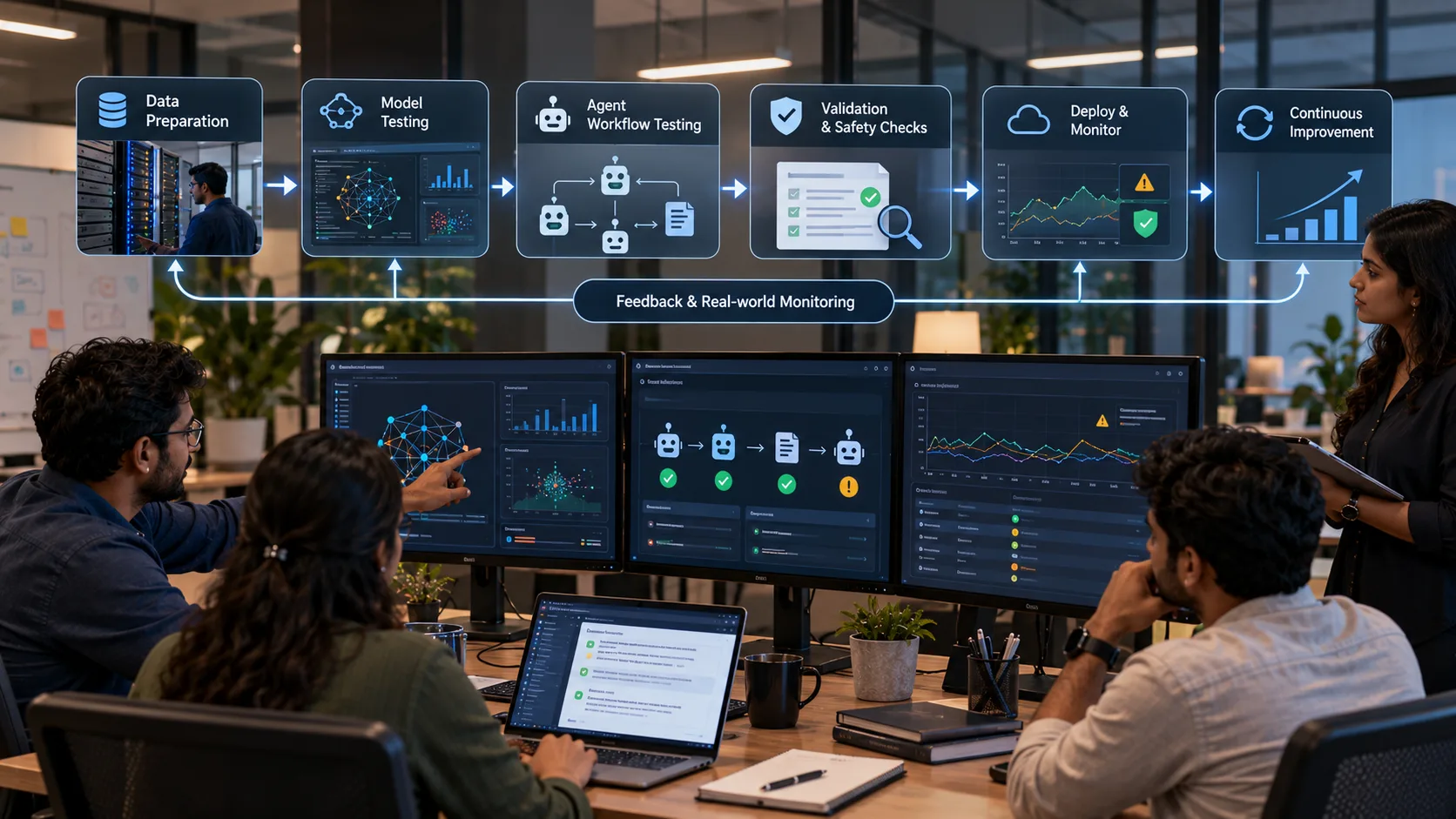
AI quality assurance intercepts these failures before they reach production. ICANIO builds Application Development and AI QA programs that span data validation, model testing and production monitoring. This guide explains why traditional software quality assurance falls short for AI, what makes AI software testing harder, and which practices and tools teams need.
Key Takeaways
- AI quality assurance tests probabilistic systems, so it validates ranges and behaviours rather than single expected values.
- Seven challenges make AI software testing harder: non-determinism, agent cascades, hallucinations, bias, drift, data quality and handoffs.
- Shift left testing brings QA into AI projects from the first sprint, starting with training data.
- Model drift detection and continuous monitoring are part of QA, not a separate operations task.
- Cross-functional teams and explainable audit trails are essential for regulated AI.
Traditional Software Quality Assurance vs AI Quality Assurance
Traditional software testing was designed for deterministic systems. The same input reliably produces the same output. Test cases check expected values. A system that passes its suite is considered ready. This works well for rule-based software, where correctness is binary and coverage is a useful proxy for reliability.
AI systems break these assumptions. They produce probabilistic outputs that vary across runs. They learn from data that changes over time. They show emergent failure modes that source code cannot predict. They also interact with other agents, where small deviations cascade downstream. AI software testing therefore needs a different methodology from traditional software quality assurance.
| Dimension | Traditional QA | AI quality assurance |
|---|---|---|
| Behaviour | Deterministic | Probabilistic |
| Test design | Fixed expected values | Rules, fairness criteria, ranges |
| Coverage | Code and branch coverage | Sampling, adversarial and edge inputs |
| Failure modes | Bugs with clear causes | Hallucination, bias, drift, cascades |
| After release | Error monitoring | Drift and output quality monitoring |
Why AI Software Testing Is More Complex in 2026
Seven specific challenges make AI software testing harder than traditional QA. Understanding each one is essential for an AI quality assurance program that catches real AI failure modes. Re-applying old test methods to new systems is not enough.
1. Non-Deterministic Behaviour
The same input may produce different outputs across runs. Traditional QA checks a single expected value. AI quality assurance must check accuracy and reliability across a distribution of outputs. Probabilistic tests ask whether responses fall within acceptable quality ranges. This shift from point validation to range validation needs new frameworks and new success criteria.
2. Agentic Complexity and Cascade Failures
Modern AI systems often use several agents in coordination. Each has its own decision logic, memory and actions. Testing must confirm that each agent works and that interactions stay stable across multi-step workflows.
A small issue in one agent can cascade across the whole workflow. These failures are often non-obvious, because they emerge from interaction patterns rather than from one component. Agentic testing needs realistic multi-agent simulations, explicit tests at handoff boundaries and checks that escalation logic works when confidence is low.
3. AI Hallucinations in High-Stakes Contexts
AI systems can produce confident but incorrect outputs, known as hallucinations. In healthcare, legal, financial and compliance settings, that risk differs from a conventional bug. AI quality assurance for these deployments should:
- Validate outputs against authoritative source documents.
- Enforce output schemas so failing responses never reach users.
- Route consequential outputs through human review.
- Run adversarial prompt tests that try to elicit wrong or harmful answers before go-live.
The OWASP Top 10 for LLM Applications is a useful checklist for these adversarial tests.
4. Bias and Fairness
AI systems learn from historical data that may reflect systemic bias. Without explicit fairness testing, a system can disadvantage people by region, gender, income or other characteristics. Usually this is not intentional. The bias sits in the training data, and the model learns it as a pattern.
Fairness testing runs structured demographic audits before and after deployment. It compares decision rates and accuracy across segments and flags significant gaps for human review. Open source tools such as Fairlearn support this work.
5. Model Drift
Model drift is the gradual decline in accuracy as real-world data diverges from training data. Researchers often call the underlying shift concept drift. A fraud model trained on older transaction patterns may underperform against new attack methods. A demand forecast may drift after a market disruption.
Drift is dangerous because it is silent. The model keeps producing outputs, the system keeps running and no error is logged. Only continuous model drift detection catches it before it causes real business impact.
6. Data Quality Validation
AI systems are only as reliable as their data, so AI quality assurance starts there. Poor data in training sets, inference inputs or agent context degrades performance regardless of model quality. AI quality assurance must validate data pipelines for completeness, schema consistency, distribution changes and degradation. Training data checks stop models learning from corrupted or biased data. Inference checks stop production systems acting on malformed or out-of-distribution inputs. This is where data engineering and QA overlap.
7. Human-AI Handoff Quality
Autonomous agents must recognise when a case exceeds their reliability threshold. They should then escalate to a human with useful context. Testing must confirm three things. The handoff triggers correctly. The context is accurate and complete. And the uncertainty information is passed on, not stripped away.
Poor handoffs turn AI into a liability. Reviewers who see AI summaries without confidence information tend to defer to them. That removes the oversight that makes human-in-the-loop designs valuable. Our guide to human in the loop AI covers handoff design in depth.

AI Quality Assurance: Modern Practices
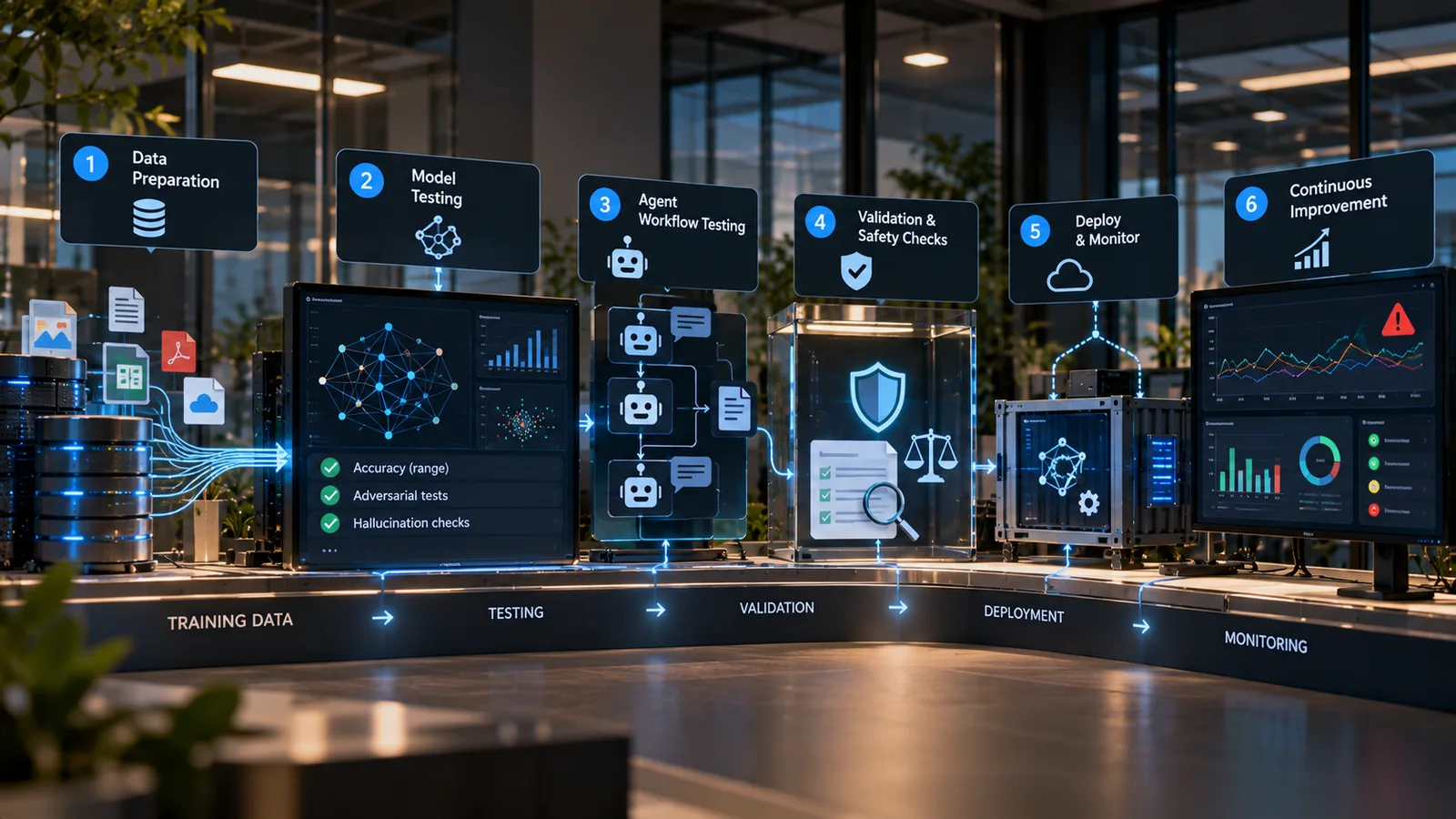
Effective AI quality assurance is not a phase at the end of development. It is a continuous discipline across the lifecycle, from data validation through model testing and integration to production monitoring. Modern programs build four capabilities that traditional software quality assurance does not cover.
Shift Left Testing: QA From Day One
Shift left testing in AI development means starting QA at the earliest stages. For AI systems, it includes:
- Validating training data before model training begins.
- Defining output quality rules and fairness criteria at the design stage.
- Setting monitoring and audit log requirements before deployment.
- Writing human handoff conditions as explicit design requirements.
Our team applies shift left testing as the default approach. We bring QA engineers into AI project teams from sprint one. Waiting until model evaluation is too late, because the most serious failures are already locked into the architecture by then.
Behavioural Testing
Behavioural testing checks whether AI systems follow defined rules for fairness, safety, privacy and accuracy. It does not compare outputs with fixed expected values. Instead, it defines properties that outputs must satisfy. Examples include output schemas, fairness thresholds, safety filters, accuracy ranges against ground truth and boundary conditions for agents.
The system is then tested against these properties across realistic inputs, not a curated demo dataset. This is what lets AI software testing give meaningful guarantees for outputs that cannot be listed in advance. Before releasing language model features, see our guide to LLM evaluation before deployment.
Continuous Monitoring and Model Drift Detection
AI quality assurance continues after deployment. Monitoring tracks performance against the baseline set during testing. It detects falling accuracy, shifting output distributions and new failure categories. Model drift detection compares current data distributions with training distributions using statistical tests. It aims to catch drift before accuracy drops significantly.
Production monitoring is not separate from QA. It is the QA function operating in production. ICANIO's support engineering services can run this monitoring for deployed AI systems.
Explainability and Audit Trails
AI systems should be able to explain the reasoning behind outputs in terms compliance teams, auditors and users can evaluate. Audit trails capture each significant decision, its inputs, its confidence level and any human review. This evidence supports obligations such as GDPR rules on automated decisions, HIPAA audit needs for healthcare AI and transparency duties under the EU AI regulatory framework. The NIST AI Risk Management Framework also offers a practical structure for this documentation.
Cross-Functional AI Quality Assurance Teams
AI quality assurance needs broad expertise across several roles. Effective teams in 2026 usually combine:
- QA engineers who design and run test strategies.
- ML engineers who understand model behaviour and training data.
- Data engineers who validate pipeline quality.
- Domain specialists who judge whether outputs are correct in context.
- Fairness and ethics specialists who run demographic audits.
No single role covers all of these. Programs that give quality to one function tend to miss failure types that need cross-functional insight.
AI Quality Assurance Tooling
Production AI quality assurance relies on tools beyond traditional unit test frameworks. The table below lists common options in a 2026 stack.
| Category | Example tools | Purpose |
|---|---|---|
| LLM output evaluation | RAGAS, DeepEval, TruLens | Response quality and grounding |
| Production monitoring | Evidently AI, Arize AI, WhyLabs | Model drift detection |
| Fairness testing | Fairlearn, AI Fairness 360 | Demographic audits |
| Schema and data checks | Pydantic, Great Expectations | Output and pipeline validation |
| Unit and integration | Pytest, unittest | Shift left testing foundation |
| Agent testing | LangSmith, custom harnesses | Workflow and handoff tests |
| Adversarial testing | Garak, PyRIT | Prompt injection and jailbreaks |
Tools only help when they sit inside a clear AI quality assurance strategy. Choose a small set, wire it into your CI/CD pipeline and expand as needs grow. Our continuous testing guide explains how to embed these checks in delivery pipelines.
AI Quality Assurance in DevOps and Cloud Pipelines
Artificial intelligence features ship through the same DevOps pipelines as other software development work. AI quality assurance should live there too. Run data checks and behavioural tests on every model or prompt change. Gate releases on evaluation scores, not just unit tests. Version datasets, prompts and models together, so any result can be reproduced.
Cloud platforms make this easier. Teams can spin up isolated evaluation environments, run large test batches in parallel and keep monitoring close to production traffic. The goal is simple: AI quality assurance becomes an automatic part of each release, not a manual review at the end.
Why AI Quality Assurance Is the Backbone of AI-Driven Development
A backbone does not perform the visible work of the body it supports. Yet nothing else works reliably without it. AI quality assurance plays the same role. It does not generate outputs or make decisions. It is the structural layer that makes AI systems trustworthy.
Without it, systems can produce unreliable outputs, biased decisions and compliance failures. With it, they become production-grade systems that organisations can build processes around.
The role of software quality assurance is also changing. QA teams once mainly wrote scripts and ran tests. Now they define quality objectives, oversee AI-generated results and check that automated decisions align with business priorities. That is a larger, more strategic role. Teams that treat AI QA as optional often learn its value through incidents and compliance findings instead.
Best Practices for AI Quality Assurance
Four practices tend to separate AI quality assurance programs that stay reliable from those that erode over time:
- Begin with shift left testing. Embed QA engineers from the first sprint. Treat data validation, output specs and monitoring requirements as design decisions.
- Design for explainability. Choose architectures that produce traceable reasoning. Build audit logging in from the start.
- Build in model drift detection. Treat production monitoring as part of QA, with owners, thresholds and response playbooks.
- Train cross-functional teams. Share QA responsibilities across QA, ML, data and domain experts.
How to Get Started
Start with one AI feature that carries real business risk. Define its quality properties, add behavioural and adversarial tests, then set up drift monitoring. Use what you learn to build a reusable AI quality assurance template for other teams. Our data and AI services team can help shape that first program. Pair it with an AI governance framework so quality and governance reinforce each other.
Conclusion
AI quality assurance is what turns impressive AI demos into dependable production systems. It handles non-determinism, hallucinations, bias, drift, data quality and handoffs, none of which traditional software quality assurance was built for. Shift left testing, behavioural tests and model drift detection form its core.
Machine learning and automation will keep changing how software is built. The teams that invest in AI software testing early will ship faster with fewer surprises. If you are planning or scaling AI features and want a second opinion on quality, contact ICANIO and our team will be glad to help.
References
- Software testing (Wikipedia)
- Concept drift (Wikipedia)
- OWASP Top 10 for LLM Applications
- Fairlearn
- NIST AI Risk Management Framework
- EU regulatory framework for AI
Frequently Asked Questions
How does AI quality assurance differ from traditional QA?
Traditional software quality assurance tests deterministic systems, where the same input always gives the same output. AI quality assurance deals with probabilistic behaviour, hallucinations, bias and model drift. It validates ranges and properties rather than exact values. It also continues after deployment, because AI behaviour can degrade without any code change.
Why is model drift detection important?
Model drift detection shows when accuracy is falling because real-world data has moved away from the training distribution. Drift is dangerous because it is silent. The system keeps running and producing outputs while quality degrades. Tools such as Evidently AI and Arize AI help teams spot drift before it causes significant business or user impact.
How are AI hallucinations reduced in production?
Teams reduce hallucinations with output evaluation frameworks such as RAGAS and DeepEval, schema enforcement with tools like Pydantic, guardrails that filter outputs and human review for high-stakes cases. Many organisations also keep generative features separate from safety-critical decisions. They apply stricter AI quality assurance standards to anything that reaches a regulated context.
What does a cross-functional AI QA team include?
A modern team usually includes QA engineers, ML engineers, data engineers, domain specialists and fairness or ethics specialists. QA engineers design test strategies. ML and data engineers understand models and pipelines. Domain experts judge whether outputs are correct in context. Fairness specialists run demographic audits. No single role covers every AI failure category alone.
Is AI quality assurance necessary for small organisations?
Yes. Small organisations can be more exposed to AI failures, because they often lack spare review capacity to catch errors before customers see them. Open source tools such as Pytest, Fairlearn, Pydantic and Evidently make shift left testing and production monitoring affordable. A focused program on the riskiest feature is a practical starting point.
What is shift left testing for AI systems?
Shift left testing for AI means starting quality work before any model is trained. Teams validate training data, define output rules and fairness criteria, and set monitoring and handoff requirements during design. This catches problems while they are cheap to fix. It also gives AI software testing clear targets once the model and application are built.