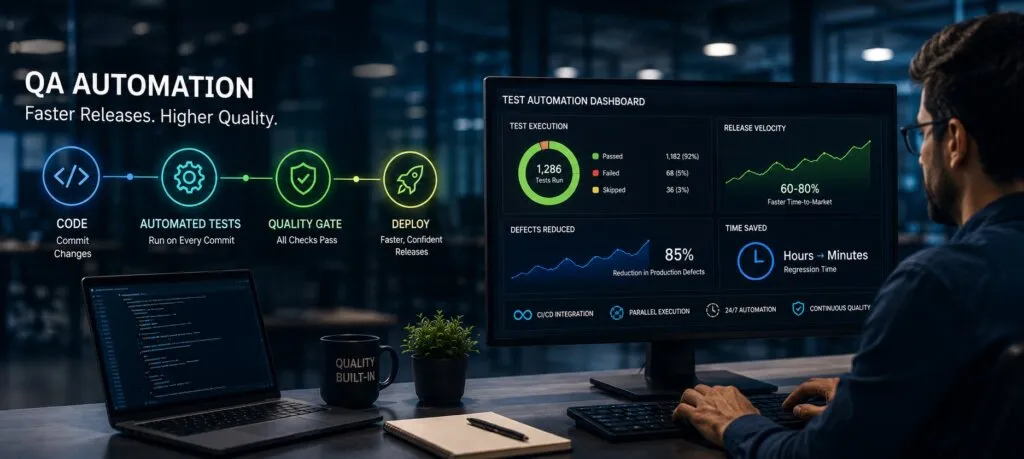
QA automation has become the core answer for engineering teams under pressure to ship faster without lowering quality. Customers expect frequent updates and smooth experiences. Traditional manual testing slows releases and adds risk through delayed feedback. In 2026, the fastest and most reliable teams are not the ones with the largest QA headcounts. They are the teams that build test automation into their pipelines, enforce quality checkpoints at every stage, and treat quality as an accelerant rather than a brake.
ICANIO's Application Development practice builds these programs for enterprise clients. The work covers test automation strategy, CI/CD integration, quality gates and AI-assisted test generation. This guide explains how QA automation removes testing bottlenecks, where time savings accumulate, which tool decisions matter most, how quality gates work and which adoption mistakes to avoid.

Key Takeaways
- QA automation moves validation from the end of the release cycle to every commit.
- Time savings come from four levers: continuous regression testing, parallel execution, round-the-clock runs and release confidence.
- A sound test automation strategy follows the test pyramid, with many unit tests and few end-to-end tests.
- Quality gates turn test results into enforced standards that deadline pressure cannot bypass.
- AI-assisted test generation speeds up coverage but does not replace testing discipline.
What Is QA Automation?
QA automation is the practice of using software to run tests, compare results with expectations and report outcomes without manual steps. It is a core part of test automation in modern software development. Tests run on every change, in every environment, as often as needed.
QA automation does not remove the need for people. It removes repetitive execution work. Testers then spend more time on exploratory testing, risk analysis and test design. For a fuller comparison, see our guide to manual vs automation testing.
How QA Automation Eliminates Testing Bottlenecks
Manual testing time is one of the main reasons software releases slip. QA automation removes this bottleneck with fast, consistent and repeatable test execution at every pipeline stage. Automated suites often finish in minutes for checks that once took days of manual effort. More importantly, they run automatically on every code change. That removes the waiting time between development and validation.
This is a structural change in how teams work. The quality gate moves from the end of the cycle to every commit. Defects surface while the developer still has full context to fix them. Without QA automation, they often appear weeks later during a regression testing run. Our teams build frameworks that deliver this commit-level feedback without adding manual overhead to releases.
Four Ways QA Automation Accelerates Time-to-Market
QA automation compresses the release cycle by removing human wait time from the critical path. The savings come from four mechanisms.
1. CI/CD Testing: Continuous Regression Coverage
Automated suites run on every commit through CI/CD testing pipelines, not just at sprint end. Defects are caught within minutes of introduction. That is when they are cheapest to fix. Manual regression testing at the end of a two-week sprint finds the same defects later. By then, fixing them may need cross-team coordination, documentation and another test round before release approval.
2. Parallel Test Execution
A manual tester works in one environment at a time. QA automation can run suites at once against development, staging and pre-production environments. A well-designed CI/CD testing architecture can shrink multi-day validation into a much shorter window. This matters most for distributed teams across time zones. There, manual handoffs between teams add days to every release.
3. Continuous Round-the-Clock Execution
Automated tests run overnight, on weekends and on public holidays without extra staffing. Builds that would wait for the next working day's manual sign-off can ship when they are ready. For distributed teams in several countries, this removes predictable holiday bottlenecks.
4. Faster Release Confidence
When a CI/CD testing pipeline stays green across all automated checks, teams gain confidence to release on demand. They no longer need to wait for a scheduled release window. That confidence comes from breadth and reliability. Fast, stable and comprehensive tests build trust. Brittle tests that fail intermittently erode it.
Test Automation Strategy: Tool Selection
Tool selection is one of the most important decisions in any QA automation program. The wrong tool creates a maintenance burden that can exceed its time savings. The right tool fits your architecture, team skills and release cadence. It then compounds in value as the suite grows.
| Testing level | Example tools | When to use |
|---|---|---|
| Unit | Jest, PyTest, JUnit | Every function and component |
| API | Postman, Karate, REST-assured | All backend services and contracts |
| E2E and UI | Playwright, Cypress | Critical user journeys only |
| Performance | k6, Gatling, JMeter | Before releases of latency-sensitive services |
| Security | ZAP, Semgrep, Snyk | Every build |
| AI-assisted generation | Diffblue Cover, Qodo | New features and legacy gaps |
A healthy test automation strategy follows the practical test pyramid. It has a large base of unit tests, a moderate layer of integration and API tests, and a thin layer of end-to-end tests. Over-relying on E2E tests is the most common structural mistake. They are slow, brittle at scale and costly to maintain.
The most reliable QA automation frameworks have many fast, stable unit tests. They keep a small number of carefully maintained E2E tests for genuinely critical paths. For browser tests, the Playwright documentation is a good starting point. For security checks, the open source ZAP project is widely used in pipelines.

Quality Gates: Enforcing Standards at Every Commit
Quality gates are automated checkpoints in the CI/CD testing pipeline. They enforce a defined standard before code moves to the next stage. They turn QA automation from an advisory report into an enforcement mechanism.
What Quality Gates Enforce
A well-designed configuration usually covers four categories:
- Test pass rate thresholds. If the pass rate falls below the agreed level, the pipeline fails. No one can override it without changing the policy itself.
- Code coverage floors. New code must not reduce overall coverage below the agreed minimum.
- Performance regression limits. Builds are flagged when response times rise beyond a set threshold compared with baseline.
- Security scan gates. Critical or high-severity findings block deployment, while medium findings raise tickets automatically.
Why Quality Gates Matter
Without quality gates, standards erode under deadline pressure. When "ship now and fix later" competes with "hold for review", quality usually loses. Quality gates make the standard automatic. They apply regardless of deadlines or the seniority of the person asking for an exception. That is how QA automation protects quality while speeding delivery.
Measuring QA Automation Impact
Our team recommends measuring QA automation with a small set of delivery metrics. Capture a baseline before you start, then track the trend. The DORA research program offers a widely used set of delivery performance measures.
| Metric | Manual baseline pattern | Mature automation pattern |
|---|---|---|
| Regression duration | Days of manual effort | Minutes to hours, automated |
| Release frequency | Scheduled windows | On demand |
| Defect leakage | Found after release | Caught in the pipeline |
| Feedback time | End of sprint | Commit level |
| QA capacity | Mostly regression runs | Exploratory and risk testing |
Your own numbers matter more than industry averages. Measure them consistently, and the business case for QA automation becomes clear.
AI-Powered Test Generation
AI-assisted test generation tools analyse source code and write unit and integration tests. They speed up coverage on new features and help close gaps in legacy codebases. These tools use machine learning and artificial intelligence as productivity multipliers. They work on top of a solid test automation strategy, not in place of one.
They are most useful where test writing has been de-prioritised under delivery pressure. In legacy Java and Python codebases, AI-generated tests can establish baseline coverage quickly. Teams do not need to pause feature delivery while suites are backfilled by hand. Combined with quality gates, this offers a practical path from minimal QA automation to a mature setup.
Review generated tests carefully. A test that asserts current behaviour can lock in an existing bug. Engineers should check each generated test for meaningful assertions.
Common QA Automation Adoption Mistakes
Adopting QA automation takes more than buying tools and assigning a team to write tests. Successful programs rest on a clear quality strategy, a well-structured test architecture, enforced quality gates and steady engineering discipline. Teams that treat automation as a one-time project often end up with a suite that is harder to maintain than the manual testing it replaced.
These are the failure modes our team sees most often:
- Over-indexing on E2E tests. This is the most common structural mistake, as described above.
- Automating unstable tests. Flaky tests undermine confidence in the whole program. Engineers learn to ignore red pipelines, which is exactly the wrong habit.
- Treating automation as a separate phase. A test automation strategy works best when QA engineers join development teams from sprint one. They write tests alongside feature code.
- Neglecting suite maintenance. Tests get harder to maintain as codebases grow. Refactoring, documentation and architecture reviews need an explicit budget.
Quality gates that enforce coverage and pass rates help surface suite decay early. They catch it before the whole suite needs a rewrite. We treat maintainability and coverage depth as first-class deliverables in every project.

QA Automation in Regulated Industries
Regulated industries such as healthcare, fintech and legal technology have extra QA requirements. Regulated products often need documented evidence of test coverage and quality review for audits. QA automation in these settings must produce structured test reports, not just pass or fail statuses.
Our teams build frameworks that produce audit-ready documentation as a standard CI/CD testing output. It is not assembled by hand before a compliance review. Where regulators expect continuous quality review, periodic manual regression testing is structurally inadequate. Automated coverage, quality gates and detailed reporting together create a compliance-grade QA record.
This also matters in procurement. Enterprise buyers in regulated sectors increasingly ask partners to show automated coverage and quality gate implementation. Our continuous testing for CI/CD guide covers pipeline design in more depth.
How to Build the Business Case for QA Automation
Engineering leaders usually need a business case framed in time savings, defect reduction and capacity reallocation. The strongest cases combine three evidence types:
- The current cost of manual regression testing, in engineering hours per release.
- The current defect leakage rate and the cost of each production defect in incident response and customer impact.
- The expected change in release frequency that QA automation would enable.
The capacity argument often carries as much weight as time savings. When QA engineers spend most of their time running manual regression scripts, little is left for exploratory testing, performance analysis or security validation. Automating the repetitive layer frees that capacity for work that tooling cannot replace.
Our team designs programs to show measurable progress early. That gives leadership the evidence it needs before committing to larger investment. A risk-based testing approach helps decide what to automate first.
Where to Start
Start where regression pain is greatest. Pick one critical service or user journey. Automate its regression testing, wire it into CI/CD testing and add a simple quality gate. Then expand step by step. Our API performance testing platform case study shows a related build. Skills frameworks from bodies like ISTQB can help structure team training.
Test Data and Environments: The Hidden Dependency
Many QA automation programs stall on test data and environments, not on tools. Tests need predictable data to give predictable results. Shared environments that drift out of sync cause failures that have nothing to do with the code under test.
Our team recommends three practices. First, create test data inside each test run, or load it from versioned fixtures. Second, provision environments from code, using containers or cloud templates, so each run starts clean. Third, isolate external services with stubs or contract tests where possible. These steps reduce flaky results and keep regression testing trustworthy.
Environment work is often where DevOps and QA meet. Treat it as part of the test automation strategy from the start, with a named owner and a budget.
How ICANIO Supports QA Automation Programs
ICANIO brings QA automation into delivery through two practices. Our application development services embed test engineers in product teams. Our DevOps and cloud engineering services build the pipelines, environments and observability that make automated testing fast and reliable. Together they cover strategy, tooling, quality gates and ongoing maintenance.
Conclusion
QA automation is one of the most reliable ways to reduce time-to-market without trading away quality. It moves feedback to every commit, runs tests in parallel and around the clock, and gives teams confidence to release on demand. A sound test automation strategy and enforced quality gates keep that speed sustainable.
The key is discipline. Follow the test pyramid, fix flaky tests fast and budget for maintenance. If you want help designing or scaling QA automation for your product, contact ICANIO and our team will be glad to talk.
References
- Test automation (Wikipedia)
- The Practical Test Pyramid (Martin Fowler)
- Playwright documentation
- ZAP by Checkmarx
- DORA research program
- ISTQB
Frequently Asked Questions
How much faster does QA automation make release cycles?
It depends on your starting point. Regression suites that take days to run by hand can often run in minutes or hours once automated. Release frequency can then move from scheduled windows toward on-demand releases. The best way to know is to measure your current regression time and release frequency, then track them as QA automation matures.
Which automated testing tools should teams start with?
Start where regression pain is greatest. For UI and E2E testing, Playwright is a strong choice. For API testing, consider Postman or Karate. For unit testing, use the framework native to your language, such as Jest, PyTest or JUnit. Integrate CI/CD testing from day one so tests run on every commit rather than manually.
What is a quality gate and do we need one?
A quality gate is an automated CI/CD testing checkpoint that blocks a build when it fails a defined standard. Common standards include test pass rate, code coverage, performance regression and security findings. Without quality gates, standards tend to erode under deadline pressure. With them, quality is enforced automatically on every release, whoever is asking for an exception.
What is the biggest mistake in QA automation adoption?
The most common mistake is over-relying on E2E tests at the expense of unit tests. E2E tests are slow, brittle at scale and expensive to maintain. A healthy test automation strategy follows the test pyramid: a large base of unit tests, a moderate integration layer and a thin E2E layer for critical journeys only.
How do AI tools like Diffblue or Qodo fit into QA automation?
They analyse source code and write tests automatically. That speeds up coverage on new features and helps close gaps in legacy codebases. Treat them as productivity multipliers on top of a solid test automation strategy. Review every generated test, because a test that simply mirrors current behaviour can lock in existing bugs.
Does QA automation replace manual testers?
No. QA automation replaces repetitive execution, not human judgment. Testers still design test cases, explore new features, assess risk and review usability. In most teams, automation frees testers from repetitive regression testing so they can focus on higher-value work. The strongest programs combine automated checks with skilled exploratory testing.