Quality engineering has become the defining shift in how enterprise software teams think about quality. Traditional QA asked one question: does it work? Quality engineering asks a different one: how do we make sure it does not break? The framing reflects a deeper structural change. Traditional testing was a phase at the end of development, run by a separate team whose job was to find bugs before release. Quality engineering is an engineering discipline embedded across the whole software development lifecycle, from planning and design to coding, deployment and production monitoring. The result is not just fewer defects. It is a more reliable delivery process.
At ICANIO, our team builds quality engineering programs that combine shift left testing, continuous testing, test automation and DevOps quality gates from the first sprint. This guide covers the core differences from traditional QA, why enterprises are moving, how to implement the change, the challenges to plan for, and how to measure success.

Key Takeaways
- Traditional QA is reactive and phase-based; quality engineering is proactive and spans the whole lifecycle.
- Shift left testing and continuous testing are the practices that make quality engineering work at modern release speeds.
- Six pressures drive the shift: release cadence, defect leakage, user expectations, complex architectures, efficiency and competition.
- Start small: automate high-value regression tests, wire them into CI/CD, then upskill and embed QE engineers in squads.
- Measure outcomes such as defect leakage, deployment frequency and recovery time, not just test counts.
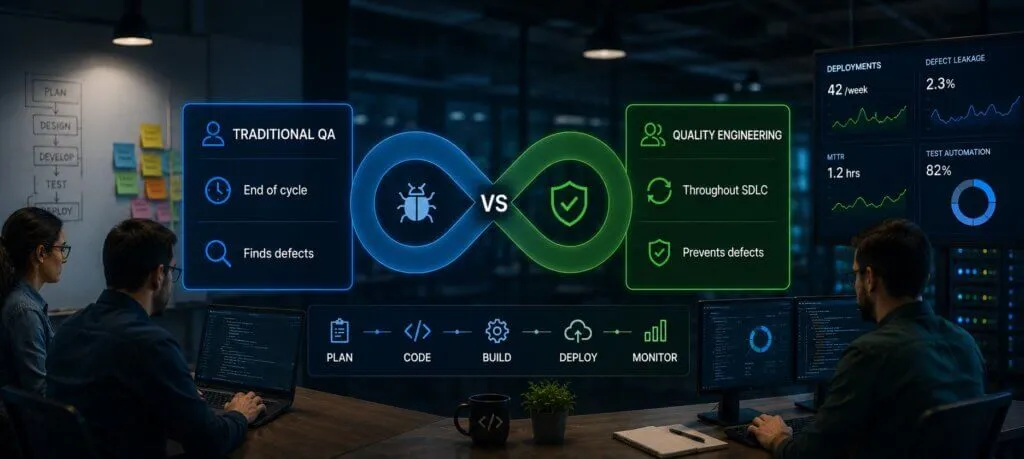
Traditional QA vs Quality Engineering: Core Differences
The table below shows where traditional QA and quality engineering differ. It is the starting point for any enterprise deciding whether and how to modernise.
| Dimension | Traditional QA | Quality engineering |
|---|---|---|
| Timing | End of cycle | Whole lifecycle |
| Goal | Find bugs | Prevent bugs |
| Team | Separate QA team | Embedded in squads |
| Method | Manual regression | Automated, in CI/CD |
| Feedback | Days | Minutes |
| Metrics | Defect counts | Leakage, MTTR, frequency |
What Is Traditional QA?
Traditional QA evaluates software against defined requirements and standards before release. It focuses on finding defects in the completed product, usually in the final stage before deployment. It works reactively. Its input is finished code. Its output is a list of defects or a sign-off.
Traditional QA has real strengths in stable environments. When requirements are fixed, cycles are long and changes are rare, end-of-cycle regression gives a reliable checkpoint.
The weaknesses appear in modern delivery. In Agile and DevOps teams that ship every sprint or every day, the model cannot keep up. Defect leakage rises as test windows shrink. The separate team adds hand-off overhead between developers and testers. Because defects are found late, they cost more to fix and are more likely to delay release.
What Is Quality Engineering?
Quality engineering is a proactive approach that embeds quality practices into every stage of the lifecycle. Rather than testing the end product, it aims to stop defects from entering the product at all. Quality becomes a first-class engineering responsibility, not a downstream activity.
Quality engineering rests on four practices:
- Shift left testing. Testing moves earlier: tests are written with code, static analysis runs during design, and requirements are validated before build.
- Continuous testing. Automated tests run in CI/CD pipelines on every commit, without manual steps.
- Cross-functional ownership. Quality engineers sit in product squads with developers, product managers and DevOps engineers.
- Data-driven quality. Teams track defect leakage, recovery time, deployment frequency and automation coverage.
Shift left testing and continuous testing are what make quality engineering viable at daily or weekly release frequencies. Without them, quality engineering is a slogan.
Why Enterprises Shift to Quality Engineering: 6 Drivers
Six structural pressures push enterprises from traditional QA toward quality engineering. Each one is common across industries.
1. Faster Release Cadence
Agile and DevOps release cadences make manual end-of-cycle regression incompatible with business needs. Continuous testing through automation is the practical way to support frequent releases without adding testers in proportion.
2. Lower Defect Leakage
Shift left testing finds issues early, when they are cheaper to fix. It is widely accepted in software engineering that defects found later, especially in production, cost more to fix than those caught during development. In regulated environments the cost goes further. A production defect can trigger audit findings and remediation work well beyond the code change.
3. Higher User Expectations
Users expect fast, reliable and accessible experiences on every device. Quality engineering covers functional and non-functional quality. Performance tests keep applications responsive under load. Accessibility tests check alignment with WCAG. Security tests in the pipeline, guided by resources such as the OWASP Web Security Testing Guide, catch vulnerabilities early. Traditional QA often treats non-functional testing as optional or periodic.
4. Complex Architectures
Cloud-native and microservice systems need API testing, contract testing and chaos experiments. Traditional testing teams were not designed for these. Quality engineering teams are built with them from the start.
5. Resource Efficiency
Quality engineering uses automation to multiply the output of smaller teams. Organisations can maintain or improve coverage without matching headcount growth.
6. Competitive Pressure
Many leading technology organisations publicly describe engineering cultures where developers own quality and testing is automated. Enterprises that stay with traditional QA while competitors modernise risk falling behind on delivery speed and reliability.

Quality Engineering Benefits: Defect Leakage and Velocity
The benefits of quality engineering compound as automation coverage grows and shift left testing becomes habit.
Faster time to market is often the first visible benefit. Continuous testing runs alongside development. It removes the sequential hand-off between development and testing that creates waiting time in traditional QA.
Lower defect leakage is the most important operational benefit. Fewer bugs reach production. That means fewer complaints, fewer emergency hotfixes and more stable products.
Developer productivity improves too. When developers get test results within minutes, they fix issues with full context. They are not interrupted days later by a bug report about code they have forgotten.
Finally, quality decisions become data-driven. Coverage, recovery time and deployment frequency replace gut feel. Teams can see whether their quality engineering investment is working. Our guide on how QA automation reduces time to market explores the speed side in more depth.
How to Implement Quality Engineering: Where to Start
Quality engineering does not need to arrive all at once. A phased plan shows value quickly and builds skills and infrastructure step by step.
- Automate high-value regression tests. Pick the manual cases that fail most often and matter most when they fail.
- Wire them into CI/CD. Run them on every commit to gain shift left testing benefits early.
- Upskill the QA team. Build skills in programming, CI/CD tooling, API testing, performance and analytics.
- Embed quality engineers in squads. Move quality ownership from a central team to the teams that write the code.
- Expand coverage. Add performance, security, accessibility and contract tests over time.
Our team shapes upskilling around the specific tool and skill gaps in each team. Hands-on project work combined with structured learning builds practical capability rather than theory. For help choosing what to automate first, see our guides on manual vs automation testing and risk-based testing.
Use the Test Pyramid
Most quality engineering programs follow some version of the test pyramid. Many fast unit tests sit at the base. Fewer integration and API tests sit in the middle. A small number of end-to-end UI tests sit at the top. Martin Fowler's practical test pyramid is a clear reference. Keeping the pyramid in shape keeps pipelines fast and reduces flaky tests.
Challenges in Adopting Quality Engineering
Every quality engineering transition meets the same obstacles. Planning for them early saves months.
Cultural resistance is the biggest. Developers may resist owning quality. Manual testers may feel threatened by automation. Strong leadership and change management are essential. The message should be clear: quality engineering does not replace QA professionals. It evolves their role into a more technical and more influential one.
Skill gaps come next. Quality engineers need programming, cloud, CI/CD and data skills. Building them takes time and sustained investment.
Legacy systems are the third challenge. Many older systems were not built for testability. Retrofitting automated tests is hard and needs a phased modernisation plan.
Tool sprawl is the fourth. The tooling market is huge. Without governance, teams pick overlapping tools and the program fragments.
Test suite maintenance is the fifth. Suites get harder to maintain as code grows. Flaky or slow pipelines erode trust in the whole program. Frameworks need ongoing care, not just initial setup.

Metrics for Measuring Quality Engineering Success
Measure quality engineering with outcome metrics, not proxies that can improve while real quality slips.
- Defect leakage rate: bugs that reach production. It is the most direct test of whether shift left testing works.
- Deployment frequency: how often code ships. Rising frequency with stable or falling defect leakage is strong evidence that continuous testing works.
- Mean time to recovery (MTTR): how fast the team restores service after an incident.
- Change failure rate: the share of releases that cause problems.
- Lead time for changes: time from commit to production.
- Automation coverage: the share of critical paths covered by automated tests.
Several of these match the DORA software delivery metrics described on dora.dev. Using a shared, well-known set makes progress easier to compare over time.
Quality Engineering Maturity Stages
Adoption usually follows a recognisable path. The table summarises five stages.
| Stage | Typical state | Next step |
|---|---|---|
| Initial | Manual testing only | Automate key regressions |
| Developing | Some automation in CI | Enforce quality gates |
| Defined | Test pyramid, gates on every commit | Track metrics |
| Managed | Metrics drive investment | Cut defect leakage further |
| Optimising | Org-wide discipline | AI-assisted testing, chaos tests |
At the optimising stage, quality engineering is shared across the organisation. Artificial intelligence and machine learning help generate tests, prioritise suites and spot flaky tests. Our article on AI quality assurance covers this in detail.
Most enterprises starting the move from traditional QA sit at the initial or developing stage. Our team structures adoption around a clear maturity model with defined milestones. Leaders can then track progress toward the defined and managed stages, where the main quality and velocity benefits appear.
Roles in a Quality Engineering Team
Quality engineering changes who does what. The job titles vary between companies, but most mature teams share a similar set of responsibilities.
- Quality engineer (SDET). Designs test strategy for a squad, writes automation frameworks and coaches developers on testability.
- Developers. Write unit and integration tests with their code and fix failures as soon as the pipeline reports them.
- Performance engineer. Designs load and stress tests and helps set performance budgets.
- Security champion. Brings security testing into the pipeline and triages findings with the team.
- Product owner. Defines acceptance criteria clearly, so tests can be written before or with the code.
The important change is shared ownership. In traditional QA, the test team owns quality and developers hand work over. In quality engineering, everyone in the squad owns quality, and the quality engineer acts as a specialist and coach.
This also changes career paths. Manual testers who learn programming, API testing and pipeline tooling often become some of the most valuable people in the squad. They bring deep product knowledge and a tester's instinct for edge cases. Our team recommends investing in these people rather than replacing them. Their domain knowledge is hard to hire, and it makes the shift to quality engineering faster and safer.
Quality Engineering and DevOps
Quality engineering and DevOps reinforce each other. DevOps provides the pipelines, environments and automation. Quality engineering provides the tests, gates and metrics that make fast pipelines safe. Without quality engineering, faster pipelines ship bugs faster. Without DevOps, quality engineering lacks the infrastructure to run continuous testing at scale.
Our article on continuous testing in CI/CD shows how the two connect in practice. ICANIO's DevOps and cloud engineering services and application development services bring both disciplines together.
Conclusion
The difference between traditional QA and quality engineering is the difference between finding bugs and preventing them. Traditional QA still has a place in stable, slow-moving systems. For modern software development at enterprise scale, quality engineering is the more reliable model.
Start small. Automate the tests that matter most, run them on every commit, and grow skills and coverage from there. Measure defect leakage and delivery speed, and let the data guide the next investment.
If you are planning a move from traditional QA to quality engineering, contact ICANIO to discuss where to begin.
References
- Wikipedia: Shift-left testing
- Wikipedia: Continuous testing
- W3C: WCAG standards and guidelines
- OWASP Web Security Testing Guide
- DORA: Software delivery performance metrics
- Martin Fowler: The Practical Test Pyramid
Frequently asked questions
How does traditional QA differ from quality engineering?
Traditional QA is reactive. It tests the product after development to find bugs before release. Quality engineering is proactive. It builds quality practices into every stage of the lifecycle, from planning to production. Traditional QA asks whether the software works, while quality engineering asks how to make sure it does not break in the first place.
Does quality engineering mean eliminating the QA team?
No. Quality engineering evolves the QA role rather than removing it. Instead of a separate testing team, quality engineers join cross-functional squads. Their skills expand to test automation, CI/CD tooling, performance engineering and data analysis. Quality becomes a shared responsibility, and experienced testers often become the people who design the strategy and coach developers.
What is shift left testing and why does it matter?
Shift left testing moves testing earlier in the development process. Engineers write tests alongside code, run static analysis during design and validate requirements before building. Defects found earlier are generally cheaper and faster to fix. The team also gets quicker feedback, which shortens delivery cycles and reduces the risk of late surprises before release.
How long does a quality engineering transition take?
It depends on system complexity, team skills and legacy constraints. Many enterprises plan a phased transition over one to two years. The usual sequence is to automate high-value tests, integrate them into CI/CD, upskill teams, then embed quality engineers in squads. Legacy systems and cultural resistance are the factors most likely to extend the timeline.
What metrics measure quality engineering success?
Useful metrics include defect leakage rate, deployment frequency, mean time to recovery, change failure rate, lead time for changes and automation coverage. Track them over time rather than as snapshots. Together they show whether quality is genuinely improving, or whether the team is simply running more tests without better outcomes for users.
Is continuous testing the same as test automation?
Not quite. Test automation means tests run without manual effort. Continuous testing means those automated tests run on every change as part of the delivery pipeline, with results acting as quality gates. You can have automation without continuous testing, but you cannot have continuous testing without automation. Quality engineering needs both working together.