Generative AI for enterprise has crossed the threshold from pilot project to operational backbone. It now appears in banking, healthcare, manufacturing, retail and logistics. For technology leaders, the question is no longer whether to adopt generative AI for enterprise. The question is how to deploy it at scale, with governance, integration depth and measurable business outcomes. ICANIO, a B2B AI and software development company, designs, builds and deploys generative AI solutions that connect directly to those outcomes.
Enterprise AI transformation is no longer driven by curiosity. Reports such as the Stanford HAI AI Index track rapid growth in corporate AI investment and adoption. For mid-market and enterprise companies, the challenge has shifted. It is now about production readiness, governance and return on investment. Our team brings together data and AI, application development, DevOps and cloud engineering, and MLOps to help organisations make that shift.
Key Takeaways
- Generative AI for enterprise means LLMs and multimodal models embedded in business systems with security and guardrails.
- The strongest results come from five domains: documents, customer experience, code, synthetic data and knowledge search.
- Generative AI use cases differ by industry, so start where manual, unstructured work is heaviest.
- AI operations automation handles unstructured inputs that traditional RPA cannot.
- A sound enterprise AI strategy runs from discovery to governed production in clear stages.
What Is Generative AI for Enterprise?
Generative AI for enterprise is the deployment of large language models, diffusion models and multimodal systems inside business environments. These models create text, code, images, structured data and synthetic content at scale. The underlying technology is described well in the Wikipedia entry on generative artificial intelligence.
Narrow models are trained for a single classification or prediction task. Generative models are different. They produce new outputs in response to natural language instructions. Those outputs include drafted documents, working code, summarised reports and personalised customer replies.
In practice, a financial services firm can automate parts of regulatory document review. A logistics operator can generate shipment commentary in real time. A healthcare platform can draft clinical notes for clinician review under HIPAA-ready controls.
How Enterprise Deployments Differ From Consumer Tools
The common thread is large language model capability combined with enterprise-grade guardrails. Security, access control and integration with CRMs, ERPs and data warehouses are what separate generative AI for enterprise from a consumer chat tool.
At ICANIO, projects usually follow one of three delivery patterns:
- LLM integration into existing enterprise applications.
- Custom fine-tuning on proprietary business data.
- Agentic workflows where several models collaborate on multi-step business processes.
Enterprise AI Transformation: Reshaping Operations in 2026
Enterprise AI transformation in 2026 is playing out across five domains where generative AI for enterprise delivers. Each represents a distinct application pattern. Each has different technical requirements, integration depth and governance needs.
1. Intelligent Document Processing
Teams use generative AI for enterprise document work: contracts, invoices, compliance documents and customer emails. Traditional RPA and OCR tools struggle with this volume and variety. Embedding LLMs into document workflows reduces manual review time while keeping audit trails intact.
Our engineers typically build these pipelines with Python and orchestration libraries such as LangChain. Model choice depends on data sensitivity: hosted models where policy allows, open-weight models such as Llama where data must stay in-house. This domain is especially valuable for banking and legal teams with heavy compliance documentation.
2. AI-Augmented Customer Experience
Generative AI for enterprise enables a new class of customer interaction in retail, banking and telecom. Scripted chatbots are giving way to conversational systems that understand context and keep session memory. They draw on product catalogues, CRM history and policy databases to generate personalised answers.
Multilingual support is a common requirement. A well-designed assistant can serve customers across time zones from one platform. Our post on conversational AI explores this pattern further.
3. Code Generation and Developer Productivity
Software teams often see some of the fastest gains from generative AI for enterprise. Coding is a natural first step for many organisations. Useful capabilities include:
- Code suggestions inside the IDE and pull request reviews.
- Automatic documentation and test case generation.
- Intelligent code review inside CI/CD pipelines.
Used well, these tools free senior engineers to focus on architecture and domain-critical problems. They are especially helpful for teams managing large, complex codebases. Human review remains essential, because generated code can be wrong in subtle ways.
4. Synthetic Data Generation
Labelled training data is a persistent bottleneck in enterprise AI development, and generative AI for enterprise can help. Generative models can produce synthetic data that mirrors real distributions without exposing sensitive records.
This matters where GDPR or data sovereignty rules limit the use of real customer data in training. Synthetic data can run as a standalone service or as part of a broader MLOps program. It still needs validation, because synthetic sets can carry over bias from their source data.
5. Knowledge Management and Enterprise Search
Knowledge search is one of the most practical uses of generative AI for enterprise. Many enterprises hold decades of manuals, regulatory filings and institutional knowledge. Generative AI makes that knowledge retrievable. Retrieval-augmented generation lets employees ask questions in plain language. They receive answers grounded in, and linked to, internal sources.
For manufacturing and field service teams, RAG on top of engineering documentation can shorten time to resolution. It also speeds up onboarding for new technical staff. See our guide to retrieval augmented generation for architecture details.
Generative AI Use Cases Across Key Industries
Generative AI use cases vary by industry, and so does the shape of generative AI for enterprise. Data types, compliance obligations and workflow patterns all shape what works. The table below summarises common starting points.
| Industry | Generative AI use cases | Target outcome |
|---|---|---|
| Banking | Contract review, credit memos | Faster compliance |
| Healthcare | Clinical notes, patient summaries | Less admin load |
| Manufacturing | Maintenance reports, defect analysis | Faster root cause |
| Retail | Product copy, returns handling | Lower content cost |
| Logistics | Delay notices, customs drafts | Faster exceptions |
| Education | Content and assessment drafts | Personalised learning |
These generative AI use cases are good starting points for enterprise AI transformation. The right choice depends on existing data infrastructure, compliance obligations and which workflows carry the heaviest manual burden. Our team maps these factors in discovery before recommending a roadmap.
Choosing the First Use Case
A strong first generative AI for enterprise use case has four traits. The work is high volume. The inputs are mostly unstructured. Errors are easy to catch with human review. And the data needed is already accessible. Our gen AI use cases guide lists more examples by function.
AI Operations Automation: Practical Applications
AI operations automation applies generative and agentic AI to repetitive, high-volume operational work. This is work that consumes human effort without producing proportionate strategic value.
It is one of the most practical forms of generative AI for enterprise, and it differs from traditional robotic process automation. RPA needs structured data and rigid rules. AI operations automation handles unstructured inputs such as free text, complex documents and conversational queries. That is why it suits healthcare, banking and logistics, where most work involves unstructured information.
Agentic Workflows
The most advanced form of AI operations automation is the agentic workflow. Here several models collaborate on a multi-step process with limited human intervention.
A typical architecture looks like this:
- A planning model decomposes the task.
- Specialist models handle individual subtasks.
- A verification model checks the outputs.
- A human approves high-stakes results before release.
Common use cases include research synthesis, compliance document assembly and customer onboarding paperwork. This is what enterprise AI transformation looks like when it moves beyond single LLM calls. Our article on agentic AI architecture goes deeper.
Integration Architecture
Effective AI operations automation needs tight integration with systems of record. CRM integration powers customer-facing AI. ERP integration supports operational and financial workflows. Document management integration feeds knowledge retrieval.
Our integration engineers connect generative AI for enterprise workflows to existing middleware. Clients keep infrastructure that took years to build. Good integration also brings automation benefits to DevOps, because the same pipelines that deploy services can deploy and monitor models.
Enterprise AI Strategy: A Practical Roadmap
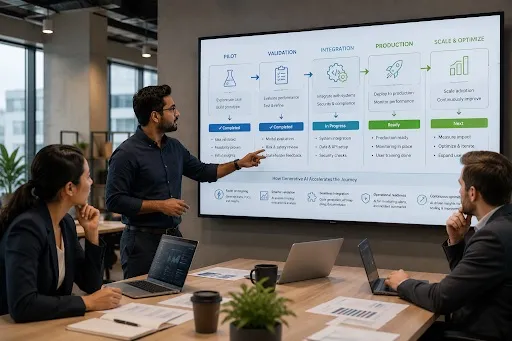
A sound enterprise AI strategy moves from opportunity identification through architecture to production and ongoing governance. It is not a single document or a one-time planning exercise. It is a living capability that aligns AI investment with the highest-value outcomes.
An effective enterprise AI strategy also manages the risks production AI introduces. And it builds the organisational muscle to iterate on early deployments. We structure the work in five stages.
| Stage | Main activity | Key output |
|---|---|---|
| 1. Discovery | Map workflows and data | Ranked use case backlog |
| 2. Architecture | Choose models and hosting | Reference design |
| 3. Build | Agile sprints with CI/CD | Working increments |
| 4. Evaluate | Accuracy and safety tests | Release decision |
| 5. Operate | Monitor and improve | Live service |
Discovery and Architecture
Every enterprise AI strategy engagement begins with structured discovery of where generative AI for enterprise fits. Solution architects and AI engineers work with stakeholders to map workflows. They identify automation opportunities and assess data readiness.
The output is a backlog ranked by business impact and technical feasibility. Architecture and model selection follow. Options are weighed on task complexity, data sensitivity, latency and expected inference volume.
Delivery and Evaluation
Delivery follows two-week Agile sprints with planning, standups and retrospectives. We use GitHub for version control and set up CI/CD pipelines from the first sprint. Sprint reviews are scheduled across the client's business hours.
Before any generative AI for enterprise model is promoted, quality assurance runs specialised evaluations. These include factual accuracy scoring, hallucination measurement, toxicity filtering and latency benchmarks. Our post on LLM evaluation before deployment describes how to automate that gate.
Build, Buy or Fine-Tune Generative AI for Enterprise?
Every generative AI for enterprise program faces the same early choice. You can buy a packaged tool, build on a hosted model API, or fine-tune a model on your own data. Each path has trade-offs.
- Buy a SaaS product when the use case is generic, such as meeting notes or writing help.
- Build on an API when you need custom workflows, integration and retrieval over your own data.
- Fine-tune when you need a specific tone, format or domain vocabulary that prompting cannot achieve.
Most generative AI for enterprise portfolios end up mixing all three. Retrieval usually comes before fine-tuning, because it is cheaper to update and easier to audit. Our comparison of RAG vs fine-tuning explains when each one wins.
Measuring the Value of Generative AI for Enterprise
Why do so many pilots stall? Often because nobody defined success before the build started. Measuring generative AI for enterprise starts with a baseline. Record how long the task takes today, how often it goes wrong and what it costs.
Then track a small set of metrics after launch:
- Time saved per task or per case handled.
- Quality, measured by review pass rates and error rates.
- Adoption, measured by active users and repeat usage.
- Cost per request, including inference and human review.
Benefits of generative AI for enterprise rarely come from the model alone. They come from redesigning the workflow around it. A model that drafts a reply in seconds adds little if approval still takes days. Our team recommends reviewing the whole process, not just the step the model touches.
Cost control matters too. Inference spend grows with usage, and long prompts add up quickly. Caching, smaller models for simple tasks and sensible context limits keep generative AI for enterprise affordable at scale. Our FinOps guide for AI workloads covers these levers.
Why Partner With ICANIO for Generative AI for Enterprise
ICANIO offers Data and AI services backed by engineers and data scientists across AI, machine learning, cloud and software development. Delivery is based in India, with teams that collaborate across US, European and Asia-Pacific time zones. Planned overlap windows keep sprint cycles moving without long gaps.
Clients get senior AI engineering capability without the friction of building an equivalent team in-house. That capability covers the full lifecycle: discovery, data engineering, model integration, evaluation and support. It also includes the cloud and DevOps work needed to run generative AI for enterprise reliably in production.
Responsible AI and Governance
Adopting generative AI for enterprise brings real governance responsibilities. Governance should scale with risk. Hallucination risk, data privacy, ownership of AI-generated content and model transparency are now board-level concerns.
We build responsible AI practices into the whole lifecycle rather than adding them at the end:
- Prompt injection protection and output filtering.
- Human-in-the-loop review for high-stakes outputs.
- Explainability documentation for each model.
- Regular red-team testing of deployed systems.
The OWASP Top 10 for LLM Applications is a useful checklist for these controls. The NIST AI Risk Management Framework offers a broader structure. For organisations subject to the EU AI Act, delivery can be structured to support conformity requirements for high-risk systems. Our AI governance framework guide explains how to set this up.
Conclusion
Generative AI for enterprise is now an operational capability, not an experiment. The organisations seeing real value pick focused use cases, integrate them with systems of record and govern them from day one.
Start generative AI for enterprise with a high-volume, unstructured workflow where human review is easy. Build evaluation and monitoring in from the first sprint. Then expand into agentic workflows once the foundations are proven in your own environment.
If you are planning your next step with generative AI for enterprise, contact ICANIO to discuss your use cases with our team.
References
- Stanford HAI: AI Index
- Generative artificial intelligence (Wikipedia)
- Large language model (Wikipedia)
- Retrieval-augmented generation (Wikipedia)
- Synthetic data (Wikipedia)
- OWASP Top 10 for LLM Applications
- NIST AI Risk Management Framework
Frequently asked questions
How does generative AI for enterprise differ from standard AI?
Generative AI for enterprise uses large language models and multimodal systems to produce text, code, images and structured data inside business environments. Narrow AI models are trained for a single prediction task. Generative models create new outputs from natural language prompts, covering document automation, code generation, conversational AI and knowledge management, with enterprise security, compliance and integration requirements built in.
How does ICANIO handle data privacy in generative AI projects?
Client data is handled under GDPR-ready protocols for European clients and HIPAA-ready controls for healthcare work. Where strict data residency applies, we can deploy open-weight LLMs inside client-controlled cloud environments on AWS, Azure or Google Cloud. That keeps prompts, documents and outputs within the client's own infrastructure and access controls.
What engagement models does ICANIO offer for enterprise AI projects?
We offer four engagement models. Fixed Price suits well-scoped deliverables. Time and Materials suits evolving or research-heavy work. Dedicated Team suits long-term AI product development. Staff Augmentation fills specific AI engineering or data science gaps in existing teams. The right model depends on scope clarity, timeline predictability and in-house capability.
How long does enterprise AI transformation typically take?
Timelines depend on scope. A focused pilot, such as a document summarisation tool or internal knowledge chatbot, often takes six to ten weeks from discovery to production. A full LLM integration into an existing application, including data pipelines, fine-tuning and quality assurance, often runs three to six months. Detailed estimates follow a structured discovery workshop.
Does ICANIO support enterprise AI strategy planning as a service?
Yes. Our discovery and architecture phases help clients build a structured enterprise AI strategy that ranks use cases by business impact and feasibility. The output includes a prioritised backlog, architecture recommendations, model selection rationale and a governance plan covering data privacy, compliance and responsible AI requirements for the client's industry and jurisdictions.
What are the biggest risks of generative AI for enterprise?
The main risks are hallucinated outputs, data leakage through prompts, prompt injection, unclear ownership of generated content and silent quality drift after launch. Each risk has known controls: grounding with retrieval, strict access policies, input and output filtering, clear content policies and continuous evaluation. Treating these as engineering requirements from the first sprint keeps them manageable.