
Developer growth is mostly a matter of discipline, not raw knowledge. The gap between a junior engineer and a senior engineer is rarely a gap in syntax or frameworks. It is a gap in habits: how fast they diagnose problems, how maintainable their code is, and how clearly they communicate. Small daily habits, practised for months and years, compound into large differences in capability. Occasional courses and reactive learning rarely do. This guide covers the practical habits, code review best practices, debugging techniques and communication skills that accelerate developer growth at every stage of a career.
The practices below reflect the disciplines our team applies on enterprise software development programs at ICANIO. They are not secret developer growth techniques. They are simple routines that most engineers know about but few apply consistently.

Key Takeaways
- Developer growth compounds from small daily habits, such as reading senior pull requests and understanding the internals of the tools you use.
- Code review best practices treat reviews as shared learning, with questions instead of directives.
- Scientific debugging techniques replace guessing with hypotheses, targeted tests and explained fixes.
- The 15-minute rule and protected deep work time raise software engineer productivity for the whole team.
- Continuous learning works best in tiny, regular doses tied to real work.
- Clear communication multiplies the impact of technical skill.
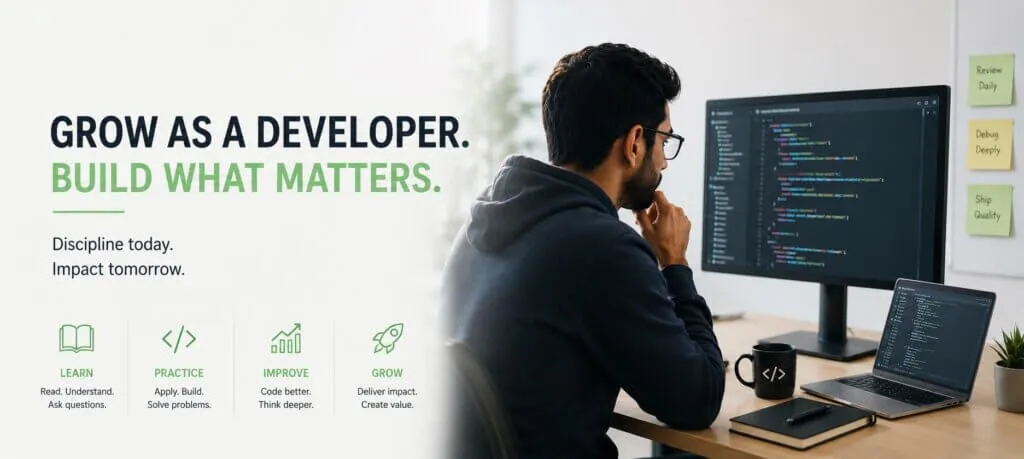
Why Developer Growth Compounds From Daily Habits
Developer growth does not happen in occasional bursts. It happens through many small improvements applied to real work. Picture two engineers. One reads a senior colleague's pull request every morning, asks one architectural question a week, and writes down one lesson a day. The other takes a course twice a year. After a year, the first engineer is usually far ahead.
The difference is attention, not information. Daily habits improve the quality of attention applied to work that is already happening. That is why developer growth is best treated as a routine rather than a project.
Read Senior Pull Requests Carefully
Reading pull requests from senior engineers is one of the highest-leverage developer growth habits for junior and mid-level engineers. Do more than approve them. Study the naming, the handling of edge cases, the architecture choices and the trade-offs accepted. Each one is a window into how an experienced engineer thinks about the same problems you face.
This developer growth habit connects learning directly to production context. That is why it often beats a structured curriculum for early-career engineers.
Understand Internals, Not Just Interfaces
The second habit is to understand how tools work underneath. When you use a library, a framework feature or a cloud service, spend five minutes on its documentation or source. Engineers with a mental model of internals diagnose failures faster. They know what can go wrong and why. This investment in developer growth pays off for the length of a career.
The 7 Habits Behind Developer Growth
The table below summarises the seven habits this guide covers. Each developer growth habit takes minutes a day, not hours.
| Habit | Time cost | Main payoff |
|---|---|---|
| 1. Read senior pull requests | 10 min a day | Faster design judgement |
| 2. Learn tool internals | 5 min per tool | Faster diagnosis |
| 3. Apply the 15-minute rule | None | Less time stuck |
| 4. Protect deep work | Calendar blocks | Higher output |
| 5. Review code as a learner | Per review | Shared quality |
| 6. Debug scientifically | Per bug | Fixes that stick |
| 7. Keep a learning log | 10 min a week | Steady continuous learning |
The rest of this guide explains how to apply each habit in practice.
Software Engineer Productivity: Habits That Compound
Software engineer productivity is not about typing faster. It is about reducing the confusion, rework and coordination overhead that slow output over time. The habits that matter are often unglamorous. Write clear commit messages. Keep an up-to-date picture of the codebase. Keep a backlog of questions to research. Communicate before people have to ask.
The 15-Minute Rule
The 15-minute rule is a practical way to manage the cost of being stuck. When you hit an obstacle, spend 15 focused minutes on it. Use the documentation, the logs and the debugger. If there is no progress, write down three things: the goal, the error, and what you already tried. Then ask a peer or senior engineer.
The rule supports developer growth and prevents two failure modes that hurt software engineer productivity at the team level:
- Asking for help too quickly, before any independent investigation.
- Spinning alone for hours when a five-minute conversation would unblock the work.
Asking well-prepared questions is an underrated part of developer growth. The written summary also helps the person you ask, because they see the context at once.
Protect Deep Work
Deep work allocation is the second pillar of software engineer productivity. Two uninterrupted hours of focused work often produce more than four fragmented hours. Context switches and notifications break concentration, and it takes time to recover.
Productive engineers protect blocks of time for work that needs sustained focus. Examples include designing systems, building complex features and diagnosing hard bugs. Our team recommends agreeing focus windows and availability windows with the wider team. That way deep work, and the developer growth it enables, does not look like unresponsiveness.

Code Review Best Practices for Engineering Teams
Code reviews are the most effective way to maintain code quality and support developer growth, but only when they are collaborative. Code review best practices are not just about catching bugs. They raise shared understanding of the codebase. They surface patterns that do not match the team's design standards. They also create feedback loops that drive developer growth for both reviewer and author. Google's public code review guidelines are a useful reference for any team.
What to Look for in Every Code Review
Start with the pull request description and context, not the diff. Then check edge cases and error handling. Evaluate naming and clarity. Ask "why" questions instead of issuing directives.
Compare two comments. "I wonder whether a Map might be faster here; what was the thinking?" invites a conversation. It may reveal a good reason for the author's choice. "Use a Map" closes the conversation before it starts.
A compact checklist helps teams apply code review best practices consistently:
- Tests exist and cover the important cases.
- The code is structured so it can be tested.
- Error handling and edge cases are explicit.
- Names explain intent without extra comments.
- The change follows the team's architecture patterns.
Our team documents checklists like this at the start of each engagement. Reviewers then apply shared standards instead of personal preferences. Automation helps too: linters, formatters and CI checks catch style issues, so humans can focus on design. The broader practice of code review has a long history in software engineering for exactly this reason.
The Boy Scout Rule and Code Quality Over Time
The Boy Scout Rule is simple: leave the code slightly cleaner than you found it. If you fix a bug and notice a confusing name, a missing null check or an outdated comment, fix it in the same commit. Applied across a team, this stops technical debt from growing silently. Code review best practices in strong teams reinforce the rule by recognising small quality improvements alongside feature work.
Debugging Techniques: From Guessing to Verifying
Developer growth shows most clearly in how engineers diagnose problems. Less experienced engineers often treat debugging as a search. They change something, run it again, and see what happens. Experienced engineers treat debugging as an experiment. They form a hypothesis, design a test, and analyse the result. These debugging techniques are learnable. They apply across languages, frameworks and domains.
The Scientific Debugging Framework
The most effective of all debugging techniques applies the scientific method in four steps:
- Observe. Find exactly where behaviour deviates from expectations. Reproduce the issue reliably before attempting any fix.
- Hypothesise. Form a specific, falsifiable theory. "The API call times out, so the downstream data is null" is a good hypothesis. "Something is wrong with the API" is not.
- Test. Add a targeted log line or breakpoint that confirms or refutes the hypothesis. Each failed hypothesis narrows the search.
- Analyse. Never accept a fix you cannot explain. If you cannot say why it worked, the root cause is still hidden.
Structured logging makes the test step much faster in production systems. Our guide to structured logging and production observability shows how.
Rubber Duck Debugging
Rubber duck debugging is one of the debugging techniques teams underestimate. You explain the code line by line, to a colleague or even to an object on your desk. Saying the logic out loud forces you to process each step deliberately. Silent reading tends to skim familiar code. Many bugs surface during the explanation itself.
In distributed teams, this often takes the form of writing a detailed problem description before posting it in a team channel. Quite often the engineer solves the problem before pressing send.
Isolation With a Minimal Reproducible Example
Creating a minimal reproducible example is one of the most powerful debugging techniques for integration issues. If the error disappears in a small, isolated case, the cause is probably in the environment or integration layer. Building the minimal case removes variables one by one. That often reveals the root cause directly.
It is also the best way to ask for help, and a quiet driver of developer growth. Stack Overflow's guide to a minimal reproducible example explains the format well. A clear example respects the time of the person helping you.

Continuous Learning Without Burning Out
The teams with the strongest long-term developer growth build learning into their regular work. Continuous learning does not need large time blocks. The most effective practices take minutes a day.
Keep a Personal Technology Debt Log
Write down every concept, tool or mechanism you meet at work but do not fully understand. Each week, research one item for ten minutes. It is a cheap developer growth routine. Over a year that adds up to about fifty concepts, each tied to a real problem. That context makes the learning stick. This is continuous learning in its most practical form.
Read Incident Post-Mortems
Post-mortems are an underused developer growth resource. They show how real production systems fail. Understanding failure modes is a fast path to designing systems that avoid them. Many companies publish post-mortems publicly. Google's chapter on postmortem culture explains why blameless reviews matter.
Learn With AI Tools, Carefully
Artificial intelligence coding assistants are now part of everyday software development. Used well, they speed up boilerplate and suggest options. Used blindly, they hide the reasoning you need to learn. Treat suggestions like a pull request from a new colleague. Read them, question them, and make sure you understand why the code works. That keeps the tool in service of developer growth rather than replacing it.
Mentor Others
Mentoring junior engineers is a strong developer growth multiplier for senior engineers. Teaching demands deeper understanding than passive knowledge. If you can explain a concept simply, including its limits, you understand it well enough to apply it with confidence. At ICANIO, structured mentoring is a deliberate part of how engineers move into senior roles.
Soft Skills as Force Multipliers for Developer Growth
Writing code is only one part of developer growth and of an engineering role. Communicating clearly, managing expectations and translating technical complexity into business language are the other parts. They decide how much impact an engineer has beyond their own code.
Proactive progress updates prevent misalignment between engineering effort and business expectations. A good update covers three things: what was completed, what is blocked, and what comes next. This simple habit prevents rework and missed commitments.
Documentation that a non-technical stakeholder can follow is another mark of seniority. It is not a soft skill in any lesser sense. It is a core capability that earns operational trust from the business. For engineers working in DevOps or cloud roles, clear runbooks and change notes serve the same purpose.
Developer Growth Across Career Stages
| Stage | Main focus | Key habit |
|---|---|---|
| Junior | Learning the codebase | Read senior pull requests |
| Mid-level | Independent delivery | Scientific debugging |
| Senior | Design and review | Coaching through reviews |
| Staff | Cross-team impact | Clear written communication |
The habits overlap, but the emphasis shifts as responsibility grows. Developer growth at each stage builds on the previous one.
How Teams Can Support Developer Growth
Individual habits work best when the team supports them. Managers and tech leads can make developer growth part of normal delivery:
- Reserve time in each sprint for reviews and learning, not only features.
- Pair junior and senior engineers on difficult tickets.
- Share interesting post-mortems and pull requests in team channels.
- Recognise good review comments and small refactors, not only shipped features.
Strong engineering cultures also invest in automation. Good CI pipelines, test suites and tooling remove repetitive work. That frees engineers for the work that actually grows their skills. Our article on continuous testing in CI/CD explains the testing side, and our piece on AI quality assurance covers how AI fits into review and testing.
Conclusion
Developer growth is a compound process. Developer growth also rewards patience. Read senior code. Learn how your tools work. Ask good questions after fifteen honest minutes. Protect deep work. Review code as a learner. Debug like a scientist. Keep a small, steady habit of continuous learning.
None of these habits needs a big budget or a long course. They need consistency. Teams that support them see better code review outcomes, fewer repeat bugs and stronger software engineer productivity over time.
If you want to work with engineers who practise these habits every day, explore our application development services, read about how to hire AI developers, or contact ICANIO to talk to our team.
References
- Google Engineering Practices: Code Review Developer Guide
- Google SRE Book: Postmortem Culture
- Wikipedia: Code review
- Wikipedia: Minimal reproducible example
- Stack Overflow: How to create a minimal reproducible example
Frequently asked questions
What are the most effective code review best practices?
Read the pull request description before the code. Check edge cases and error handling, evaluate naming clarity, and ask "why" questions instead of giving orders. Verify that tests exist and follow team patterns. Treat each review as shared learning rather than gatekeeping. Done this way, code review drives developer growth for both the reviewer and the author.
How can engineers improve software engineer productivity?
Apply the 15-minute rule when stuck: investigate for fifteen minutes, then document what you tried and ask for help. Protect blocks of deep work. Read one senior pull request a day. Use rubber duck debugging and keep a personal learning log. These small habits compound into much larger gains than occasional intensive learning bursts.
What debugging techniques do senior engineers use?
Senior engineers use the scientific method. They observe where behaviour deviates, form a specific hypothesis, test it with a targeted log or breakpoint, and analyse the result. They also use rubber duck debugging to expose hidden assumptions and build minimal reproducible examples to isolate root causes. These debugging techniques work across languages and problem domains.
What is the most impactful developer growth practice?
For junior and mid-level engineers, reading senior pull requests carefully is one of the most impactful developer growth practices, because it ties learning to real production code. For senior engineers, mentoring is the strongest multiplier. Teaching forces a deeper understanding of a concept, including its limits, than passive knowledge ever does.
How does continuous learning fit into a busy delivery schedule?
Keep it small and regular. Spend ten minutes a week researching one item from a personal technology debt log. Read a published post-mortem when you have a spare moment. Ask one architecture question a week. Because each step is tied to real work, the learning sticks, and it never competes seriously with delivery commitments.
Why do soft skills matter for developer growth?
Technical skill only creates impact when others understand and trust the work. Clear progress updates, honest estimates and documentation that business stakeholders can follow prevent rework and misalignment. As engineers become more senior, written communication and influence across teams matter as much as code. That is why soft skills are a core part of developer growth.