Enterprises that hire AI developers today are learning a hard lesson. Building enterprise AI systems is not just about models. It is about engineering. Organisations across industries are investing in AI-powered applications, intelligent automation, predictive analytics and AI-driven workflows. Yet many underestimate what it takes to run those systems in production.
A successful AI initiative needs more than a chosen model or an integrated API. Real enterprise systems must run reliably under production load. They must connect to existing platforms, handle changing business data, and scale securely across teams.
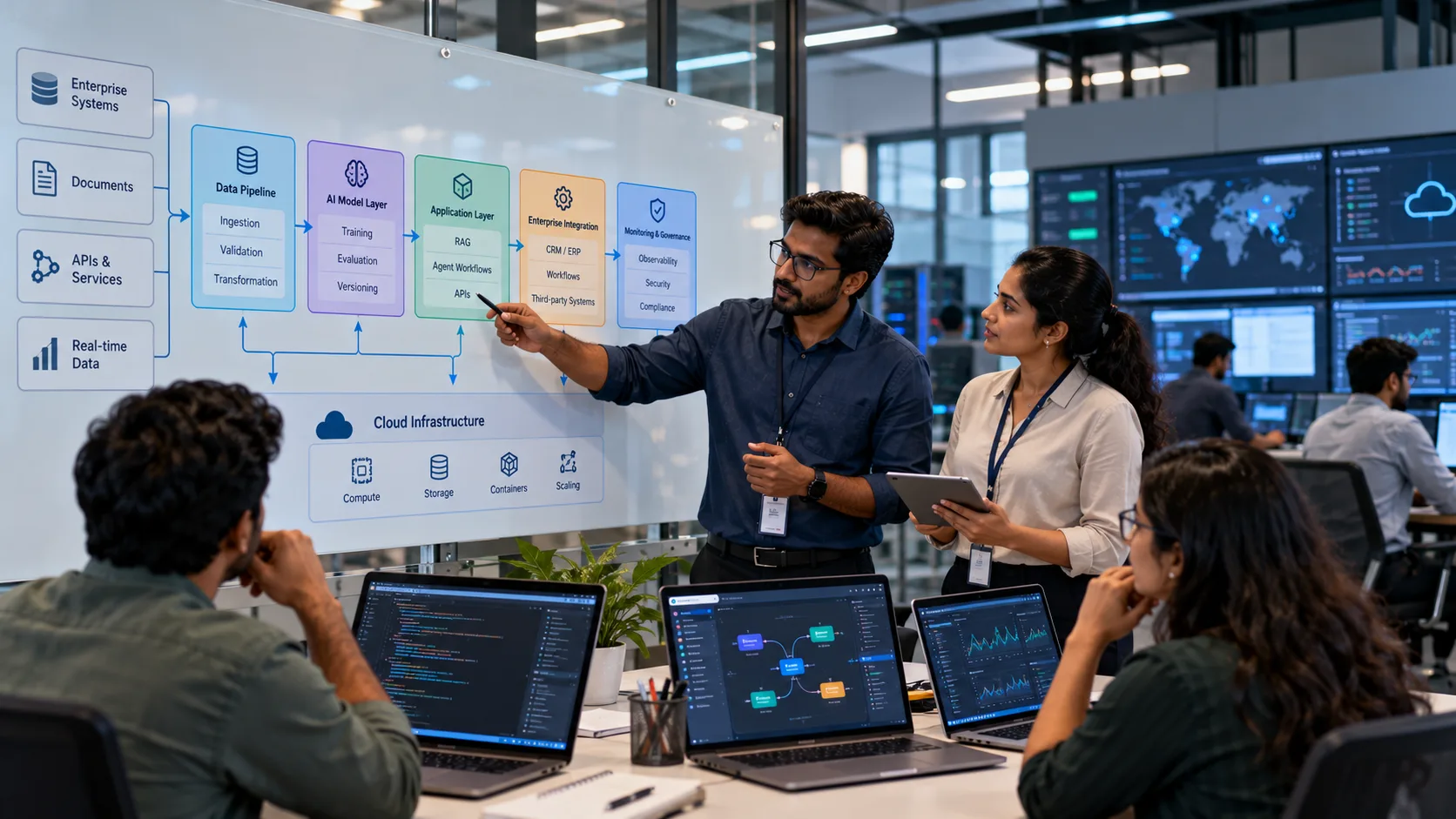
That is why organisations that hire AI developers are shifting their criteria toward engineering depth. Access to AI tools is no longer the challenge. The challenge is finding people who can turn AI capabilities into scalable, maintainable business systems. ICANIO's application development and data and AI practices help enterprises build that capacity and move beyond proof of concept.
Key Takeaways
- When you hire AI developers, prioritise production engineering skills over familiarity with the latest models.
- Five capabilities matter most: application development, enterprise AI integration, cloud infrastructure, data engineering and operational thinking.
- Enterprise AI development must fit real workflows, support human review and build in security and governance.
- A modular, API-first AI engineering team scales better than a group of isolated specialists.
- Measure success with operational KPIs such as uptime, latency and time to production, not model accuracy alone.
Why Most Attempts to Hire AI Developers Fall Short
Many organisations approach enterprise AI hiring with unrealistic expectations. They focus heavily on model expertise. They underestimate the complexity of enterprise application development. As a result, projects stall after the first experiments.
| Hiring approach | Typical outcome | Main limitation |
|---|---|---|
| PoC or demo work only | Good demos, failed scaling | No operational ownership |
| Generalist developers | Isolated solutions | Weak integration depth |
| Model expertise first | Brittle production systems | No monitoring or governance |
| Short-term contractors | Fast delivery, maintenance risk | Misaligned with standards |
| Full-stack AI engineering team | Reliable, scalable systems | Higher initial investment |
The most common failure mode is the PoC-to-production gap. Organisations that hire AI developers only to build prototypes often succeed at first. They then fail during scaling, because nobody owns engineering or operations.
A demo on curated data in a controlled environment is not a production system. A production system handles real volumes, integrates with several enterprise platforms, and stays observable as data changes. Closing that gap is an engineering challenge, not an AI challenge. Our article on scaling AI from PoC to production explores this in more depth.
What to Look For When You Hire AI Developers
Hiring for enterprise projects means evaluating more than experimentation skills. The focus should be system-building capability and production experience. An effective team is not defined by familiarity with the latest models. It is defined by building systems that stay reliable, scalable and maintainable.
In our experience, five capabilities separate strong enterprise candidates from the rest.
1. Application Development Experience
Strong AI developers understand how enterprise applications are designed, deployed and maintained. This is the foundation of any reliable production AI system.
A developer who can fine-tune a model but cannot design a production API is a risk. So is one who ignores failure modes or monitoring. When you hire AI developers for production systems, application development depth is the first thing to evaluate. Ask candidates to walk through a system they shipped and supported, not just one they prototyped.
2. Enterprise AI Integration Expertise
AI systems must talk to enterprise platforms and third-party services through scalable integration patterns. Enterprise AI integration is central to deploying AI across business workflows.
AI applications rarely work alone. They connect with CRMs, ERPs, enterprise databases, internal applications and workflow tools. Developers without integration experience often create isolated solutions that cannot scale. In complex, legacy-heavy landscapes, enterprise AI integration depth is often the capability that matters most. Our guide to ERP and CRM integration shows the kind of patterns involved.
3. Cloud and Infrastructure Knowledge
Modern AI systems rely on cloud-native infrastructure, scalable deployment pipelines and distributed environments. Teams without this depth build systems that work locally but fail at scale.
When you hire AI developers, cloud knowledge to probe covers container orchestration, GPU resource management, inference optimisation and cost control. Each needs engineering depth distinct from model knowledge. Each is essential for enterprise AI development that meets production reliability standards.
4. Data Engineering Understanding
Reliable AI systems need structured data pipelines, validation and operational consistency. Without strong data engineering, even sophisticated custom AI solutions give inconsistent results.
The quality of an AI system's output is bounded by the data infrastructure beneath it. Teams that hire AI developers with data engineering depth catch data quality issues early. Problems are stopped before they reach model outputs that drive business decisions.
5. Operational Thinking
Enterprise AI developers must design systems that stay reliable and observable long after deployment. The best teams combine software engineering discipline with intelligent system design.
Operational thinking means building monitoring dashboards, anomaly detection, logging and alerts from day one. It also means planning retraining and rollback. This is the discipline usually called MLOps. Google's guide to MLOps continuous delivery and automation pipelines is a useful reference. Our team embeds these standards into custom AI solutions from the first sprint, so systems are built for sustained operation rather than demonstration.
How to Assess Candidates and Partners
When teams hire AI developers, interviews often over-index on model trivia. A better process tests how candidates handle real enterprise constraints. Our team recommends a short, practical assessment:
- A system design exercise covering data flow, APIs and failure handling.
- A code review of an existing service with intentional weaknesses.
- A discussion of a past production incident and what changed afterwards.
- A governance scenario involving sensitive data or a regulated decision.
- A cost question, such as how to cut inference spend without losing quality.
The same questions work when evaluating a delivery partner. Ask for references to production systems, not demos. Ask who owns monitoring after go-live. Ask how knowledge transfers to your staff. These answers reveal more than any portfolio slide.
Common Mistakes When You Hire AI Developers
Some hiring mistakes appear again and again. Avoiding them saves months of rework. Watch for these patterns when you hire AI developers:
- Writing job descriptions that list model names but no production responsibilities.
- Hiring a single "AI person" and expecting them to cover data, cloud and integration.
- Skipping security and governance questions in interviews.
- Measuring candidates on demos rather than on systems they have supported.
- Leaving ownership of monitoring and retraining undefined after launch.
Each mistake has the same root cause. It treats AI as a research task rather than a software engineering discipline. Teams that hire AI developers for production roles should write job descriptions around outcomes: reliable services, clean integrations and measurable operational KPIs.
It also helps to define the career path before you hire AI developers. Strong engineers want to know how they will grow, who reviews their work and how quality is judged. A clear engineering ladder, shared code review standards and time for learning all improve retention. Our post on developer growth and code review best practices covers this in more detail.
Enterprise AI Development: System Requirements
Enterprise AI projects differ from standalone experiments. They must work inside large operational ecosystems where reliability, governance and scalability are essential. This is where custom AI solutions earn their value over generic tools.
AI as Part of Business Workflows
Successful deployments plug directly into operational workflows instead of acting as disconnected tools. Examples include AI-assisted customer support, intelligent document processing, predictive analytics dashboards and automated operational recommendations.
Each goes beyond model performance and embeds AI in daily operations. ICANIO builds these integrations against existing systems. Clients do not have to restructure their technology stack around new AI infrastructure. Organisations that hire AI developers with this mindset see adoption grow, because the tools appear where people already work.
Human-in-the-Loop Architecture
Many enterprise environments require human validation for critical decisions. AI systems must support collaboration between automation and human oversight. That makes human-in-the-loop design a core part of enterprise AI architecture.
This is especially important in financial services, healthcare and legal services. Regulated decisions there need documented human review. Organisations that prioritise human-in-the-loop design build systems that satisfy operational and compliance needs at the same time. Our guide to human in the loop AI covers the patterns.
Security and Governance
AI systems often process sensitive business information. Security, access control and compliance are therefore critical. Teams operating under GDPR or similar data protection laws should treat AI governance as an architectural requirement.
The NIST AI Risk Management Framework offers a structured way to identify and manage AI risks. For applications built on large language models, the OWASP Top 10 for LLM Applications lists threats such as prompt injection. Designing for these from the first decision is far cheaper than addressing them later.
Building and Scaling an AI Engineering Team
As AI initiatives grow, building a sustainable AI engineering team becomes a strategic priority. Team structure determines how far an enterprise AI development programme can scale.
Modular Architecture
Modular AI architectures let enterprises expand capabilities without disrupting existing systems. An AI engineering team that designs for modularity builds components that can be updated, replaced or expanded independently. That reduces the risk that one early decision limits the programme years later.
API-First Design and Data Coordination
API-first architectures let AI services talk cleanly to enterprise applications. They are the foundation of sustainable enterprise AI integration at scale.
Multi-system data coordination is the third requirement. Production AI often depends on synchronised data across several business platforms. Teams without this skill produce systems with data inconsistencies. Those inconsistencies degrade model accuracy over time.
Embedded Team Models
Not every organisation needs to hire AI developers for a full team at once. ICANIO provides embedded engineering teams that work alongside internal staff. Capability and documentation transfer as the programme matures. This model lets you hire AI developers at programme pace, rather than committing to permanent headcount before the scope is clear.
KPIs for Measuring Enterprise AI Development Success
Model accuracy matters, but it is not enough. Operational KPIs show whether the decision to hire AI developers is paying off.
| KPI | What it measures | Why it matters |
|---|---|---|
| Uptime | Production availability | Operations depend on it |
| Inference latency | Response time under load | Drives user adoption |
| Integration success | Working integration points | Shows integration quality |
| Defect escape rate | Bugs reaching production | Shows process maturity |
| Time to production | Build to deploy cycle time | Shows delivery speed |
| Cost per inference | Spend relative to throughput | Shapes long-term economics |
ICANIO sets baselines for these KPIs at the start of each engagement. Leadership can then track progress across the programme lifecycle. Clear baselines also make it easier to compare in-house and partner delivery honestly.
What This Means for Enterprises in 2026
The enterprise AI landscape is shifting quickly. Organisations no longer compete on access to AI tools. They compete on their ability to operationalise AI through dedicated developers and purpose-built engineering programmes.
To hire AI developers well today is to build teams that design scalable systems and integrate AI into operations. They maintain reliability over time and support growth through sustainable architecture. The most successful enterprises will not be the ones with the most pilots. They will be the ones with AI systems that run reliably in real business environments.
Why Partner With ICANIO
Enterprises that hire AI developers face a build-versus-partner decision. It depends on programme maturity, timeline and long-term goals. In early and middle stages, a partner-led model can offer a faster route to production and lower initial risk. Internal capability can grow in parallel.
ICANIO's approach rests on four principles:
- Production-first engineering: monitoring, governance and integration are specified before model code is written.
- Full-stack composition: teams cover model engineering, application development, cloud, data engineering and DevOps.
- Integration by default: deployments connect to legacy ERPs, proprietary databases or bespoke workflow systems as needed.
- Knowledge transfer: internal teams gain capability alongside delivery, so you are not permanently dependent on a partner.
Learn more about our Data and AI services and AgenticOps offerings.
Conclusion
The decision to hire AI developers is really a decision about engineering capability. Model skills are necessary but not sufficient. Production systems need application development, enterprise AI integration, cloud, data engineering and operational discipline working together.
Structure the team for modularity and clear ownership. Measure it with operational KPIs. Build governance and human oversight into the design rather than adding them later.
If you are planning your next AI programme, contact ICANIO to discuss how our team can help you build and scale it.
References
- MLOps (Wikipedia)
- Google Cloud: MLOps continuous delivery and automation pipelines
- Human-in-the-loop (Wikipedia)
- NIST AI Risk Management Framework
- OWASP Top 10 for LLM Applications
Frequently Asked Questions
Why should enterprises hire AI developers with engineering depth?
Developers with engineering depth build production-ready AI systems that integrate with enterprise operations. Beyond models, they bring skills in infrastructure, data engineering, application architecture and governance. Enterprises that hire AI developers with this profile build systems that survive the move from proof of concept to production instead of stalling during scaling.
What skills should enterprise AI developers have?
Enterprise AI developers should combine AI knowledge with software engineering, cloud infrastructure, enterprise AI integration, data engineering and operational system design. Together these define an effective AI engineering team. Model expertise alone is not enough. The engineering foundations that make custom AI solutions reliable in production matter just as much as the AI itself.
Why do enterprise AI projects fail after initial success?
Projects often fail because teams focus on models and underestimate integration, operations, governance and scalability. A proof of concept rarely exposes the data quality, monitoring and integration demands of production. Organisations that hire AI developers without integration experience tend to hit this wall during scaling, when fixes are most expensive.
Are custom AI solutions better than generic AI tools?
Custom AI solutions usually suit enterprises better when workflows, data or regulations are specific. Generic tools are useful for quick experiments. For complex integration landscapes, proprietary data or regulated environments, custom AI solutions align the system with the business context. Many organisations use both, starting generic and moving custom where value is proven.
What is the biggest challenge in enterprise AI deployment?
Two challenges stand out: enterprise AI integration across existing systems, and long-term operational reliability. Both are engineering problems. Addressing them from the outset, with developers who understand integration, monitoring and governance, makes production success much more likely and keeps systems valuable after launch.
In-house or partner: how should we hire AI developers?
It depends on maturity, timeline and goals. A partner can speed up early delivery and reduce risk while scope is still evolving. An in-house team builds long-term ownership. Many enterprises combine both: they hire AI developers through a partner first, then transfer knowledge to permanent staff as the programme stabilises.