
Generative AI use cases have moved well beyond drafting emails and summarising documents. In 2023 and 2024, most organisations treated generative AI as a productivity assistant. By 2026, that view has changed. Enterprises are embedding it into core business systems to automate workflows, speed up decisions and improve efficiency. The most important deployments are no longer isolated chatbots. They are connected systems built on agentic architectures, retrieval-augmented generation, multimodal reasoning, domain-specific models and workflow orchestration. That shift is turning enterprise AI from an experiment into an operational priority across retail, finance, healthcare, manufacturing, legal services and technology.
ICANIO's Data and AI practice builds enterprise AI systems and AI workflow automation programs. Our work covers RAG architecture design, agentic AI engineering, intelligent document processing, LLM integration and AI governance. This guide walks through seven generative AI use cases that matter in 2026, the architecture patterns behind them, and how to choose where to start.
Key Takeaways
- The strongest generative AI use cases run inside complete workflows, not as standalone tools.
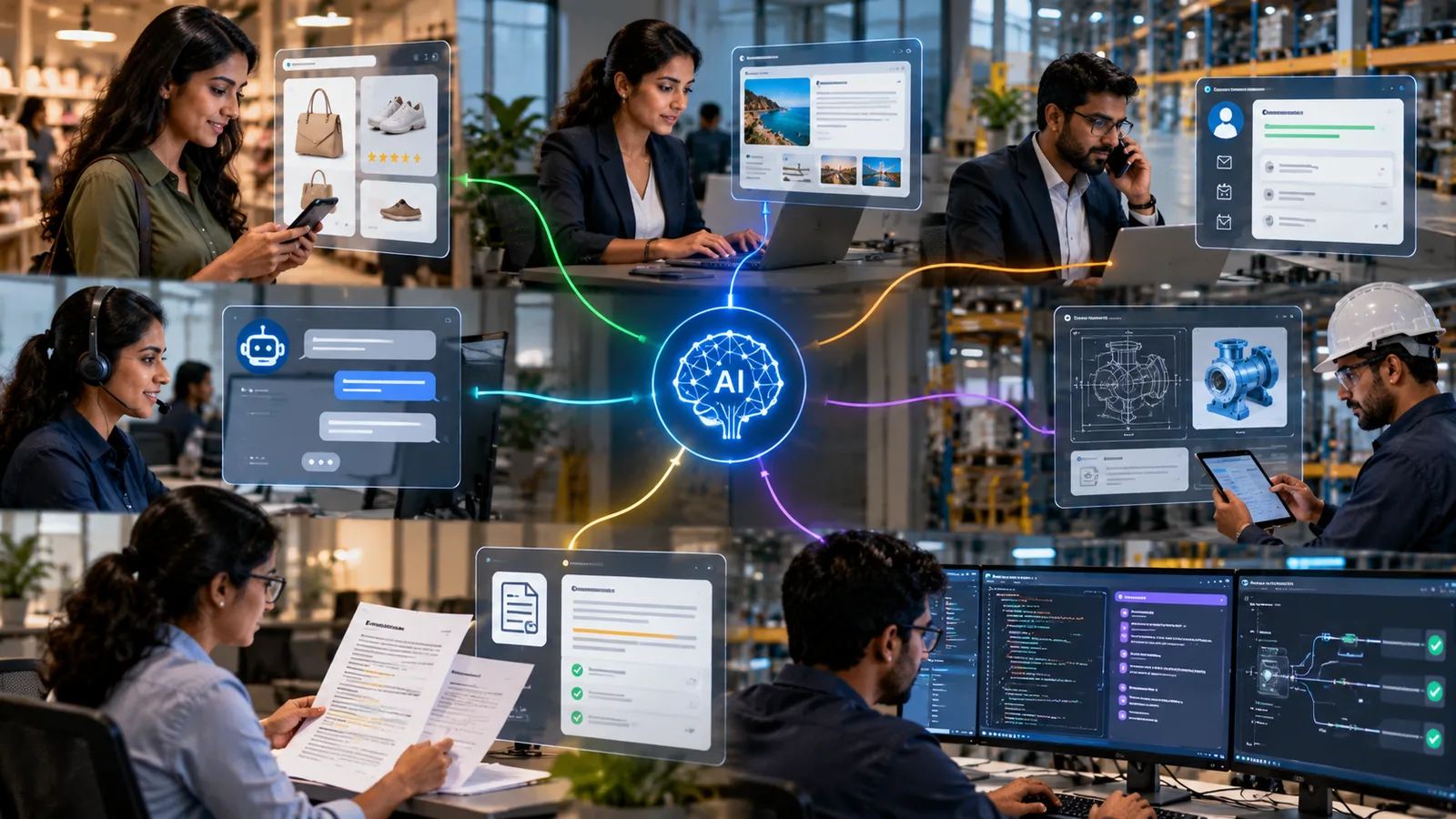
- Seven use cases stand out: personalisation, marketing automation, sales copilots, customer support, document processing, drawing interpretation and SDLC acceleration.
- RAG architecture grounds answers in company data and is now the default for enterprise AI.
- AI workflow automation tends to create more value than automating single tasks.
- Start with high-volume, structured work and a business metric you already track.
What Is Generative AI in the Enterprise?
Generative artificial intelligence refers to models that produce new content, such as text, images, code or structured data, from patterns learned during training. Large language models are the best-known example. In the enterprise, the model is rarely the whole product. It sits inside a system that retrieves data, calls tools, applies business rules and logs every step.
That is why generative AI use cases look different in business settings than in consumer apps. A consumer chatbot answers a question. An enterprise AI system might read a contract, compare it against policy, flag risks, update a record and route an exception to a lawyer. The value comes from the workflow, not the single response. The best generative AI use cases are designed around that workflow from the start.
Generative AI Use Cases at a Glance
| Use case | Core technology | Business outcome |
|---|---|---|
| Retail personalisation | Recommenders, LLMs | Higher relevance and conversion |
| Marketing automation | Text and image models | Faster campaign production |
| Sales copilots | CRM-connected LLMs | Less admin per rep |
| Customer support | RAG, vector search | Lower support load |
| Document processing | RAG, domain LLMs | Faster document review |
| Drawing interpretation | Multimodal models | Less rework and search time |
| SDLC acceleration | Coding assistants | Faster release cycles |
From AI Tools to AI Systems
Earlier AI deployments focused on isolated tasks. They generated text, answered questions or summarised information. Modern enterprise AI systems execute workflows instead. They coordinate several systems, make context-aware decisions and assist people in real time.
For generative AI use cases, this is a shift from productivity help to business transformation. AI was once a tool applied to a task. Now it is infrastructure applied to a whole workflow. That changes how teams are structured and how value is measured.
| Dimension | Traditional AI | Enterprise generative AI |
|---|---|---|
| Interaction | One query, one answer | Multi-step, with memory and tools |
| Integration | Isolated API call | CRM, ERP, databases, live feeds |
| Scope | Single task | End-to-end workflow |
| Grounding | Model knowledge only | RAG over company data |
| Autonomy | Human at every step | Defined escalation thresholds |
Generative AI Use Cases for Customer Growth and Marketing
1. Hyper-Personalisation in Retail
Retail is home to some of the most visible generative AI use cases. Retailers are using AI to deliver more relevant customer experiences. Traditional segmentation relied on broad demographic groups and seasonal campaigns. It often missed individual preferences and product fit.
AI-driven recommender systems now analyse purchase history, browsing behaviour and engagement signals. Generative models then produce personalised product descriptions, offers and journeys in real time. The strongest designs unify the customer data platform, mobile apps, recommendation engine and marketing automation into one layer. Large beauty and fashion retailers have publicly reported revenue and conversion gains from this kind of AI-driven experience. Results depend heavily on data quality and integration depth.
2. AI Marketing Automation
Generative AI is speeding up campaign execution and creative production. Marketing teams have long struggled with manual drafting, slow localisation and multi-channel bottlenecks.
AI creative platforms now generate ad variants, adapt messaging for each market and produce visual assets quickly. Several well-known consumer brands and publishers have described large reductions in drafting and production time. The pattern across marketing generative AI use cases is consistent. The biggest gains come when AI workflow automation covers the whole campaign lifecycle, from brief to approval to launch, rather than just the first draft.
3. AI Sales Copilots
Sales teams use AI copilots to cut administrative work. Representatives traditionally spend a lot of time researching leads, updating the CRM and preparing notes.
Sales copilots are practical generative AI use cases because they work inside existing tools. They summarise account history, score leads, draft follow-ups and surface relevant customer information on demand. Agentic orchestration connects the CRM, internal knowledge bases and communication tools into one assistant. Organisations adopting these generative AI use cases commonly report more time spent selling and less time on data entry. The key design choice is keeping the copilot inside the tools reps already use.
Generative AI Use Cases for Operations
4. Autonomous Customer Support
Support is one of the most mature generative AI use cases. AI agents are taking over many repetitive support workflows. Companies face rising support costs, long resolution times and large volumes of similar questions.
Context-aware agents now handle routine conversations, look up information in enterprise systems and escalate complex cases to people. Most deployments use a RAG architecture connected to knowledge bases, CRM records, policy documents and ticketing systems. The retrieval layer keeps answers grounded in company-specific information rather than general model knowledge. That grounding is the key governance requirement for customer-facing AI.
Several large fintech and insurance firms have publicly described AI assistants handling a substantial share of their support volume. Our enterprise AI chatbot case study shows how ICANIO approached a similar build.
5. Intelligent Document Processing
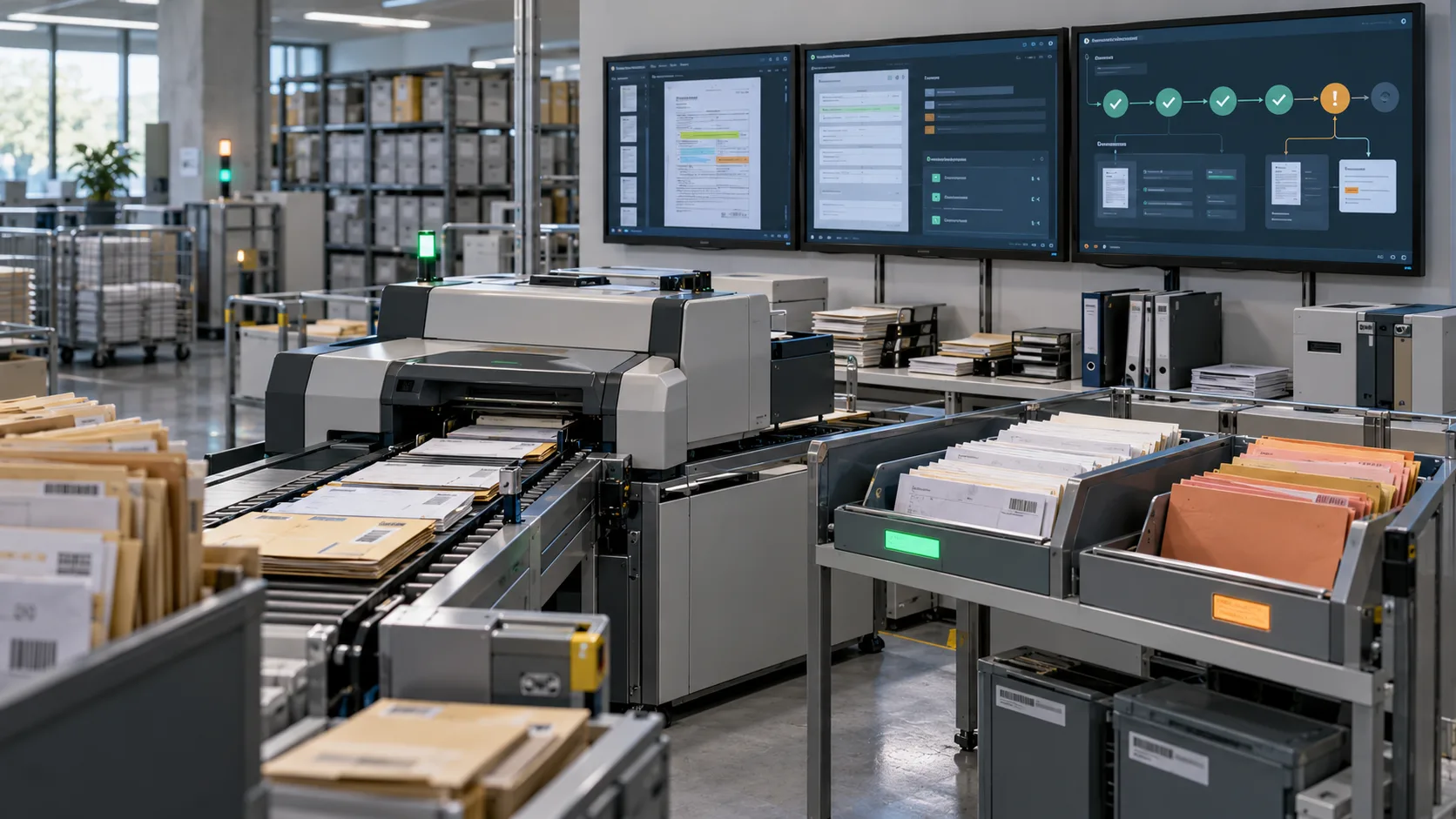
Document-heavy industries are seeing real productivity gains. Intelligent document processing addresses a specific pain point. Manual review of contracts, regulatory filings, compliance documents and risk reports is slow, costly and error-prone.
Document agents now extract key clauses, summarise obligations, flag compliance risks and let users query files conversationally. Modern systems combine ingestion pipelines, vector databases, domain-specific language models and RAG architecture for retrieval. Professional services firms and banks have publicly reported lower handling costs and faster review of long regulatory documents.
In our experience, intelligent document processing is often a strong first project in regulated industries. It targets expensive, repetitive work, and success is easy to measure in review time and exception rates.
Generative AI Use Cases for Engineering Teams
6. Engineering Drawing Interpretation
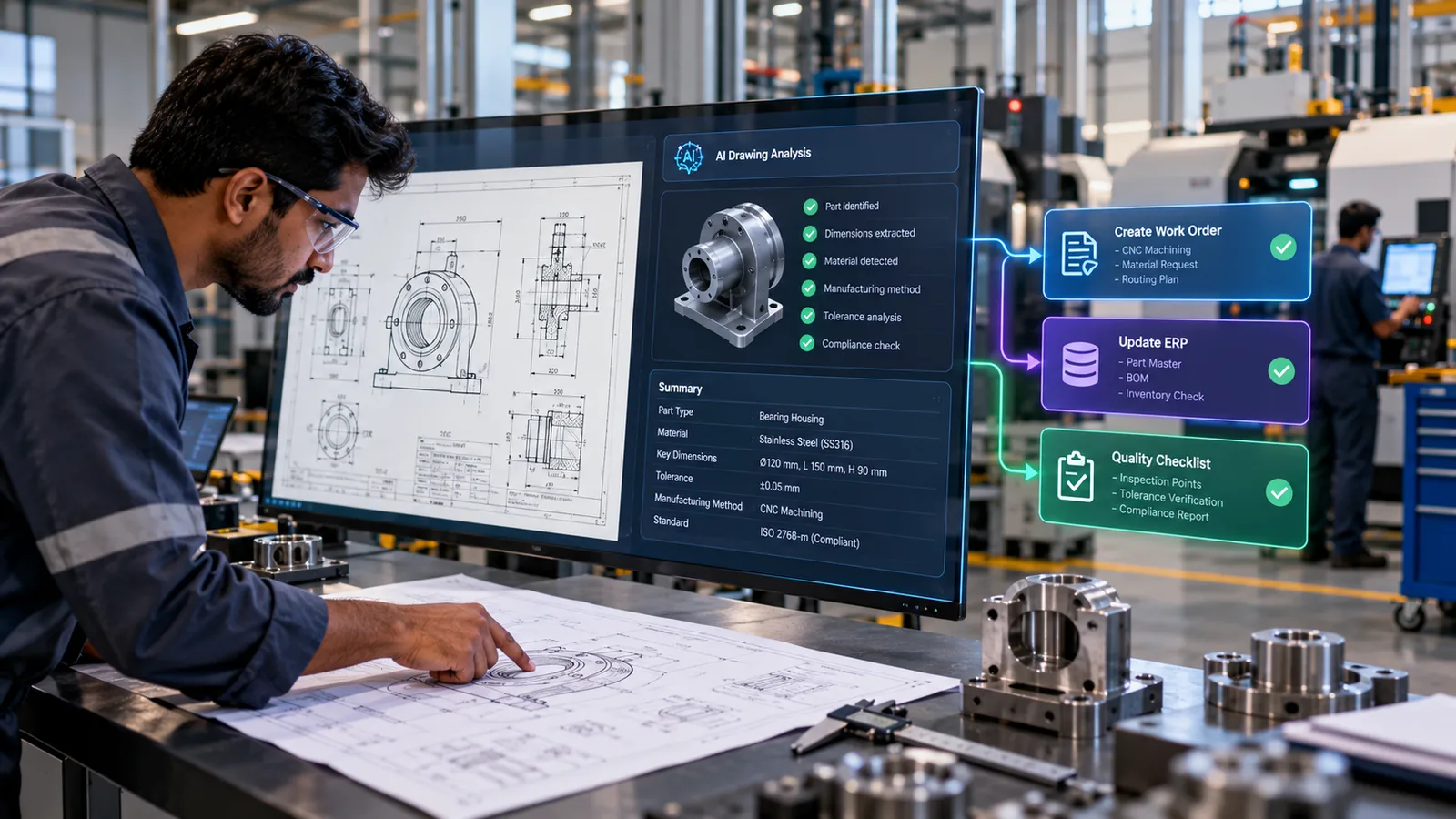
Engineering drawing review is one of the newer generative AI use cases. Manufacturers are using multimodal AI to interpret technical drawings and schematics. Engineers traditionally spend significant time reviewing each drawing, validating tolerances and searching for similar past designs. Errors lead to costly rework.
Multimodal models can now parse diagrams, check geometry against internal standards, flag tolerance inconsistencies and retrieve related designs. Many teams run these models on private infrastructure using open-weight models such as Qwen or Mistral through runtimes like Ollama. Some use the Model Context Protocol to standardise how agents call enterprise tools. The value scales with the volume of technical documentation a manufacturer manages.
7. SDLC Acceleration
Generative AI is now built into many software development pipelines. SDLC acceleration is among the most widely adopted generative AI use cases in engineering organisations. Manual coding, testing and debugging slow release cycles.
AI coding assistants generate code, suggest refactors, write tests and help with debugging. Teams connect them to source control, documentation, CI/CD pipelines and internal knowledge bases. Large banks and technology firms have publicly reported meaningful developer productivity improvements. The gains are largest when assistants are paired with strong code review and automated testing, so speed does not come at the cost of quality.
Common Architecture Patterns Behind Generative AI Use Cases
Despite differences across industries, a few technical patterns appear in nearly every successful deployment. These patterns matter more than the choice of model for most generative AI use cases.
RAG Architecture for Accuracy
Retrieval-augmented generation combines a foundation model with search over proprietary data. RAG architecture has become the standard foundation for reliable enterprise AI in regulated industries. It lets outputs cite verified, company-specific information instead of relying on training data alone. Accuracy, explainability and compliance requirements are hard to meet without it. For a deeper comparison, read our guide to RAG vs fine-tuning.
AI Workflow Automation for Value
The largest gains usually come from redesigning whole workflows around AI, not automating isolated steps. AI workflow automation replaces the coordination layer of knowledge work: the hand-offs, lookups and status updates between people and systems. Our article on agentic AI in enterprises explains how autonomous agents fit into these designs.
Security and Governance by Design
Generative AI introduces new risks, including prompt injection, data leakage and unreliable outputs. The OWASP Top 10 for LLM Applications is a practical checklist for these threats. The NIST AI Risk Management Framework helps structure governance across the lifecycle. Both are worth reading before a system reaches customers.
How to Build Enterprise Generative AI Use Cases
Generative AI use cases that deliver real value share a set of engineering habits. Our team applies five success factors on every enterprise AI engagement:
- Design the RAG architecture before choosing a model. Data sources, chunking, embeddings and the vector database come first, because grounding quality drives reliability.
- Scope AI workflow automation at the process level. Replace whole manual workflows rather than adding AI to single steps.
- Treat integration as a primary deliverable. Connecting to the CRM, ERP or workflow platform is where many projects hit their most expensive delays.
- Build governance and monitoring from the first sprint. Logging, output checks and escalation paths should exist before business users touch the system.
- Measure business KPIs, not just model scores. For support, track resolution rate and handling time. For document processing, track review time and exception rate.
Model accuracy metrics are useful engineering signals. They are not business value indicators on their own.
Choosing Your First Generative AI Use Case
Start with the work that has the highest volume of repetitive, structured tasks and a success metric the business already tracks. That combination makes value visible quickly. It also builds the executive sponsorship needed to expand.
| Criterion | Good first project | Poor first project |
|---|---|---|
| Volume | High and repetitive | Rare, one-off tasks |
| Data | Accessible and clean | Scattered or restricted |
| Metric | Already tracked | Hard to define |
| Risk | Human review possible | Fully autonomous, high stakes |
Customer support and intelligent document processing are generative AI use cases that often meet these criteria. Teams that start narrow and iterate tend to do better than those that attempt a broad platform first. Our guide to scaling AI from PoC to production covers the next steps once a first use case proves itself.
Measuring Generative AI Use Cases in Production
Generative AI use cases need clear measures before launch. Without a baseline, it is hard to prove what changed. Pick two or three business metrics and one or two quality metrics for each system.
- Business metrics: handling time, cost per case, cycle time, revenue per visit.
- Quality metrics: answer accuracy on a test set, escalation rate, user ratings.
- Risk metrics: policy violations, data exposure incidents, unsupported claims.
Review these numbers on a regular cadence with the business owner. Generative AI use cases drift as data, prompts and user behaviour change. Ongoing evaluation catches problems early. Our guide to LLM evaluation before deployment explains how to automate this gate.
Cost deserves its own line. Token usage, retrieval calls and GPU time add up quickly at scale. Track cost per transaction from the pilot onwards, so the business case stays honest as volume grows.
Conclusion
The most valuable generative AI use cases in 2026 are not standalone tools. They are connected systems that run real workflows, grounded in company data through RAG architecture and governed from day one. Personalisation, marketing, sales, support, document processing, engineering drawings and software delivery are generative AI use cases that all follow this pattern.
The practical lesson is to start small, measure what the business already cares about, and expand once the first system proves itself in production. If you are weighing where generative AI could help your organisation, contact ICANIO and our team will help you assess the options.
References
- Generative artificial intelligence (Wikipedia)
- Retrieval-augmented generation (Wikipedia)
- Intelligent document processing (Wikipedia)
- Recommender system (Wikipedia)
- OWASP Top 10 for LLM Applications
- NIST AI Risk Management Framework
- Model Context Protocol introduction
Frequently asked questions
What are the most impactful generative AI use cases in 2026?
Seven generative AI use cases stand out: retail personalisation, marketing automation, sales copilots, autonomous customer support, intelligent document processing, engineering drawing interpretation and SDLC acceleration. Across all of them, the biggest returns come from embedding AI into complete workflows rather than using it for isolated tasks. Integration with existing systems is usually what separates a useful deployment from a demo.
Why is RAG architecture important for enterprise AI?
RAG architecture lets an AI system retrieve trusted, company-specific data at the moment it answers. That improves accuracy, reduces hallucinations and supports compliance, because responses can point to their sources. Without retrieval, a model relies only on its training data, which is often out of date and knows nothing about internal policies, products or customers.
What drives the most value in enterprise AI?
Value usually comes from redesigning end-to-end workflows through AI workflow automation, not from deploying isolated tools. Organisations that treat AI as infrastructure and connect it to core systems tend to see larger, more durable gains. The difference between an AI tool and an AI system is the difference between small efficiency wins and a real change in how work gets done.
What is intelligent document processing?
Intelligent document processing uses AI to extract, classify, summarise and query information from unstructured documents such as contracts, filings and reports. Modern systems combine RAG architecture, vector databases and domain-specific language models. The result is faster, more consistent review with an audit trail, while people stay responsible for judgement calls and exceptions.
How do I choose which generative AI use case to start with?
For first generative AI use cases, pick work that is high in volume, repetitive and already measured by the business. Make sure the data is accessible and that a person can review outputs during the early stages. Customer support and document processing often fit well. Prove value on one use case in production, then expand to related workflows using the same platform and governance.
What are the main risks of generative AI use cases?
For most generative AI use cases, the main risks are inaccurate outputs, prompt injection, sensitive data leakage, weak access control and poor monitoring. Grounding answers with retrieval, limiting what agents can do, logging every step and keeping humans in the loop for high-impact decisions all reduce risk. Frameworks from OWASP and NIST provide useful checklists for security and governance reviews.