AGRITECH ERP · CROP LIFECYCLE · OFFLINE-FIRST MOBILE
Icanio built a smart farm ERP that replaces manual logbooks and disconnected spreadsheets with a unified dashboard for real-time farm and crop monitoring.
Quick Answer
What Is a Smart Farm ERP for Modern Agricultural Operations?
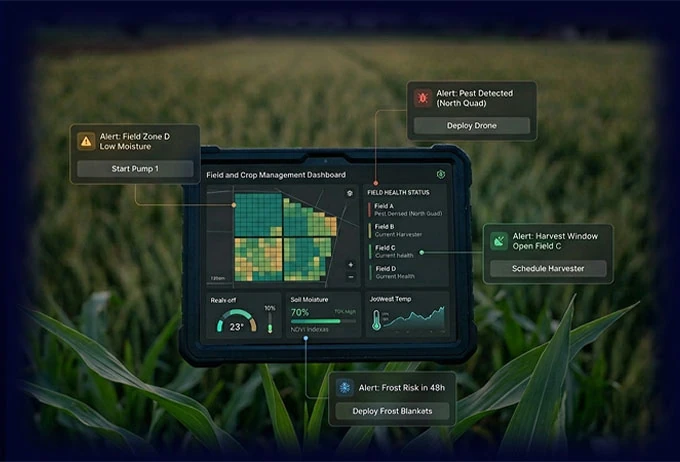
A smart farm ERP is agriculture ERP software that replaces manual logbooks and disconnected spreadsheets with a unified dashboard for real-time farm and crop monitoring, resource tracking, and labor task management. ICANIO built this smart farm ERP with offline-ready mobile architecture for remote fields, lifting crop yield by 30% and giving the client 100% digital traceability from seed to harvest.
Executive Summary
Turning Manual Logbooks Into a Data-Driven Smart Farm ERP
Manual record-keeping might work for a small plot, but it becomes a genuine liability once an agricultural enterprise is managing vast acreage across multiple fields. ICANIO’s partner was facing exactly that scalability wall: fragmented data spread across manual logbooks and disconnected spreadsheets, no way to track real-time resource consumption of water and fertilizers, no visibility into labor productivity and field-level task completion, and difficulty monitoring crop health and growth cycles at scale.
ICANIO addressed this by developing a comprehensive smart farm ERP rather than digitizing individual logbooks. The objective was to build a unified dashboard for real-time farm and crop monitoring, automate resource tracking for water, seeds, and fertilizers, add a task management module for field labor, integrate crop lifecycle management, and centralize inventory and supply chain tracking, all on a mobile-first architecture with offline data sync for remote fields. The result was a 30% increase in yield and 100% digital traceability from seed to harvest.
Every one of those outcomes traces back to the same design decision: capturing farm data at the point of activity, in the field, with offline sync, instead of relying on paper records that only got reconciled back at the office.
“A logbook can tell you what happened last week, it cannot tell a farm manager what a field needs today, and by the time paper catches up, the yield opportunity is already gone.”
The Challenge
Five Scalability Limits of Manual Farm Record-Keeping
Traditional farming operations face significant scalability challenges due to manual record-keeping and a lack of real-time data. Without a centralized system, agricultural enterprises struggle with resource wastage and unpredictable yields.
Fragmented Manual Data
Fragmented data across manual logbooks and disconnected spreadsheets left no single, reliable source of truth for farm operations.
No Real-Time Tracking in This Smart Farm ERP
The inability to track real-time resource consumption like water and fertilizers meant waste often went unnoticed until it had already happened.
No Labor Visibility Before This Smart Farm ERP
A lack of visibility into labor productivity and field-level task completion left managers unable to see where work stood across the operation.
Crop Health Gaps Before This Smart Farm ERP
Difficulty in monitoring crop health and growth cycles across vast acreage made it hard to catch problems early enough to act on them.
High Supply Chain and Inventory Risk
High operational risk from unpredictable supply chain and inventory management, compounded by inefficient historical data analysis, made seasonal planning and yield forecasting unreliable.
Smart Farm ERP Solutions Provided
A Six-Part Comprehensive Smart Farm ERP
Icanio Technologies developed a Comprehensive Smart Farm ERP, integrating field-level data with centralized management tools to automate the end-to-end agricultural lifecycle. The solutions included:
Unified Real-Time Farm Dashboard
Developed a unified dashboard for real-time farm and crop monitoring, giving managers one place to see the entire operation.
Automated Resource Consumption Tracking
Implemented automated resource tracking for water, seeds, and fertilizers, catching waste as it happens instead of after the fact.
Labor Management in This Smart Farm ERP
Built a task management module to assign and track labor across fields, giving managers real-time visibility into field activity.
Crop Lifecycle Management
Integrated crop lifecycle management to record growth stages and health, supporting the data-driven decisions that lifted yield by 30%.
Inventory Tracking in This Smart Farm ERP
Centralized inventory and supply chain tracking for farm equipment and yield, eliminating the stockouts and overstocking that used to disrupt operations.
Offline-Ready Mobile Architecture
Leveraged mobile-first architecture for offline-ready farm data sync in remote fields, so data capture never depends on a live connection.
Business Outcomes
Measurable Results Across Yield, Resources, and Traceability
This smart farm ERP delivered outcomes across every dimension of the operation’s original scalability constraint, converting fragmented manual record-keeping into a data-driven system that lifts yield, cuts waste, and gives the operation full seed-to-harvest traceability.
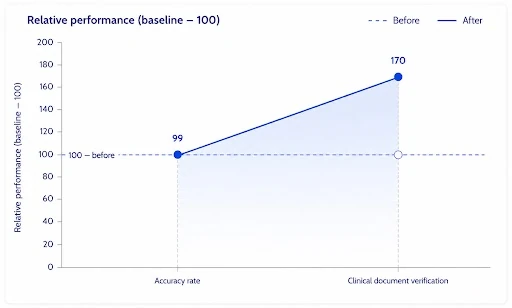
Smart farm ERP outcomes: a 30% increase in yield, optimized water and fertilizer usage, and full digital traceability from seed to harvest.
30%Increase in Yield
Achieved through data-driven crop lifecycle management and health monitoring.
Optimized Resource Usage
Reducing wastage of water and fertilizers via real-time consumption tracking.
100%Digital Traceability
From seed to harvest, ensuring compliance and superior quality control.
Enhanced Labor Productivity
Through automated task assignments and real-time field activity tracking.
Data-Driven Planning
Leveraging historical analytics for accurate seasonal forecasting and budgeting.
Streamlined Inventory Control
Eliminating stockouts and overstocking of critical farming inputs and tools.
Key learnings
What This Engagement Proves for Large-Scale Agricultural Operations
This Smart Farm ERP Needs Offline Sync
Remote fields cannot guarantee reliable connectivity, so a smart farm ERP that only works online would have simply recreated the manual logbook problem in digital form. Building offline data sync into the mobile architecture from the start is what made real-time field data capture actually achievable.
Yield Gains Come From Health Monitoring, Not Just Automation
Automating resource tracking alone would not have lifted yield by 30%, that came from pairing crop lifecycle management with health monitoring so problems could be caught and acted on during the growth cycle, not discovered at harvest.
Traceability Is a Byproduct of Consistent Data Capture
Reaching 100% digital traceability from seed to harvest was not a standalone feature built on top of the ERP, it was the natural result of capturing resource, labor, and crop data consistently at every stage instead of only at a few checkpoints.
Conclusion
From Manual Logbooks to a Data-Driven Smart Farm ERP
Manual record-keeping might have been workable for a small operation, but for an agricultural enterprise managing vast acreage, it had become the primary constraint on yield and resource efficiency. This engagement demonstrates that a single smart farm ERP can resolve visibility, resource, and traceability gaps within one structured programme rather than three separate initiatives.
By building a unified real-time dashboard, automating resource tracking, integrating crop lifecycle management, and enabling offline data sync for remote fields, ICANIO helped this partner lift crop yield by 30% and achieve 100% digital traceability from seed to harvest. The real-time monitoring, offline-ready mobile architecture, and centralized inventory tracking delivered through this engagement are the foundation every future growing season this operation runs will depend on.
Related Resources
This smart farm ERP is an example of ICANIO's software development work. Our team builds ERP platforms like this through application development services. Analytics and data engineering sit within our data and artificial intelligence services. Our cloud and DevOps engineering practice supports sync and hosting. See our industry solutions. Also read our guide to ERP CRM integration. To plan a similar ERP, contact ICANIO.
- Application Development Services
- Industry Solutions
- Fix Slow ERPs: ERP Integration Automation in 2026
- ERP CRM Integration: Real-Time Data Sync Guide 2026
- Top 5 Best Progressive Web App Development Wins
References
- Enterprise resource planning: Wikipedia overview of ERP systems.
- Precision agriculture: Wikipedia overview of data-driven farming.
- Traceability: Wikipedia overview of supply chain tracking.
- FAO Digital Agriculture: the UN FAO hub on digital farming.
- Farm management: Wikipedia overview of farm planning.
Frequently asked questions
Common Questions About This Smart Farm ERP
What is a smart farm ERP and why replace manual logbooks with one?
A smart farm ERP is agriculture ERP software that unifies farm monitoring, resource tracking, and labor management into one system. Manual logbooks get replaced because they cannot provide the real-time visibility needed to manage resource use and crop health at scale.
How does crop lifecycle management drive a 30% yield increase?
Crop lifecycle management records growth stages and health data throughout the season, giving managers the information needed to intervene early rather than discovering problems only at harvest, which is what drove the 30% yield increase.
Why does offline data sync matter for a farm ERP in remote fields?
Many fields lack reliable connectivity, so offline data sync lets field teams log resource usage and task completion locally and sync automatically once a connection is available, rather than losing data or waiting for a signal.
How does real-time resource tracking cut water and fertilizer waste?
Automated resource tracking flags consumption as it happens instead of only being visible after the season ends, letting managers catch and correct waste while it is still happening.
What does 100% digital traceability from seed to harvest require?
Full traceability requires consistent data capture at every stage, resource use, labor activity, and crop health, not just at a few checkpoints, so the complete history of a crop can be reconstructed from digital records alone.
How does centralized inventory tracking prevent stockouts?
Centralized inventory and supply chain tracking gives the operation a single, current view of farm equipment and input levels, replacing the fragmented tracking that previously caused both stockouts and unnecessary overstocking.