AI AGENTIC FRAMEWORK · COMPUTER VISION · SPORTS ANALYTICS
An end-to-end AI sports coaching assistant for player tracking, tactical analysis, and real-time coaching intelligence. Zero manual video tagging required.
Quick Answer
What is an AI Sports Coaching Assistant?
An AI sports coaching assistant is a computer vision platform that automatically extracts player tracking data, tactical formations, and biomechanical heatmaps from raw game footage. It eliminates manual video tagging entirely. ICANIO’s YOLO-powered AI sports coaching assistant delivered a 70% reduction in manual video review time, 90% accuracy in real-time player and jersey recognition through YOLO player detection, and a 3x increase in coaching capacity. It replaced frame-by-frame analyst workflows with a 3-click AI-driven video-to-insight pipeline across football, basketball, and tennis. ICANIO Technologies built and deployed this AI sports coaching assistant as a full-stack sports video analysis AI engineering engagement for a sports analytics partner with over a decade of professional athletic training experience.
Executive Summary
Transforming Raw Footage into an Athlete Intelligence Platform
Professional coaching organisations invest enormous resources in capturing game footage, yet the majority of the insight locked inside that footage remains inaccessible. Manual video tagging processes force analysts to spend preparation time on frame-by-frame review rather than on athlete development and tactical planning. The traditional approach is not just inefficient. It is systemically preventing coaching teams from acting on the performance data their footage already contains. Computer vision player tracking and athlete performance analytics have existed as research capabilities for years. Accessible, club-level deployment has lagged because most implementations require expensive wearable sensor infrastructure.
ICANIO approached this as a full-stack sports video analysis AI engineering challenge. It was not a basic video annotation tool. The goal was to deliver immediate coaching time savings through YOLO player detection and computer vision player tracking. It also meant building the AI-driven intelligence layer that future-proofs athlete performance analytics across football, basketball, and tennis at any club budget level. The result was an AI sports coaching assistant that processes raw camera footage through a 3-click pipeline, requires no hardware sensors, and delivers professional-grade tracking accuracy from standard broadcast or training camera feeds.
“Manual video tagging was treated as an unavoidable cost of professional coaching not as a solvable computer vision and automation problem. That framing had to change first.”
The Challenge
The Athletic Insight Gap
Without automated computer vision player tracking and sports video analysis AI, every performance insight remained locked inside raw video files. It was impossible to extract at speed, impossible to quantify consistently, and impossible to benchmark against professional standards. Analysts and coaches operated reactively, reviewing footage manually with no tooling to surface player-level athlete performance analytics upstream. Five distinct failure modes defined the pre-deployment state for this sports analytics partner.
Manual Video Tagging
No automation for player identification. Every frame was reviewed and tagged manually by analysts.
High-Frame-Rate Processing
Inability to process high-frame-rate video for real-time tactical feedback. Insight was always delayed.
Player Fatigue Visibility
No structured visibility into player fatigue indicators across sports training. Load management was entirely manual.
Analyst Fatigue
Analysts were fatigued by manual frame-by-frame jersey and metric extraction. This reduced both accuracy and throughput.
Benchmarking Deficit
No structured workflow for comparing athlete performance against professional benchmarks. Competitive gap analysis was impossible.
Each failure mode compounded the others. Without YOLO player detection, player identity could not be maintained across frames, making computer vision player tracking impossible to deliver at match speed. Without tracking, athlete performance analytics such as speed metrics, heatmaps, and fatigue indicators could not be computed. Without those analytics, coaching teams had no data-driven basis for tactical decisions or individual athlete development plans. The entire system rewarded manual effort over sports video analysis AI. The cost was measured in analyst hours, coaching preparation time, and missed competitive insight.
AI Sports Coaching Assistant Solutions Provided
A Six-Component AI Sports Coaching Assistant Framework
ICANIO designed and delivered an AI sports coaching assistant that transforms raw video footage into a high-precision, data-driven training ecosystem. Rather than addressing individual pain points in isolation, ICANIO engineered a six-component AI sports coaching assistant pipeline in which each module feeds the next, ensuring that sports video analysis AI operates as a seamless, end-to-end system rather than a collection of disconnected annotation tools. The architecture was designed from day one to deliver athlete performance analytics from standard camera footage, requiring no wearable sensors or specialist hardware.
YOLO Player Detection Engine
Deployed a YOLO-powered detection engine that automatically identifies and tracks players across every frame of raw game footage eliminating manual video tagging entirely and delivering frame-accurate positional data at high-frame-rate processing speeds.
Jersey OCR Identity Engine
Built an OCR engine that reads and maintains jersey number identity even through partial occlusions, player overlap, and fast movement ensuring continuous, uninterrupted individual player tracking throughout the full duration of each match.
KMeans Team Classification Layer
Implemented a KMeans-based team classification layer that automatically distinguishes between competing squads using kit color clustering enabling instant team-level tactical analysis without manual roster configuration or pre-labeling.
Tennis Ball Detection Module
Deployed YOLOv12n optimized for tennis ball detection at high velocities enabling rally tracking, serve speed estimation, court coverage analysis, and shot pattern extraction from raw broadcast footage without specialized tracking hardware.
Automated Sport Classification Engine
Integrated a deep learning classifier that automatically identifies the sport being analysed from raw footage enabling the AI sports coaching assistant to route video through the correct sport-specific detection and analytics pipeline without any manual configuration by the coaching team.
Real-Time Coaching Intelligence Dashboard
Delivered live coaching dashboards that surface player speed metrics, fatigue indicators, positional heatmaps, and tactical formation patterns in real time giving coaches the actionable intelligence they need to intervene, adapt, and develop athletes with data-driven precision.
Business Outcomes
Measurable Results in Coaching Efficiency, Accuracy, and Tactics
The AI sports coaching assistant platform fundamentally changed how coaching staff extract and act on performance data. It turned hours of manual footage review into a 3-click, AI-governed video-to-insight pipeline that scales across football, basketball, and tennis without additional hardware investment.
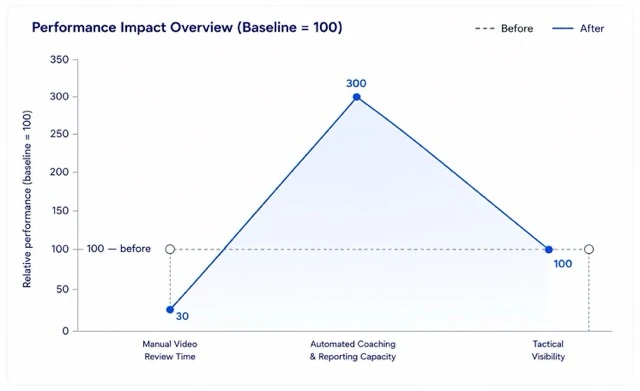
AI-powered automation reduced manual video review time by 70% while tripling coaching and reporting capacity for faster, data-driven decisions.
70%
Reduction in manual video review time for coaching staff
3x
Increased automated coaching and reporting capacity
Full
Tactical visibility via heatmaps and pattern detection
90%
Accuracy in real-time player and jersey recognition
Automated
Workflows via 3-click video-to-insight AI processing
Seamless
Intelligence across football, basketball, and tennis
Key learnings
What this engagement proves for sports technology leaders
Computer vision brings elite analytics without elite hardware budgets
The most significant barrier to professional-grade athlete performance analytics has never been data availability, it has been sensor cost. By building on camera-native computer vision player tracking rather than wearable tracking infrastructure, ICANIO’s AI sports coaching assistant delivers equivalent intelligence at a fraction of the investment, opening elite-level coaching tools to clubs at every budget level. This is the commercial insight that makes sports video analysis AI a viable proposition for the vast majority of professional and semi-professional clubs that cannot justify the capital expenditure of sensor-based tracking systems.
Player identity continuity is the hardest problem in sports AI
Detection accuracy means nothing if player identity is lost the moment two athletes overlap on screen. Building robust jersey OCR with occlusion-tolerant YOLO player detection from day one, not as a later enhancement, the engineering decision that separates a usable AI sports coaching assistant from an unreliable prototype. Sports technology leaders commissioning computer vision player tracking platforms should treat player identity continuity as a primary design requirement, not a secondary accuracy metric. Without it, the athlete performance analytics produced are unreliable at precisely the moments high-contact, high-speed phases of play when they matter most.
Coaching adoption depends on insight speed, not insight depth
Coaches do not lack analytical curiosity. They lack time. Every component of the AI sports coaching assistant was designed to minimise the steps between raw footage upload and actionable output. The 3-click pipeline is not a convenience feature. It is the primary adoption driver that determines whether sports video analysis AI tools get used in daily practice or remain unused in dashboards. For sports technology leaders deploying performance analytics platforms, the user experience design of the insight delivery layer is as commercially important as the underlying computer vision player tracking accuracy.
Conclusion
From Footage Backlog to Real-Time Athletic Intelligence
Sports video is not a documentation asset. It is the richest source of performance data any coaching team has access to. This engagement demonstrates that with the right AI sports coaching assistant, organisations can eliminate manual analysis bottlenecks entirely, achieve professional-grade YOLO player detection accuracy from standard camera footage, and fundamentally shift their coaching operations from reactive video review to proactive, data-driven athlete development.
By treating game footage as an AI-solvable engineering challenge from the outset, ICANIO helped this partner build an AI sports coaching assistant that will continue to deliver compounding competitive advantage as their video analysis AI and performance analytics practice scales. The 70% reduction in manual video review, 90% player recognition accuracy, and 3x coaching capacity increase are not one-time outcomes. They are the baseline from which every future improvement in this organisation’s coaching operations will be measured.
Related Resources
This AI sports coaching assistant draws on ICANIO's artificial intelligence and machine learning practice. Our team builds computer vision systems through data and AI services. The dashboards and pipelines rely on our application development services and wider software development work. See more in our software development case studies. To explore a similar platform, contact ICANIO.
- Data and Artificial Intelligence Services
- Industries We Serve
- AI Medical Image Diagnostic System: 60% Faster
- Proven AR Computer Vision Shelf Intelligence in 2026
- AI Defect Detection: 5X ROI, Zero Downtime 2026
References
- You Only Look Once (YOLO): Wikipedia overview of the YOLO object detection family.
- Ultralytics YOLO documentation: official docs for training and running YOLO models.
- Optical character recognition: Wikipedia overview of OCR techniques.
- k-means clustering: Wikipedia overview of the KMeans clustering algorithm.
Frequently asked questions
Common questions about the AI Sports Coaching Assistant
What is this AI sports coaching assistant and how does it work?
This AI sports coaching assistant is a computer vision platform that automatically extracts player tracking data, tactical formations, and performance metrics from raw game footage. It replaces manual video tagging with an AI-driven pipeline. ICANIO's AI sports coaching assistant uses YOLO-based detection, jersey OCR, KMeans team classification, and real-time coaching dashboards to convert raw video into actionable performance analytics through a 3-click workflow, with no hardware sensors or manual configuration required.
How does YOLO detection work in sports video analysis?
YOLO detection processes entire video frames in a single neural network pass enabling simultaneous, real-time identification of players, balls, and referees without the processing lag of traditional sequential detection methods. Applied to sports footage, YOLO detection delivers frame-by-frame positional data at high-frame-rate speeds, forming the foundation of ICANIO's AI sports coaching assistant pipeline. ICANIO uses YOLOv12n for tennis ball detection at high velocities, and a sport-adaptive YOLO configuration for player tracking across football and basketball.
Which sports does the AI sports coaching assistant support?
ICANIO's AI sports coaching assistant currently supports football, basketball, and tennis. An automated sport classification engine routes each video through the correct sport-specific detection and analytics pipeline without manual configuration. The AI sports coaching assistant's video analysis AI architecture is designed to be extensible. Additional sports can be added by training the classification engine and detection models on sport-specific footage datasets, without rebuilding the core player tracking or dashboard infrastructure.
Can clubs without professional tracking sensors use this solution?
Yes. ICANIO's AI sports coaching assistant was specifically designed to deliver professional-grade performance analytics from standard broadcast or training camera footage with no wearable sensors, no specialist tracking hardware, and no existing digital infrastructure required. player tracking built on camera-native YOLO detection delivers equivalent intelligence to sensor-based systems at a fraction of the investment, making elite-level coaching analytics accessible to clubs at every budget level.
How does the platform keep player identity through occlusions?
ICANIO's jersey OCR engine maintains individual player identity through partial occlusions, player overlap, and high-speed movement by combining YOLO detection with occlusion-tolerant jersey number recognition built into the core tracking pipeline. Positional continuity alone breaks down during physical contact and tight clustering. So rather than relying on it, the engine re-identifies players by jersey number whenever a tracking interruption occurs. This approach ensures that performance analytics such as individual speed profiles, distance covered, and fatigue indicators remain accurately attributed to the correct player throughout the full duration of each match.
How does the real-time coaching dashboard surface analytics?
The AI sports coaching assistant dashboard converts raw player tracking output into visual, actionable coaching intelligence displaying player speed metrics, fatigue indicators, positional heatmaps, and tactical formation patterns in real time. The dashboard is designed for coaching practitioners, not data scientists: it presents performance analytics in the language of football, basketball, and tennis tactics rather than raw data outputs. Coaching staff can review a complete match's worth of video analysis AI output including team-level formation analysis and individual player development metrics within minutes of footage upload, without any technical configuration.