CrowdStrike vs SentinelOne is one of the most common questions security teams ask in 2026, usually with Microsoft Defender added as a third option. Endpoint detection and response is now a core security requirement. Ransomware, supply chain breaches and persistent threats affect organisations of every size. CrowdStrike Falcon, SentinelOne Singularity and Microsoft Defender for Endpoint are three of the most widely deployed platforms. All three offer genuine enterprise-grade protection. The real difference is architecture. Each is built on a distinct philosophy, and that philosophy decides which organisations it serves best.
ICANIO supports enterprise teams through its DevOps and Cloud Engineering practice, where EDR selection is often part of wider security architecture work. This EDR platform comparison covers how the three platforms differ, how to read independent evaluations, what suits each one to particular environments, and how enterprises deploy them in practice. The question is not which product is objectively best. It is which one matches your infrastructure, team maturity, compliance obligations and operating model.
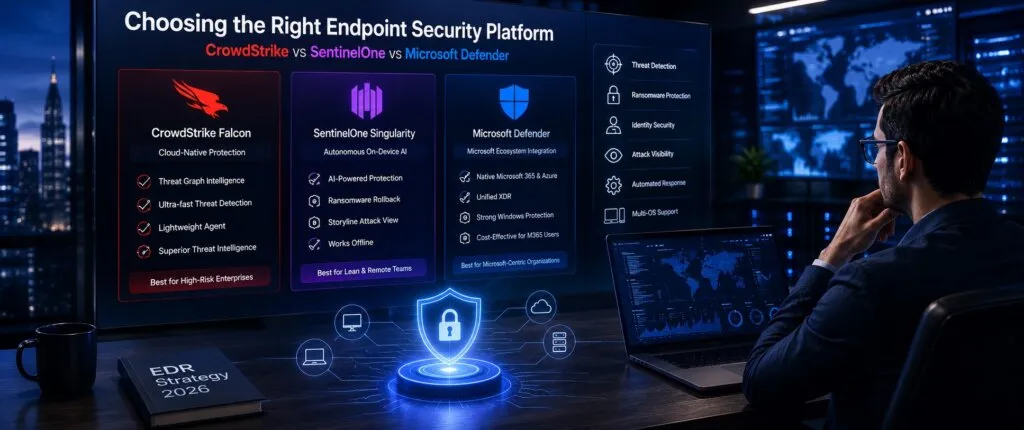
Key Takeaways
- CrowdStrike vs SentinelOne is mainly a choice between cloud-centred intelligence and on-device autonomy.
- Microsoft Defender for Endpoint is the lowest-friction option for Microsoft 365 and Windows-heavy estates.
- MITRE ATT&CK Evaluations are useful, but read the specific round and scenario rather than vendor headlines.
- Many enterprises run more than one platform, split by risk tier or by connected versus remote endpoints.
- Four questions decide the fit: operating systems, team maturity, connectivity and compliance.
- Update governance and vendor concentration risk now belong in every EDR platform comparison.
Platform Overviews: Three Distinct Architectures
CrowdStrike Falcon
CrowdStrike Falcon is a cloud-native platform built around a lightweight single agent. The agent streams endpoint telemetry to CrowdStrike's cloud, where large-scale analytics and threat intelligence are applied. Falcon covers endpoint detection and response, next-generation antivirus, threat intelligence, identity protection and cloud workload security. It uses a modular model in which capabilities are added as separate modules. The CrowdStrike platform overview lists the current modules.
The CrowdStrike vs SentinelOne distinction starts here. CrowdStrike centralises intelligence in the cloud for breadth. SentinelOne pushes more decision-making to the endpoint for autonomy.
SentinelOne Singularity
SentinelOne takes a different approach. Its machine learning models run on the device, so detection and response continue even when an endpoint is offline. That design powers several signature features. Storyline links related events into a single attack chain. Ransomware rollback, available on Windows, can restore files changed by an attack using shadow copies. Behavioural analysis runs locally in real time. The SentinelOne platform page describes the current product tiers.
SentinelOne bundles some capabilities into its tiers that other vendors sell as add-ons, so compare packages carefully. In a CrowdStrike vs SentinelOne evaluation focused on operational completeness, that packaging can matter.
In CrowdStrike vs SentinelOne terms, SentinelOne tends to suit lean security teams, remote-heavy environments and organisations that want strong automated protection without constant analyst attention.
Microsoft Defender for Endpoint
Microsoft Defender for Endpoint has grown far beyond basic Windows antivirus. For organisations built on Microsoft 365 and Azure, it is a capable enterprise platform. It is included in some Microsoft 365 enterprise licences, such as E5, so many organisations already own it. It integrates natively with Microsoft Sentinel, Entra ID, Purview and Intune. Microsoft's Defender for Endpoint overview explains the architecture.
For Windows-centric organisations, Defender is the lowest-friction path. Its sensor is built into supported Windows versions, so onboarding is simpler than installing a third-party agent. The main question is how well it covers your non-Windows endpoints. Validate macOS and Linux coverage in your own pilot before committing. For many Microsoft-centred organisations, CrowdStrike vs SentinelOne then becomes a secondary question about specific high-risk devices.
MITRE ATT&CK Evaluations: How to Read the Benchmarks
The MITRE ATT&CK Evaluations are among the most respected independent tests in the endpoint detection and response market. They emulate real adversary behaviour mapped to the MITRE ATT&CK knowledge base of tactics and techniques. All three vendors have taken part in past rounds, and the results are published openly.
Use the results carefully. Each round emulates different adversaries and platforms, so a strong score in one round does not guarantee the same result in another. MITRE does not rank vendors or declare winners. Vendors publish their own summaries, which naturally highlight their strengths. The same caution applies when reading CrowdStrike vs SentinelOne marketing claims.
Our team recommends reading the raw results for the most recent round. Focus on the operating systems you run, the detection types that matter to you and how much configuration change each vendor needed. Then run your own proof of concept. In a CrowdStrike vs SentinelOne decision, results on your endpoints and your attack scenarios matter more than any headline percentage.
What to look for in evaluation results
- Detection quality: technique-level detections rather than generic telemetry.
- Coverage on your operating systems, especially macOS and Linux.
- Protection results, if the round included prevention tests.
- Configuration changes made during testing.
- False positive behaviour, where the round measured it.
CrowdStrike vs SentinelOne: Intelligence and Response
Threat intelligence is CrowdStrike's clearest differentiator in the CrowdStrike vs SentinelOne comparison. Its cloud aggregates telemetry from a very large installed base. That supports detailed adversary profiles covering nation-state groups, criminal groups and supply chain attack patterns. For enterprises facing sophisticated adversaries, that depth is a genuine operational advantage.
CrowdStrike also offers managed threat hunting and managed detection and response services. That makes it an option for organisations that want specialists to handle round-the-clock hunting instead of building the capability internally.
SentinelOne's differentiator is autonomous response. Because decisions are made on the device, the agent can detect ransomware-like behaviour, kill the process, roll back changes and isolate the endpoint without waiting for a cloud verdict or an analyst. That matters most when an attack hits out of hours or on a poorly connected device. Storyline also groups related events into one narrative, which can reduce alert noise and speed up investigation.
For lean teams, that operational efficiency can be as valuable as intelligence depth. That is the heart of the CrowdStrike vs SentinelOne trade-off: breadth of insight versus speed of autonomous action.
CrowdStrike vs SentinelOne vs Defender: Key Differentiators
| Factor | CrowdStrike Falcon | SentinelOne Singularity | Microsoft Defender |
|---|---|---|---|
| Core design | Cloud analytics | On-device AI | Microsoft ecosystem |
| Offline protection | Limited | Strong | Partial |
| Threat intelligence | Very deep | Good | Good, Microsoft graph |
| Ransomware rollback | Not native | Yes, Windows | Not native |
| Best fit | Mature SOC teams | Lean or remote teams | Microsoft 365 estates |
CrowdStrike Falcon strengths
CrowdStrike leads this EDR platform comparison on threat intelligence depth and investigative tooling. Managed hunting is available for organisations that prefer to outsource part of their SOC. The modular architecture lets organisations add identity protection, cloud workload security or intelligence feeds to match their risk profile. CrowdStrike suits enterprises with dedicated SOC teams or managed security partners who can use its full depth.
SentinelOne Singularity strengths
SentinelOne leads on autonomous and offline protection. That is valuable for remote endpoints, branch offices, ATMs and environments with intermittent connectivity. Ransomware rollback adds a recovery option on Windows. Storyline shortens the path from alert to understanding. Data handling options can help organisations with data residency concerns, but confirm the details with the vendor for your region and licence tier.
Microsoft Defender for Endpoint strengths
Microsoft Defender for Endpoint wins on ecosystem integration for Windows and Microsoft 365 estates. Native links with Sentinel, Entra ID, Purview and Intune produce a unified operations experience without third-party connectors. Compliance reporting is easier when everything lives in one Microsoft tenant. Defender suits organisations whose security operations already centre on Microsoft, and where any non-Windows gaps can be accepted or covered with supplemental tooling.
Endpoint Detection and Response: Deployment Patterns in 2026
Large organisations often avoid running a single endpoint detection and response platform everywhere. Many CrowdStrike vs SentinelOne vs Defender decisions end with a layered design that uses different tools for different risk tiers. Our team helps enterprise clients design these layered architectures rather than default to one platform that either leaves gaps or costs more than it should.
Three patterns appear often:
- Risk-tiered deployment. Defender on standard workstations, with CrowdStrike on high-risk endpoints such as privileged admin machines, trading terminals and executive devices.
- Branch and core split. SentinelOne at branches, ATMs and remote endpoints where offline protection is essential, with CrowdStrike or Defender in well-connected data centres.
- Managed overlay. Defender across a Microsoft 365 estate, plus a managed detection and response service for round-the-clock coverage.
Running two products on one device needs care. Microsoft documents how Defender Antivirus can run in passive mode alongside a third-party solution in its compatibility guidance. Test coexistence in a pilot group before any wide rollout. A coexistence pilot is also a fair way to run a CrowdStrike vs SentinelOne trial side by side on the same hardware.
How to Choose CrowdStrike vs SentinelOne vs Defender: 4 Questions
A CrowdStrike vs SentinelOne vs Defender comparison for a specific organisation should start with four operational questions, not vendor feature lists.
1. What is your primary operating environment?
Organisations running mostly Windows and Microsoft 365 should evaluate Microsoft Defender for Endpoint seriously before buying a separate platform. Mixed estates with many macOS and Linux devices should test each candidate on those systems. SentinelOne and CrowdStrike both support all three major operating systems, and your pilot will show which performs best on your fleet.
2. How mature is your security team?
CrowdStrike rewards organisations with dedicated security operations capability. Its depth pays off when trained analysts use it. SentinelOne's autonomous approach needs less hands-on management, which suits lean IT and security teams. Defender is the lowest-overhead option for Microsoft-integrated environments. In a CrowdStrike vs SentinelOne shortlist, team maturity is often the deciding factor.
3. How connected are your endpoints?
SentinelOne's on-device approach is a strong choice for remote workers, branch offices, ATMs and intermittently connected sites. CrowdStrike's richest capabilities rely on cloud connectivity, although its agent keeps local protection when offline. Map your endpoint connectivity before deciding. Connectivity is where the CrowdStrike vs SentinelOne difference is most visible in daily operation, because it decides how much response automation happens on the device.
4. What are your compliance and data residency needs?
Defender has strong native compliance tooling for Microsoft-centred regulated environments. Every vendor offers regional data hosting options, but terms differ by product and licence. Ask each vendor where telemetry is stored, for how long and under which jurisdiction. Then map the answers to your obligations, such as GDPR or national privacy laws. No CrowdStrike vs SentinelOne decision should be final until legal and compliance teams review these answers.
Update Governance After the 2024 CrowdStrike Outage
The July 2024 incident, when a faulty CrowdStrike content update caused widespread Windows crashes, changed how buyers think about EDR risk. The Wikipedia summary of the 2024 CrowdStrike-related IT outages covers the timeline and impact. CrowdStrike has since introduced more customer control over how updates are rolled out.
The lesson applies to every vendor, not just one. Any kernel-level security agent can cause disruption if an update goes wrong. In any CrowdStrike vs SentinelOne vs Defender evaluation, ask:
- Can we stage content and sensor updates to pilot groups first?
- How quickly can we pause or roll back an update?
- What is the recovery procedure if endpoints fail to boot?
- How is the vendor's own release testing governed?
Incident response planning should cover security tooling failures too. NIST's incident response guidance in SP 800-61 Revision 3 is a useful reference when updating playbooks. For ransomware specifically, the CISA StopRansomware guide offers practical prevention and response checklists.
Where ICANIO Fits in EDR Platform Evaluation
ICANIO's DevOps and Cloud Engineering practice supports EDR selection, including CrowdStrike vs SentinelOne vs Defender shortlists, as part of broader cloud and security architecture work. That includes architecture evaluation, interpreting MITRE ATT&CK Evaluations, deployment design and implementation support for CrowdStrike, SentinelOne and Microsoft Defender for Endpoint environments. The goal is a layered design that matches the actual risk profile.
Ongoing operation matters as much as selection. Our support engineering services team can help with monitoring and day-to-day operations after rollout. If you are integrating EDR telemetry with other security tools, our guide to cloud security integration with CrowdStrike, SentinelOne and Defender covers the connectors and data flows. For the detection techniques behind modern agents, see our article on AI endpoint security and behavioural detection. EDR also sits naturally inside a zero trust security implementation, where device health informs access decisions.
Conclusion
CrowdStrike vs SentinelOne vs Defender is not a contest with one universal winner. CrowdStrike offers deep threat intelligence and investigative power for mature SOC teams. SentinelOne offers autonomous, offline-capable protection that suits lean and distributed teams. Defender offers tight integration and licensing convenience for Microsoft-centred organisations.
The right answer comes from your environment. Work through the four questions, read evaluation results critically, run a pilot on your own endpoints and plan for update governance from day one. The CrowdStrike vs SentinelOne question, in particular, is best settled by evidence from your own fleet rather than vendor headlines.
If you would like an independent view on which platform, or which combination, fits your estate, our team is glad to help. Contact ICANIO to discuss your endpoint security strategy.
References
- MITRE ATT&CK Evaluations
- MITRE ATT&CK knowledge base
- Wikipedia: Endpoint detection and response
- Wikipedia: 2024 CrowdStrike-related IT outages
- Microsoft Learn: Microsoft Defender for Endpoint
- NIST SP 800-61 Rev. 3: Incident Response
- CISA StopRansomware Guide
Frequently asked questions
CrowdStrike vs SentinelOne vs Defender: which is better?
There is no single best platform. CrowdStrike leads on threat intelligence depth and suits enterprises with a dedicated SOC. SentinelOne leads on autonomous and offline protection and suits lean teams and remote-heavy estates. Defender wins on integration and licensing for organisations already invested in Microsoft 365. The right choice depends on infrastructure, team maturity and compliance requirements.
Can Microsoft Defender and CrowdStrike run together?
Yes. Many enterprises run Microsoft Defender for Endpoint on standard workstations and CrowdStrike on high-risk endpoints. Where both are present on one device, Microsoft documents how Defender Antivirus can run in passive mode alongside a third-party solution. Always test coexistence on a pilot group first, and confirm the supported configuration with both vendors.
Does SentinelOne work without internet connectivity?
Yes. SentinelOne's detection models run on the device, so it continues to detect and respond when an endpoint is offline. That makes it well suited to remote workers, branch offices, ATMs and sites with intermittent connectivity. Some features, such as central visibility and threat hunting, still need the endpoint to reconnect and report back to the management console.
How did the 2024 CrowdStrike outage affect EDR selection?
The July 2024 outage, caused by a faulty content update that crashed Windows machines, raised scrutiny of update governance across all EDR vendors. Many buyers now ask about staged rollouts, rollback speed and vendor concentration risk. CrowdStrike added more customer control over update deployment. The incident remains a fair consideration in any EDR platform comparison, for every vendor.
Which EDR platform handles macOS best?
All three platforms support macOS, but results vary by evaluation round and configuration. Check the latest MITRE ATT&CK Evaluations results for macOS specifically, then run your own pilot on a representative set of Mac devices. Coverage on your actual fleet, with your management tools, is the most reliable guide to which platform performs best for you.
How long should an EDR proof of concept run?
Long enough to see normal business cycles and real alert volumes, which for many organisations means several weeks. Include representative devices from every operating system and location. Measure detection quality, false positives, analyst workload, performance impact and ease of deployment. A structured scorecard makes the CrowdStrike vs SentinelOne vs Defender decision far easier to justify.
Is CrowdStrike vs SentinelOne pricing easy to compare?
Not directly. CrowdStrike sells many capabilities as separate modules, while SentinelOne bundles more into its tiers, and Defender may already be included in some Microsoft 365 licences. Build a like-for-like list of the capabilities you need, then request quotes for exactly that scope. A fair CrowdStrike vs SentinelOne cost comparison also counts deployment effort, analyst time and any managed service fees.